
As the legendary investor finally steps away from Berkshire Hathaway’s active leadership, his six-decade relationship with textile, clothing and footwear businesses offers a remarkably human story of failure, persistence, humility and reinvention
TCF POST Special Feature
OMAHA, Nebraska — On September 18, 2026, Warren Buffett finally stepped away from the chairman’s office at Berkshire Hathaway.
At 96, Buffett became Chairman Emeritus, remaining on Berkshire’s board, while his son Howard Buffett became chairman. Greg Abel, who took over as chief executive at the beginning of 2026, continues to run the business. In his farewell letter, Buffett wrote that he had served Berkshire since 1965 and that the time had come to complete the transition. “Father Time always wins,” he wrote, adding that it had nevertheless been generous to him.
For the textile, clothing and footwear industry, however, Buffett’s departure carries a particular resonance.
Because Berkshire Hathaway did not begin as the financial colossus the world knows today. It began in textiles — and textiles nearly defeated Warren Buffett.
The irony is extraordinary. The man who built one of the world’s most famous investment companies first made one of his most enduring mistakes trying to make an American textile mill work.
And yet, decades later, he would return to the sector — repeatedly — through uniforms, footwear, carpet, underwear, children's clothing, sportswear and intimate apparel.
His story was not one of abandoning textiles forever.
It was the story of learning which textile businesses to own — and which ones to leave behind.
The young Buffett and the mill that looked cheap
When Buffett’s partnership acquired control of Berkshire Hathaway in 1965, the company was fundamentally a New England textile manufacturer. Berkshire and Hathaway had come together from the old American textile industry, but by the time Buffett arrived, the economics were deteriorating badly.
The company had generated about $530 million in sales over the previous nine years but had accumulated a loss of roughly $10 million. Its accounting net worth at the time Buffett took control was about $22 million, all tied to textiles.
Buffett initially saw an opportunity.
The shares appeared cheap relative to the underlying assets. He believed cost advantages and better management could improve the mills. It was an early expression of the investment style he had learned from Benjamin Graham: buy something for less than what it appeared to be worth.
But textiles had another lesson waiting.
The mills could become more efficient. Machinery could be upgraded. Managers could work harder. Costs could be cut.
None of that solved the fundamental problem.
American textile producers were competing with lower-cost producers overseas. Every producer could invest in productivity; collectively, those investments increased capacity and put pressure on prices.
Buffett eventually reached a conclusion that would influence Berkshire for generations: the economics of the industry were more important than the apparent cheapness of the assets.
The mills continued for years, but their importance diminished as Buffett redirected Berkshire's capital into more attractive businesses. The textile operation finally closed in 1985.
The experience became one of his great investment lessons.
Then came Waumbec — and another mistake
Buffett did not immediately abandon the idea that textile manufacturing could be made to work.
In 1975, Berkshire bought Waumbec Mills in Manchester, New Hampshire.
Again, the attraction was largely financial. Buffett believed the assets were extraordinarily cheap and expected the operation to complement Berkshire's existing textile business.
Again, the economics won.
Berkshire terminated Waumbec’s operations by about 1980, and Buffett later described the purchase simply and painfully: “The purchase was a mistake.”
That admission mattered.
Buffett had not merely lost money on a textile company. He had discovered one of the central differences between buying an inexpensive asset and owning a good business.
The lesson would stay with him.
But Buffett did not really leave textiles behind
The fascinating part of the story is what happened next.
After closing Berkshire's own textile mills, Buffett did not decide that everything connected to cloth, apparel or footwear was inherently unattractive.
Instead, his acquisitions began to change in character.
In 1986, Berkshire bought Fechheimer Brothers, a specialist uniform business. It was very different from a commodity textile mill: established customers, specialized markets, strong management and a recognizable niche.
The company fit a formula Buffett increasingly preferred — a business whose competitive strength came from more than machinery alone. Berkshire's first-year earnings contribution was about $3.8 million, and Buffett praised the management behind the operation.
The shift was subtle but profound.
Buffett was moving from factories competing on cost to businesses competing through brands, relationships, specialization, distribution and management.
The painful detour into footwear
Then came footwear.
In 1993, Berkshire acquired Dexter Shoe Company, giving Buffett a substantial position in the American footwear industry.
Dexter appeared to have many of the characteristics he liked: a respected name, a profitable history, established manufacturing expertise and strong management.
But once again, Buffett underestimated the force of low-cost foreign competition.
Dexter became one of his most painful investment mistakes. The problem was not merely the company's operating performance; Buffett later emphasized the enormous opportunity cost of the Berkshire shares exchanged in the deal.
The episode echoed Berkshire's textile failure.
A company could be well managed and possess a respected heritage, yet still operate inside an industry whose economics were deteriorating.
The factory floor, Buffett was learning, was not enough.
Then came Justin — footwear with a different proposition
Buffett's relationship with footwear did not end with Dexter.
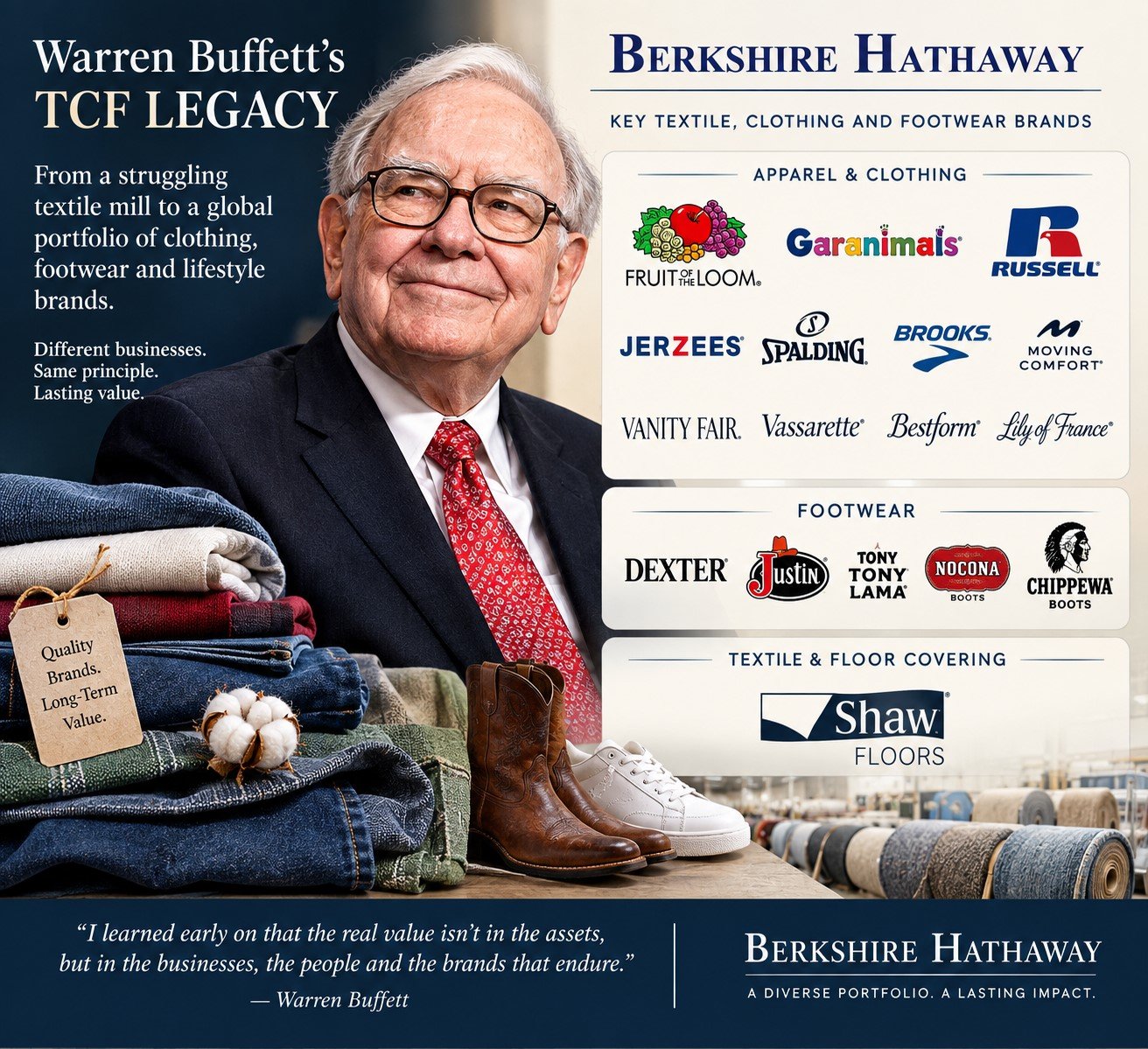
In 2000, Berkshire acquired Justin Industries for approximately $600 million. The company was diversified, but its footwear businesses brought with them a collection of established Western brands, including Justin, Tony Lama, Nocona and Chippewa.
It was a different kind of footwear proposition.
Here were specialist brands with heritage and customer recognition — assets whose value extended beyond the physical manufacturing process.
That distinction would define much of Berkshire's later TCF strategy.
Shaw: Buffett returns to textiles — but not to the old textile model
In 2001, Berkshire acquired approximately 87.3% of Shaw Industries for $2.1 billion, buying the remaining stake a year later.
Shaw was, in scale, almost the opposite of the textile mills Buffett had struggled with decades earlier. It was a market-leading floor-covering manufacturer with enormous scale and distribution, producing broadloom carpet, rugs and residential and commercial flooring.
Shaw generated approximately $4.0 billion of revenue and $292 million in pre-tax operating profit in 2001.
Buffett had not reversed his 1985 conclusion.
He had refined it.
He was no longer betting on a commodity textile mill simply because its assets were cheap. He was buying a large-scale, established business with market position, distribution, management and product breadth.
And then Fruit of the Loom
In 2002, Buffett made perhaps his most important modern apparel acquisition.
Berkshire bought the basic apparel business of Fruit of the Loom for a final cost of approximately $730 million.
Fruit had gone through bankruptcy, but Buffett believed the underlying business still contained something valuable: the brand and the operating capability.
The acquisition brought Berkshire underwear, T-shirts, fleece, activewear, casualwear, children's clothing and a vertically integrated textile and apparel operation.
Buffett's central insight was blunt: “John and the brand are Fruit's key assets.”
The numbers quickly showed why the purchase mattered.
Berkshire's 2002 apparel segment, including Fruit of the Loom, Garan and other apparel businesses, generated $1.619 billion in revenue and $229 million in pre-tax earnings, compared with $726 million of revenue and a $33 million pre-tax loss in 2001.
Fruit became the platform for a much larger Berkshire apparel group.
Garan, Russell and Vanity Fair
Berkshire acquired Garan in 2002 for about $270 million, adding children's clothing and the Garanimals brand.
Then, in 2006, Fruit of the Loom acquired Russell Corporation, expanding Berkshire into athletic apparel, teamwear, uniforms and sportswear. Brands associated with the transaction included Russell Athletic, JERZEES, Spalding, Brooks and Moving Comfort.
In 2007, the group added VF Corporation's intimate-apparel operations, bringing brands including Vanity Fair, Vassarette, Bestform, Lily of France and Curvation into the Berkshire orbit.
The early financial results were not perfect; Berkshire reported operating losses in the newly acquired women's intimate-apparel businesses. But the brands became part of the continuing Fruit of the Loom platform.
By then, Buffett's relationship with TCF had come full circle.
He had started with textile mills.
He had failed.
He had walked away from the old model.
And then he returned to the same broad industries through businesses built around brands, scale, specialist markets, distribution and management.
The lesson was never really about textiles
That may be the most emotional part of Buffett's textile story.
His first textile investment failed as an operating business. But the failure became a source of Berkshire's future strength.
The mills taught him that capital expenditure cannot repair fundamentally poor industry economics. Waumbec taught him that cheap assets can remain bad businesses. Dexter taught him that even a seemingly excellent company can be overwhelmed by structural competition.
Fechheimer showed him the power of specialization.
Justin showed him the appeal of established footwear brands.
Shaw showed him that scale and market leadership could make a textile-related manufacturing business economically attractive.
Fruit of the Loom showed him that a distressed apparel company could be rebuilt around brand, management, manufacturing and distribution.
In the end, Buffett's relationship with the textile, clothing and footwear industries was not a straight line from failure to success.
It was something more human.
He was wrong. Then he learned. Then he tried again — differently.
A fitting final chapter
Buffett's retirement from the Berkshire chairmanship does not erase his relationship with the businesses that helped define his investment education.
Berkshire still has substantial apparel, uniform, footwear and textile-flooring exposure, including Fruit of the Loom, Garan, Fechheimer, BH Shoe Holdings and Shaw Industries. The Fruit of the Loom group remains involved in knitting, cloth finishing, cutting, sewing and packaging, alongside its brand and distribution operations.
That is perhaps the most fitting ending.
The man who once tried to save a textile mill eventually built a conglomerate in which textiles, clothing and footwear became only one part of a far larger portfolio.
And yet, after six decades, the old textile lesson remains buried inside Berkshire Hathaway.
Buffett's greatest contribution to the sector may not have been any single acquisition.
It may have been the willingness to say, I was wrong, close the mills, preserve the lesson and move the capital elsewhere.
In his farewell message this week, Buffett said he was more confident than ever about what lies ahead for Berkshire and that the company was in excellent hands.
For a man whose career began by betting on a struggling textile company, there is something almost poetic about that final confidence.
He could not make the old mills last.
But he made the lesson last.