TCF POST Report
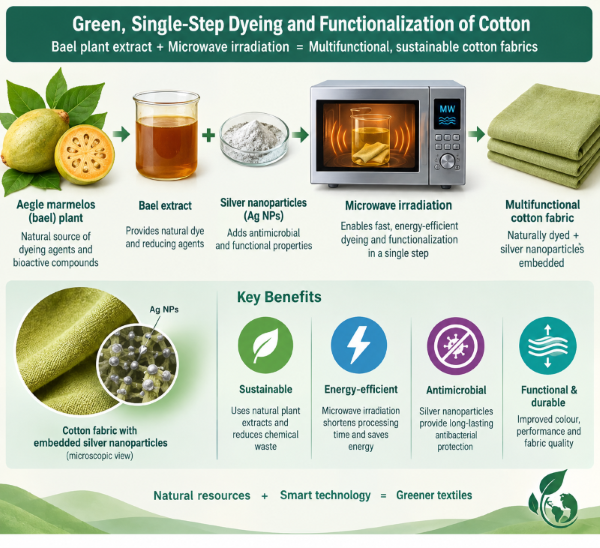
Researchers from the National Research Centre and Ain Shams University in Cairo, Egypt, have developed a sustainable, energy-efficient technique to dye and functionalize cotton textiles in a single step. Published in Scientific Reports, the study details a green production method utilizing Aegle marmelos (bael) plant extracts combined with microwave irradiation to yield multifunctional cotton fabrics embedded with silver nanoparticles (Ag NPs).
A One-Step Green Process
Traditional textile finishing and functionalization rely heavily on toxic chemical reducing agents, high solvent consumption, and prolonged heating cycles. The research team addressed these environmental challenges by deploying microwave-assisted extraction (MAE) on bael plant leaves and fruits.
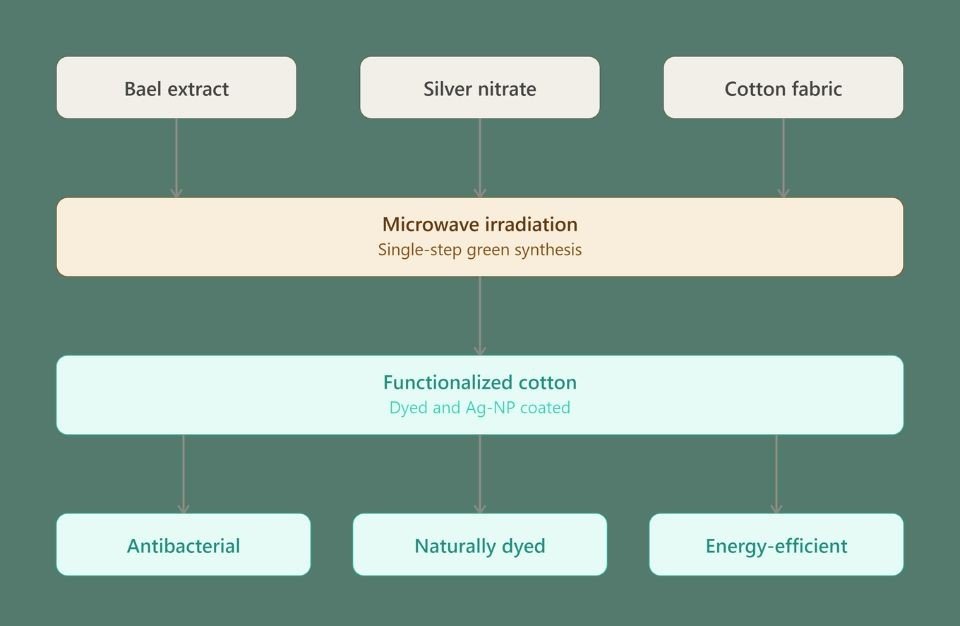
In this integrated process, bioactive compounds from the A. marmelos extract—specifically phenolics, flavonoids, and coumarins—serve a dual purpose. They act as natural pigments to color the fabric while simultaneously functioning as bio-reducing and stabilizing agents that convert silver ions into silver nanoparticles directly on the cellulose fiber surface. Microwave irradiation accelerates this chemical reduction and uniform deposition, significantly cutting down processing times compared to conventional heating methods.
Enhanced Fabric Performance
The multifunctional treated cotton demonstrated superior performance across several critical functional metrics compared to untreated textiles:
- Antimicrobial Protection: The in situ synthesized Ag NPs and plant extracts imparted strong antibacterial activity against both Gram-positive (Staphylococcus aureus) and Gram-negative (Escherichia coli) bacteria, showing significant zones of inhibition.
- Ultraviolet Shielding: The treated fabric achieved high light scattering and absorption capabilities, yielding an Ultraviolet Protection Factor (UPF) exceeding 50, which provides maximum protection against harmful UV-A and UV-B radiation.
- Antioxidant Capacity: Utilizing the DPPH radical scavenging assay, the functionalized fabric retained an antioxidant capacity of up to 80% due to the persistent active phenolic groups bound to the fibers.
- Durable Coloration: Colorimetric analyses and fastness testing indicated high color strength ($K/S$) alongside very good to excellent fastness against washing, rubbing, perspiration, and light exposure.
Advanced Characterization and Mechanism
To verify the structural integrity and chemical bond formation, the researchers conducted comprehensive material characterizations. Scanning Electron Microscopy (SEM) and Transmission Electron Microscopy (TEM) confirmed that spherical silver nanoparticles, ranging in size from 5 to 25 nanometers, were uniformly distributed along the cotton fibers.
Fourier-Transform Infrared Spectroscopy (FTIR) and X-Ray Diffraction (XRD) analyses further revealed that the crystalline structure of the cellulose remained intact. Strong hydrogen bonding and coordination complexes between the hydroxyl groups of the cotton, the phytochemical capping layer, and the silver nanoparticles ensured durable anchoring without disrupting the native fiber structure. High-Performance Liquid Chromatography (HPLC) confirmed the direct participation and partial oxidation of phenolic compounds during silver ion reduction.
Environmental Considerations
By eliminating synthetic chemical reductants and capitalizing on microwave efficiency, this green chemistry approach lowers energy demands and reduces chemical waste. While the authors noted that long-term toxicological evaluations and laundering leaching behavior require further study, this process offers a promising, eco-friendly framework for producing advanced medical, protective, and sustainable commercial apparel.