New data covering more than 100,000 finishing processes shows real gains on energy and worker safety, a stalled water line, and an industry still leaning on the same two dirty habits it's been trying to quit for years.
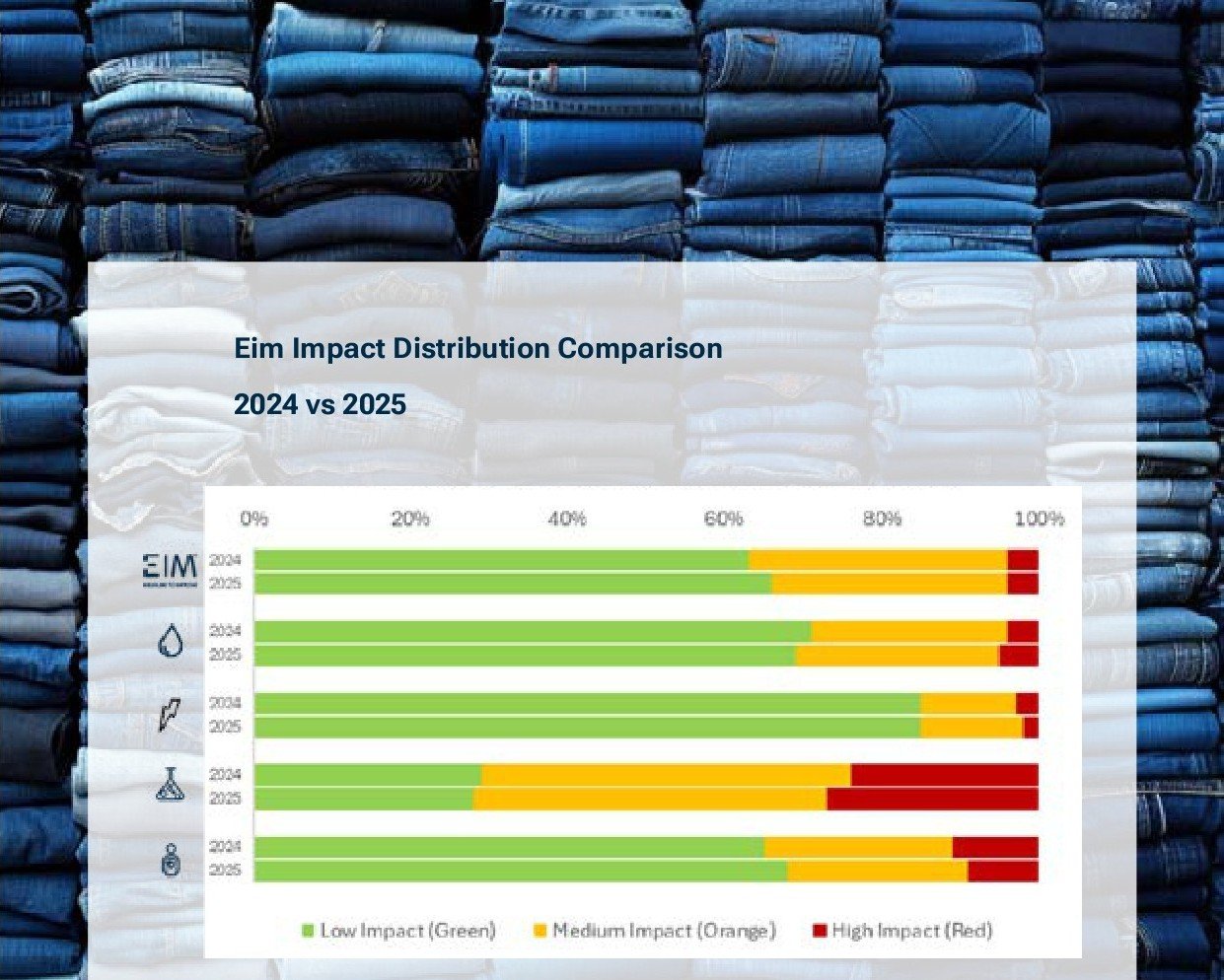
Two-thirds of the world's denim finishing processes are now rated "low impact" on the industry's closest thing to a standardized emissions gauge — a share the report says has grown over the past year. Energy consumption is down 7% per garment. Worker-health scores are climbing. And yet the industry's oldest, least defensible habits — stone-washing and permanganate spraying — are proving almost impossible to quit.
That's the picture in Denim Industry Progress & Insights 2025, the second annual report from EIM (Environmental Impact Measurement), built by Jeanologia's Begoña García — a member of the company's Innovation Team since 1997 — and co-authored by textile engineer Michael Kininmonth, who joined Lenzing Fibers in 2004 and was named one of the industry's 100 most influential people by WeAr magazine in 2023. The analysis draws on 100,280 real finishing processes — 90% of them denim — logged by 359 manufacturers worldwide across all of 2025, a slightly smaller sample than the previous edition, though the report says it remains broadly representative. Notably, its authors say they work only from aggregated calculation outcomes supplied by EIM users, with no visibility into individual factories' underlying operational data; results are separately spot-checked through a verification programme run with GoBlu International, which awards audited facilities a star rating from one to five.
By the numbers
- Overall: 66% low impact, 30% medium, 4% high
- Energy (best-performing category): 85% low impact; average use down from 1.17 to 1.09 kWh per garment
- Water: 69% low impact, but average consumption flat at ~30 litres per garment
- Chemicals (worst-performing): 28% low impact, 27% high impact
- Worker health: 68% low impact
The easy wins are banked. Water's hit a wall.
Energy is doing the heavy lifting on the industry's improving average — the report credits equipment modernization and a steady swap of manual finishing for laser and automated abrasion systems, alongside boiler optimization and adoption of industrial heat pumps. It flags one wrinkle worth watching: that same shift toward electrically powered equipment could push electricity consumption back up in future datasets as adoption spreads. Water tells a flatter story — the report says consumption per garment has held steady after years of incremental gains, suggesting the industry may be nearing an efficiency plateau; further reductions, it argues, will depend on water reuse and recycling infrastructure rather than further tweaks to existing lines.
Chemicals are the industry's blind spot
This is the section that undercuts the good news. Of EIM's four tracked categories, chemical impact performs worst by a wide margin — barely a quarter of processes rate low impact, while nearly as many rate high. Part of the problem is transparency: 16% of the chemical formulations logged in EIM's database are generic, meaning their full composition isn't disclosed, which the report frames as a straightforward opening for improvement through better chemical selection. But most of it comes down to two legacy practices. Pumice-stone washing automatically triggers the maximum possible chemical-impact score regardless of anything else a factory does right, and still shows up in 14% of processes — down from 16% a year earlier — while alone accounting for roughly half of all the industry's high-impact chemical classifications. Potassium permanganate, the spray-on bleaching agent, is used in some form — spray or manual application — in 15% of processes; the report notes it was recently added to ZDHC's Chemical Watch List.
Worker health is the flip side of that same story
As automated and digitally controlled finishing displaces manual techniques, worker-health scores have climbed to 68% low-impact, which the report attributes largely to reduced use of potassium permanganate spray application. It's the clearest evidence in the dataset that fixing worker exposure and fixing chemical impact are, functionally, the same fix.
What's next
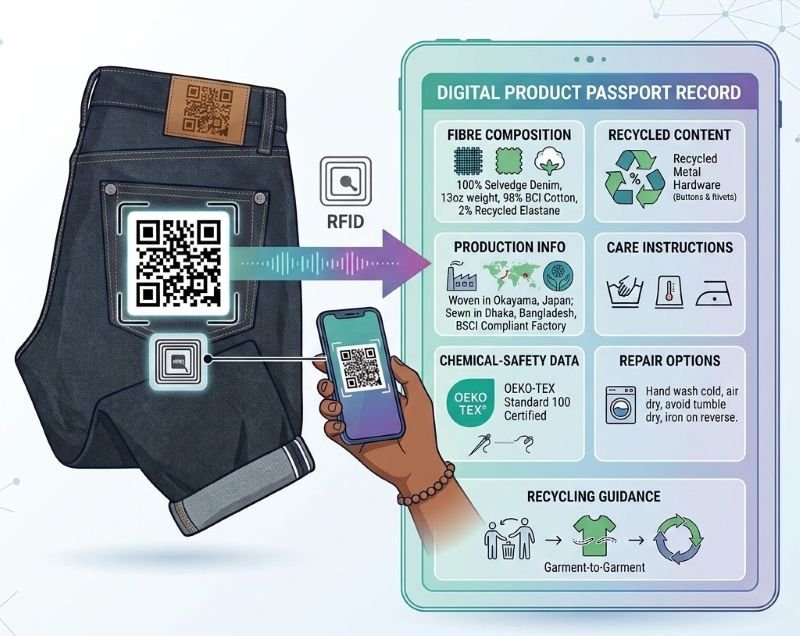
None of this changes the report's core argument: the fixes for denim's chemical problem — compliant, verified formulations and reduced reliance on legacy chemistry — already exist and are already in use somewhere in the industry; the gap is adoption, not invention. The report leans on its verification architecture to make that case: benchmarks are reviewed periodically using a percentile-based methodology so they track actual industry performance rather than fixed targets, and audited facilities can earn a one-to-five star rating that vouches for their reported scores. With the EU's sustainability-claims framework and forthcoming Digital Product Passport in view, the report argues that kind of verified, comparable data is shifting from a nice-to-have into a requirement for market access.