TCF POST Report
Global Market Insights (GMI) estimates that the global luxury footwear market will reach $27.9 billion in 2026, up from $27 billion in 2025, and expand to $42.5 billion by 2035, representing a 4.8% CAGR from 2026 to 2035. The report defines luxury footwear as products priced at $400 or more per pair and sold through luxury and premium fashion brands across boutiques, department stores, multi-brand retailers and e-commerce.
GMI said the sector is emerging from the post-pandemic normalization that constrained aspirational spending in 2024 and 2025. Its outlook suggests that recovery will depend increasingly on wealth-led demand, casual product adoption and geographic diversification, while brands seek to protect desirability and margins through selective distribution, clienteling and product scarcity.
Sneakers lead the product shift
Sneakers and athletic footwear generated $6.2 billion in 2025 and are forecast to grow at a 6.7% CAGR through 2035, making the segment a major engine of category expansion. GMI links the momentum to the continuing casualization of luxury wardrobes, limited releases, collaborations and recognizable designer silhouettes.
Formal shoes are projected to reach $7.7 billion by 2035, while heels and pumps are forecast at $6.8 billion. Boots generated $3.5 billion in 2025 and are expected to grow at 3.9% annually, while loafers and moccasins generated $3 billion and are projected to grow at 5.8%.
The material mix remains heavily anchored in leather. Full-grain and smooth leather generated $11.3 billion in 2025 and are projected to represent 40% of the market by 2035. Synthetic and technical fabrics, meanwhile, accounted for 14.1% of the market in 2025 and are expected to grow at 7% annually, reflecting demand for luxury sneakers, lighter construction and performance-oriented designs.
North America leads, emerging markets accelerate
North America generated $10 billion in 2025, retaining its position as the world's largest regional luxury footwear market. The region is forecast to grow at 4.1% annually through 2035.
The United States accounted for 34.4% of the global market in 2025 and is projected to reach $14 billion by 2035. However, GMI highlights tariff-related cost pressure as an important factor for brands, particularly in sneakers and more accessible luxury categories.
Asia Pacific generated $7.6 billion in 2025 and is forecast to grow at 6.2% annually through 2035. China represented 12.2% of the global market and is projected to reach $5.6 billion by 2035, while India is forecast to reach $2.2 billion. GMI identifies digital engagement, localized clienteling and evolving affluent consumer cohorts as important drivers across the region.
The Middle East & Africa is projected to be the fastest-growing regional market, with a 7.1% CAGR from 2026 to 2035. The region generated $1.2 billion in 2025, supported by concentrated wealth, young luxury consumers, tourism and destination retail. Saudi Arabia is forecast to grow at 7.6% annually during the period.
Digital growth without abandoning stores
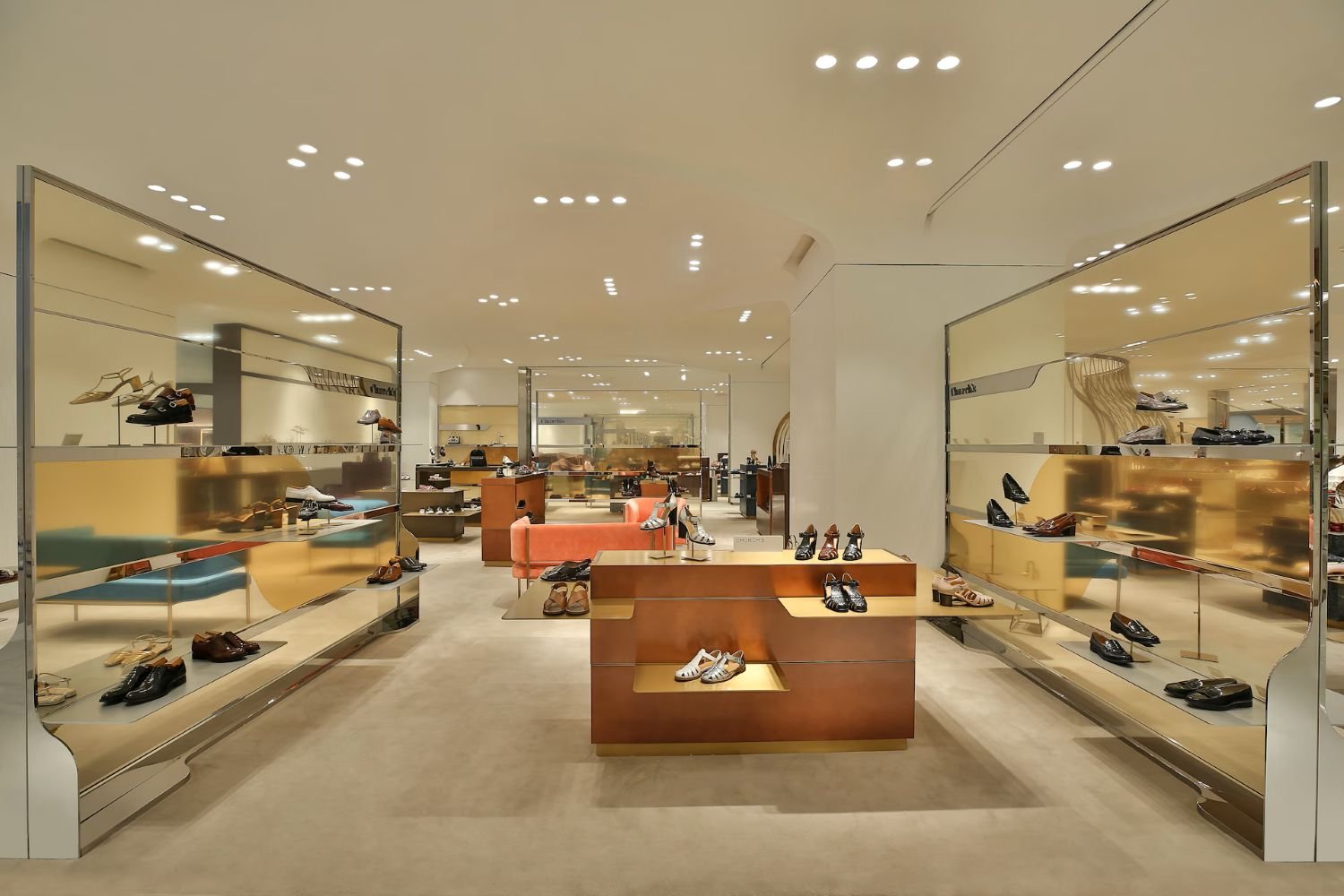
Luxury footwear remains heavily dependent on physical retail. Offline channels accounted for 67% of the market in 2025 and are projected to generate $25.4 billion by 2035. Flagship boutiques and premium department stores continue to provide fitting, styling, personalized service and brand experiences that are difficult to replicate digitally.
At the same time, online channels generated $8.9 billion in 2025 and are projected to reach a 40.2% market share by 2035. Virtual appointments, personalized recommendations and direct fulfillment are becoming increasingly important as brands seek to combine digital reach with luxury-level service.
LVMH holds leading market position
The competitive landscape is moderately concentrated. LVMH held a 16.5% share of the global luxury footwear market in 2025, while the five largest players — LVMH, Kering, Chanel, Prada Group and Christian Louboutin — collectively represented 40.7% of market revenue.
Recent consolidation and collaboration are also reshaping the sector. GMI notes that Prada Group completed its acquisition of Versace in December 2025, expanding its footwear and luxury portfolio, while Balenciaga collaborated with J.M. Weston for its winter 2026 collection, combining contemporary fashion positioning with traditional shoemaking expertise.
For luxury footwear manufacturers and brands, the report points to a market increasingly divided between fashion-led casual footwear driven by cultural relevance and speed, and high-end products built around craftsmanship, scarcity and personalized service. That shift is likely to influence product development, sourcing, retail investment and brand strategy through the next decade.