Five-week hybrid programme targets Indigenous designers working across jewellery, handbags, headpieces and contemporary garment techniques, with international applicants eligible
TCF POST Report
The Banff Centre for Arts and Creativity is inviting Indigenous fashion designers and artists to apply for a new Indigenous Fashion Creation Residency: Embellishments and Accessories, positioning experimental accessories and advanced embellishment techniques as a key area for contemporary Indigenous fashion development.
The five-week programme, scheduled for April 5 to May 7, 2027, will combine one week of online learning with four weeks of in-person project development at Banff Centre in Alberta. The application deadline is December 16, 2026, with applications set to open soon.
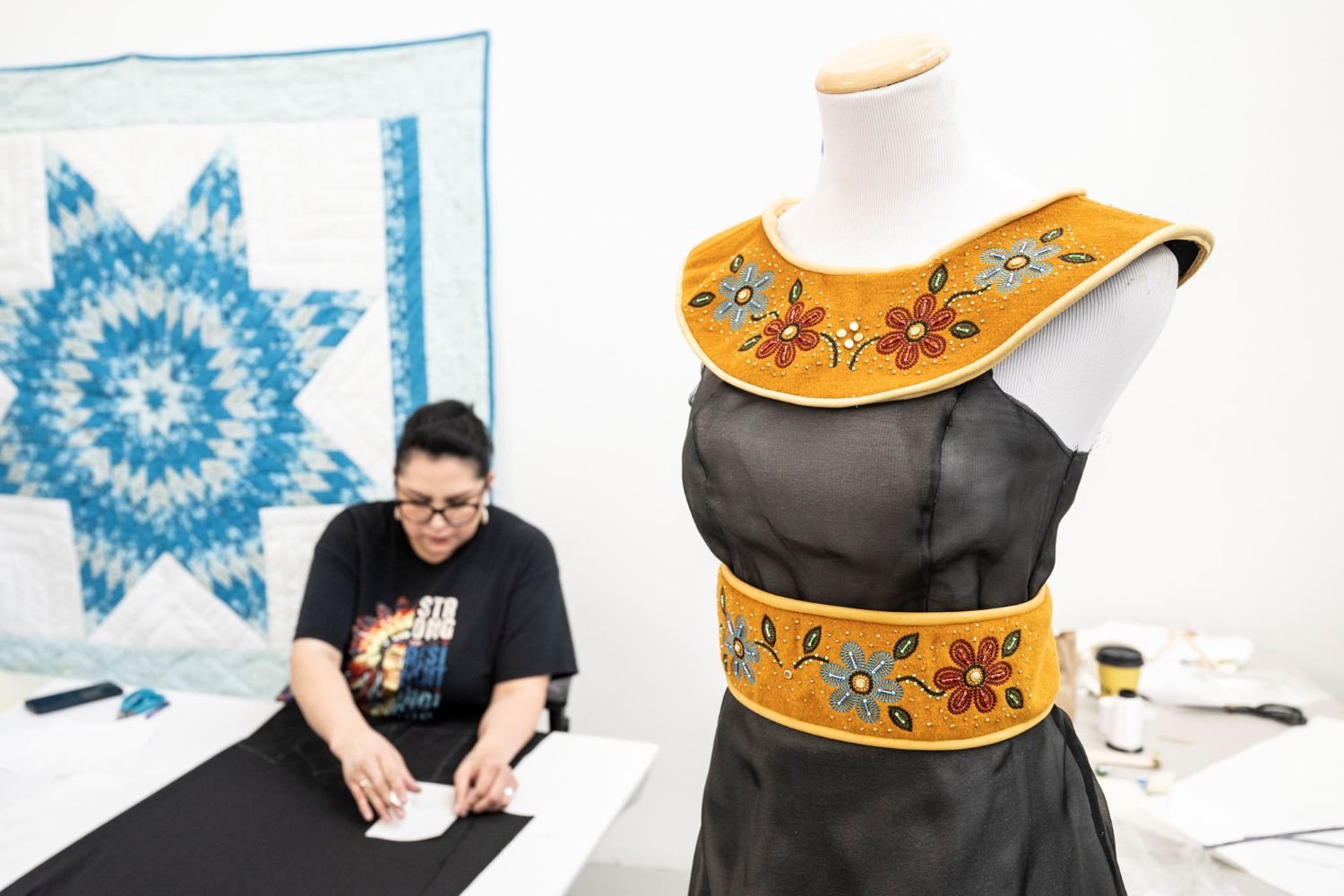
Designed for individual Indigenous artists, fashion makers, designers and design companies, the residency covers projects ranging from jewellery, belts and handbags to headpieces, necklaces and bracelets, while also encouraging designers to develop new and unconventional approaches that move beyond established forms.
For the fashion industry, the programme reflects the growing importance of accessories and surface development as independent areas of creative and commercial value. Banff Centre says participants will work on personal projects through pattern development, technical experimentation and faculty-led workshops, supported by individual consultations and dedicated studio facilities.
The programme also has a practical production focus. Participants will receive technical guidance and production-facility overviews from Visual Arts Facilitators, while developing their work through hands-on experimentation. An Open Studios event on May 4, 2027 will provide a public platform for showing work in progress.
Traditional craft meets new fashion technology
The residency is particularly relevant to the evolution of Indigenous fashion because its faculty combine traditional techniques with contemporary design and production methods.
Faculty member Heather Bouchier, a Plains Cree designer, works with up-cycled and sustainable materials alongside beadwork, horsehair and dentalium shell techniques. Her practice has also incorporated 3D-printed dentalium shells, illustrating how Indigenous material knowledge can be translated into contemporary fashion processes.
Another faculty member, Rhonda Johnson, works across fashion, textiles, appliqué, beadwork and visual art, with a design practice centred on culture, storytelling, identity and innovation.
The combination could make the residency relevant not only to haute couture and designer fashion but also to the wider accessories value chain, including craft-led product development, bespoke production, material experimentation and small-scale fashion businesses.
International access — but not a student route
There is also a cross-border mobility element for designers outside Canada. Domestic and international applications are welcome, and the programme allows collaboration with designers or creative partners from regional, national and global locations.
For international applicants, however, the residency is explicitly not eligible for a Canadian Student Visa. Accepted participants must obtain a Visitor Visa to enter Canada and are responsible for meeting the relevant immigration requirements and checking visa-processing times in advance.
That makes the programme potentially relevant to migrant and internationally mobile fashion creatives as a short-term international creative-development opportunity, rather than as a conventional study or migration pathway.
Full programme scholarship
The financial structure further lowers the barrier to participation. Banff Centre lists the total programme fee at C$8,605.80, matched by a Banff Centre Indigenous Arts Scholarship, bringing the stated participant cost to C$0 after the scholarship is applied. Tuition, accommodation and meals are covered for scholarship recipients. There is, however, a C$35 non-refundable application fee for Indigenous individuals and groups.
Banff Centre also says limited named scholarships are available to eligible Canadian and international participants, with qualifying applicants automatically considered.
For the global Textile, Clothing and Footwear industry, the residency highlights a broader shift in which Indigenous design is being developed not simply as cultural expression but through professional fashion practice, technical innovation, accessories development, sustainability and international creative exchange.