TCF POST APAC Desk
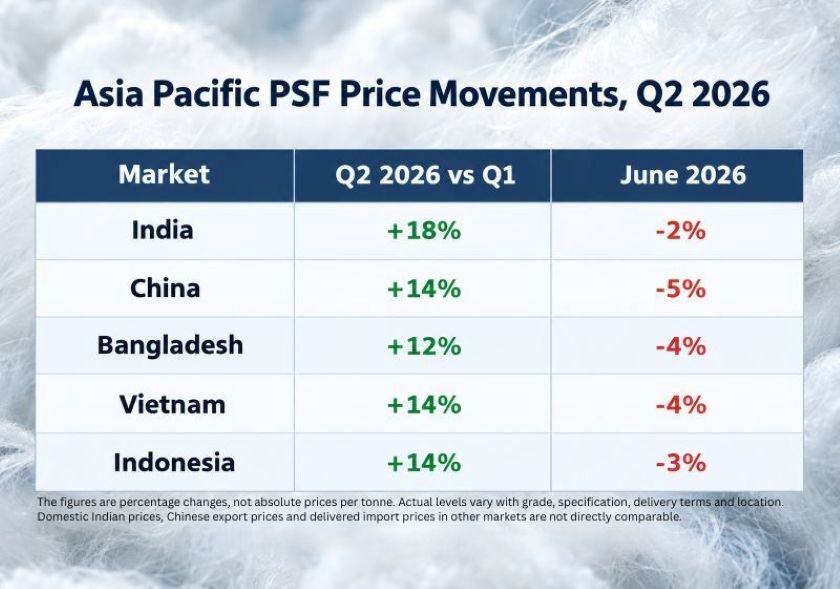
Polyester staple fibre (PSF) prices rose sharply across major Asia Pacific markets in the second quarter of 2026. Higher raw material costs and rising freight charges pushed up both production and import costs. Prices then eased in June as supply improved and buyers grew more cautious.
Feedstock and freight drive the quarter
Costlier purified terephthalic acid (PTA) and monoethylene glycol (MEG), the key inputs for polyester, raised PSF production costs. Tensions between the US and Iran, along with disruption around the Strait of Hormuz, added pressure to crude oil prices and shipping costs. As a result, importers across the region faced higher landed costs.
Demand from spinning mills, garment makers, home textile producers and nonwoven manufacturers stayed steady. Many buyers, however, purchased only for immediate needs rather than building stocks as prices rose.
India: up 18% on the quarter
PSF prices in India rose by about 18% in Q2 compared with Q1. Higher PTA and MEG costs raised production expenses for domestic fibre makers, and higher transport costs added to the pressure. Demand from nonwoven and furniture-filling businesses supported the market. In June, prices fell by about 2% as supply improved and feedstock costs eased slightly.
China: up 14%, June down 5%
Chinese PSF prices gained about 14% over the quarter. Stronger feedstock prices and export demand from textile and nonwoven makers supported supplier offers. Prices fell by around 5% in June as raw material costs eased, supply improved and downstream buyers held back. Because China is a major PSF exporter, its offers influence what importers across Asia pay.
Bangladesh: up 12%, June down 4%
Bangladesh recorded a rise of about 12%, mainly linked to firmer Chinese export prices and higher freight costs that lifted the import value of the fibre. Spinning mills, garment exporters and home textile producers, which rely on imported material, felt the impact on their budgets. June prices dropped about 4% as supply improved, freight pressure eased and procurement became more selective.
Vietnam: up 14%, June down 4%
In Vietnam, prices climbed by about 14% on the quarter. Higher Chinese offers, increased PTA and MEG costs and rising freight all contributed. Prices slipped by roughly 4% in June as supply improved and manufacturers bought cautiously.
Indonesia: up 14%, June down 3%
Indonesian prices rose by about 14%, driven by higher Chinese export prices and polyester feedstock costs. Textile mills, nonwoven makers and furniture-filling producers supported demand. June brought a decline of about 3% amid better supply, easing feedstock costs and careful buying.
Outlook
The direction of PSF prices after Q2 will depend on PTA and MEG costs, freight rates, supply availability and downstream demand. If feedstock costs stay high, producers may face continued pressure, and firm Chinese export offers or higher freight could support import-dependent markets. Improved supply and softer feedstock prices, combined with cautious buying, could ease prices further. The June corrections in all five Asia Pacific markets show that the earlier pace of increases is not guaranteed to continue. Buyers are advised to track PTA and MEG prices, crude oil, Chinese export offers and shipping costs.