TCF POST History of Industry
Sixty years ago, sewing machines and knitting frames carried a young nation's first industrial push. The factories have largely gone, but the apparel story is still shaping Singapore's role in Asia's fashion supply chain.
A nation in need of jobs
When the People's Action Party took office in 1959, Singapore lived off entrepot trade and had too many people out of work. A United Nations mission in 1961 set a stark target: some 200,000 new jobs within a decade. The answer was industrial land. Jurong, the country's first major industrial estate, began to take shape, and garments were among the quickest ways to put people to work.
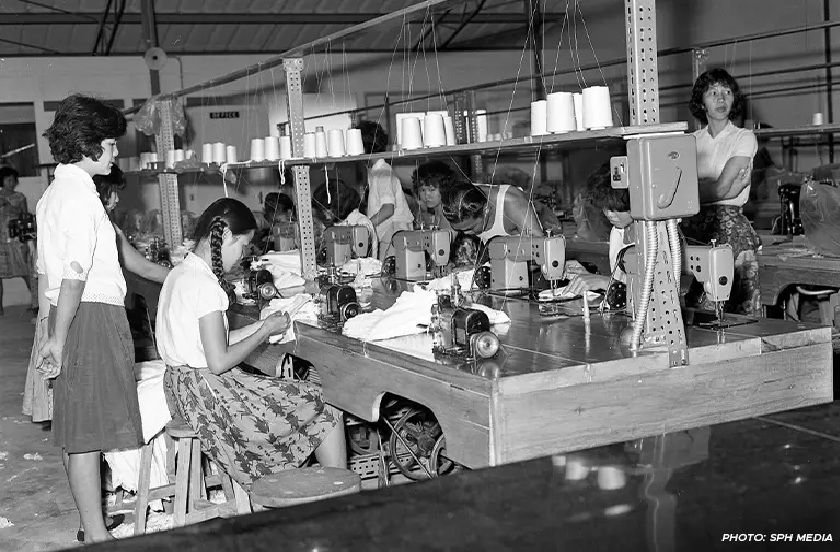
The early tenants were light, labour-intensive and easy to start. Alongside toys and wigs, apparel and textile plants filled the first factory rows. A 1965 photograph from the Min Ngai Knitting Factory in Jurong, which made singlets and vests, remains one of the enduring images of that era. Archive records also place the Pelican Textiles factory in Jurong by 1964, and the Unitex garment factory at the Tanglin Halt estate, one of the earliest industrial sites. By the end of the 1960s, Jurong alone counted 181 factories in production.
The textile trade grew around them. Figures drawn from a 1979 study of the period indicate that textile-related establishments in Singapore rose from 33 to 398 between 1960 and 1977, with industry employment climbing from roughly 1,300 to more than 35,000. Singapore also became a redistribution point for textiles across Southeast Asia.
Plugged into global brands
These were not simply local workshops. Academic research on the region notes that Singapore's garment industry was folded into global production networks led by large American and European apparel companies from the 1960s, with Malaysia following in the 1970s. Garments were a core part of the export-led strategy that defined the city-state's economic model.
Success that outgrew the sector
The strategy worked almost too well. After the British military withdrawal in 1967 removed a major source of local jobs and spending, the Economic Development Board stepped up its search for foreign investors, and in 1968 landed US chipmaker National Semiconductor. Other electronics names followed.
By the 1970s, labour-intensive manufacturing had produced a labour shortage, and neighbouring countries had started industrialising as well. Singapore's planners chose to climb the value chain rather than compete on wages. Precision engineering, petrochemicals, electronics, aerospace and later biomedical manufacturing took priority. Apparel makers faced rising costs, and by the late 1980s factories at older estates such as Tanglin Halt were moving to larger industrial clusters. Much of the sewing capacity went to lower-cost neighbours. Today manufacturing still contributes more than 17 per cent of GDP, but the products are very different from vests and singlets.
What stayed behind
Singapore's apparel industry did not vanish so much as change shape. The work that remained moved toward design, sourcing, brand-building, trade and finance, the functions that sit at the head of a regional supply chain rather than on the sewing floor.
The Textile and Fashion Federation (TaFF), the local industry association, has argued that technology and sustainability are widening what counts as fashion beyond clothing alone. That thinking has attracted backing from larger players. In 2021, fibre producer RGE announced a three-year partnership with TaFF on sustainable fashion programmes, backed by nearly S$3 million in funding, alongside a five-year research collaboration with Nanyang Technological University on textile recycling technology. The partnership was tied to a pilot textile recycling plant in Singapore.
Lessons for Asia's garment exporters
For garment-producing economies today, Singapore's path is a reminder that cut-and-sew work can be a starting point rather than a destination. Its early factories offered jobs, skills and foreign-buyer relationships at a moment when the country had little else. Its later choices, moving upmarket as wages rose and keeping a foothold in design, sustainability and trade, offer a template, though one that depended on a small population, strong state coordination and heavy foreign investment that few others can replicate.