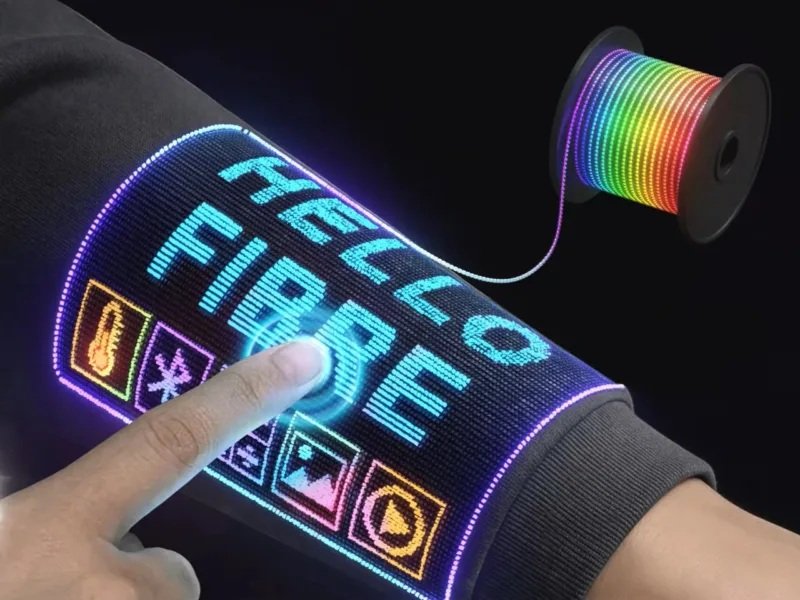
A fibre that acts as both pixel and touch sensor survives 50 washes and could be handled on standard textile machinery; thinner versions can be knitted, woven and embroidered using standard industrial machines, the team says.
TCF POST Report
Singapore -Researchers at the National University of Singapore’s College of Design and Engineering (CDE) have built what they describe as the world’s first touchscreen integrated into a garment. The team developed a fibre that works as a display pixel and a touch sensor at once, then threaded 54 of them into a sleeve. The result displays images and video, responds to finger presses and connects wirelessly to other devices, while staying flexible, breathable and washable.
Why it matters for textiles
Graphical user interfaces have so far lived on flat, rigid panels. Textiles, built from one-dimensional fibres, could not match that capability. A full-colour, touch-sensitive display that can be threaded like yarn had been out of reach until now.
“What made this possible was our ability to construct the GUI system from electronic building blocks in fibre form,” Khudiyev said, comparing the fibres to traditional yarn with electronic functions built in.
For apparel and textile makers, the main point is that no rigid screen is attached to the garment. The display and sensing elements run along the length of the fibre itself.
How it was built
The central challenge was geometry. A fibre is one-dimensional and axially symmetric, which makes it hard to build complex circuitry with methods designed for conventional two-dimensional electronics. The NUS team addressed this with a new interconnection architecture.
- Programmable soldering. The method creates connection points along tiny insulated wires exactly where each microchip needs them. A laser exposes the locations, and controlled surface wetting guides molten solder to bond only at those points.
- Scale. This allowed the integration of more than 5,000 chips through over 20,000 electrical connections.
- Thermal drawing. The resulting strip of interconnected digital LEDs was built into a multilayer fibre by thermal drawing, which forms the touch-sensitive and pixel layers precisely. Each finished thread is one millimetre thick and 10 metres long.
- Touch sensing. A layer beneath the LEDs senses touch. Pressing the fibre completes a circuit, and the signal identifies where the finger landed so the nearest pixel lights up.
Prototype specifications
The prototype uses 54 pixel fibres, each carrying 96 LEDs, threaded into the forearm of a sleeve.

ParameterSpecificationResolution96 × 54 pixelsDisplay size168 mm × 105 mmRefresh rate30 frames per secondColour depth8-bitVideo playback30 fps (25 fps with synchronised audio)TouchMulti-touch supported
Each fibre has its own control channel, so a fault in one line leaves its neighbours working normally.
Alongside the pixel fibres, the team added peripheral fibres made the same way. They carry a microphone, a speaker, and sensors for movement, magnetic north, temperature and ambient brightness.
Together these support functions comparable to early smartphones. The sleeve can run a calculator, show a photo gallery, work as a compass, respond to voice commands, receive images over Bluetooth, and rotate the screen and adjust brightness automatically. With the temperature fibre positioned under the arm, it can read and display body temperature.
Durability: behaving like fabric
Wearability and care requirements are often where smart-textile concepts fail, so the reported durability results are significant:
- Light output and touch response were nearly unchanged after 50 detergent washes in a typical washing machine.
- Performance held after 1,000 bends around a 5 mm radius.
- The display is as breathable as cotton, polyester and denim.
- It stays within established safety limits for skin contact.
Manufacturing outlook
The researchers say smaller microchips and thinner fibres, both compatible with their method, offer a route to sharper and larger displays. Because the display and sensing elements sit along the length of the fibre, thinner versions can be knitted, woven and embroidered using standard industrial machines. That compatibility could shorten the path from lab demonstration to production if it holds at scale. The announcement does not give a commercialisation timeline or name manufacturing partners.
Applications
Khudiyev identified healthcare as a particularly promising area. A garment could continuously collect physiological information through fibre-based sensors and let the wearer view and interact with it directly through their clothing. Combined with artificial intelligence, this could enable personalised health monitoring, feedback and assistance.
“Just as smartphones enabled applications that were difficult to imagine when they first appeared, garment GUIs could ultimately enable entirely new applications that do not yet exist,” he said. The same technology could eventually track other health signs and deliver touch-based feedback.
What’s next
The team plans to push toward higher resolution, integrated sensing and on-device AI, combining display, touch, sensing and intelligence on one textile platform. The stated goal is clothing that understands both the wearer and their surroundings, and an interface to digital intelligence that becomes “a natural part of what they wear” rather than a device carried.