TCF POST Analysis
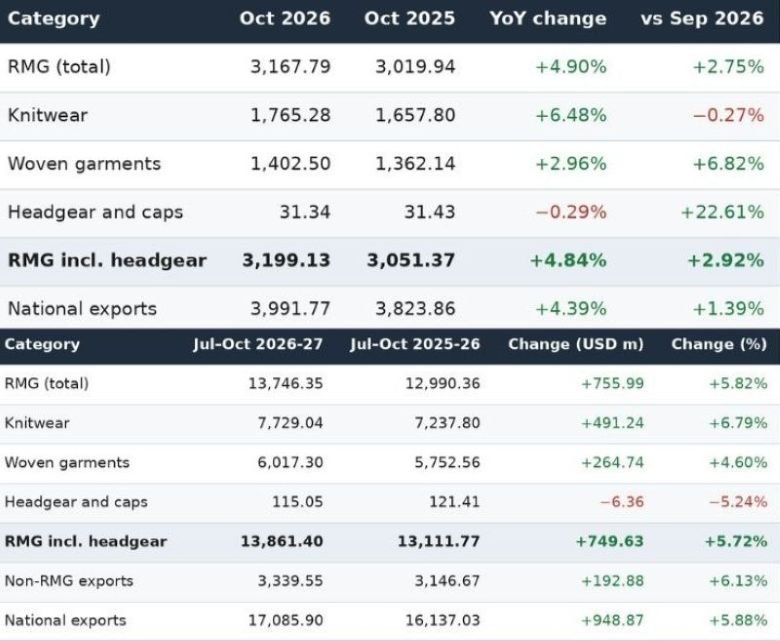
Bangladesh’s ready-made garment (RMG) exports earned USD 3,167.79 million in October 2026, up 4.90 percent from USD 3,019.94 million a year earlier and 2.75 percent above September, according to a report the country’s Export Promotion Bureau (EPB) released on Sunday. Over July–October of FY 2026-27, RMG earnings totalled USD 13,746.35 million, 5.82 percent above the USD 12,990.36 million recorded in the same months of the previous year.
The headline numbers look solid, but the month-level detail points to a sector that is still growing while growth itself is easing, and a weak comparison base is flattering the year-on-year figures.
Apparel carries the month
Garments did most of the heavy lifting in October. RMG added USD 147.85 million year-on-year, about 88 percent of the USD 167.91 million rise in national exports. Its share of total exports edged up to 79.36 percent from 78.98 percent a year earlier.
Headgear and caps (HS 65), which this report counts with RMG as finished wearable items, earned USD 31.34 million in October. That was flat year-on-year (−0.29 percent) and 22.61 percent above September. Including them, apparel exports came to USD 3,199.13 million, up 4.84 percent year-on-year and 2.92 percent on September, and made up 80.14 percent of national exports against 79.80 percent a year earlier.
Knitwear leads, woven lags
Knitwear grew 6.48 percent and now accounts for 55.73 percent of RMG shipments, up from 54.90 percent. Woven garments grew only 2.96 percent year-on-year, even though they jumped 6.82 percent from September.
The two segments moved in opposite directions month-on-month. Knitwear was essentially flat (−0.27 percent, about USD 4.7 million lower), while woven supplied almost all of the sequential rise in RMG.
A weak base flatters the growth
October 2025 was a poor month for the sector. According to EPB’s FY 2025-26 summary, RMG exports fell 8.39 percent in October 2025 from a year earlier, with knitwear down 10.76 percent and woven down 5.33 percent.
Measured against October 2024 (USD 3,296.45 million), this October’s RMG figure is still about 3.9 percent lower. Knitwear is roughly 5.0 percent below that level and woven about 2.5 percent below. In other words, October’s growth is largely a recovery from a depressed base, not a new high.

October slower than the months before
Stripping October out of the cumulative totals gives implied July–September RMG exports of USD 10,578.56 million in 2026 against USD 9,970.42 million in 2025, a rise of about 6.1 percent. October’s 4.90 percent is below that pace.
The slowdown is concentrated in woven garments, which grew about 5.1 percent in July–September against 2.96 percent in October. Knitwear held up better, at about 6.9 percent against 6.48 percent.
Four-month picture
Apparel drove four-fifths of the gain over the four months. RMG contributed USD 755.99 million of the USD 948.87 million national increase, about 80 percent. Knitwear supplied roughly 65 percent of the RMG gain (USD 491.24 million) and woven the remaining 35 percent.
RMG’s share of national exports was 80.45 percent, against 80.50 percent a year ago. The sector’s weight is essentially unchanged, with non-RMG exports growing slightly faster (6.13 percent) than RMG (5.82 percent).
Headgear and caps are the one apparel line moving the wrong way. They fell 5.24 percent to USD 115.05 million from USD 121.41 million, after rising 3.20 percent a year earlier. Including them, apparel exports reached USD 13,861.40 million, up 5.72 percent (+USD 749.63 million), and accounted for 81.13 percent of national exports against 81.25 percent a year ago.
The prior year puts the numbers in context. In July–October 2025-26, RMG had grown only 1.40 percent over 2024-25 (USD 12,811.00 million). Compounding the two periods, RMG is about 7.3 percent above its July–October 2024-25 level, with knitwear up roughly 7.2 percent and woven about 7.4 percent over two years. That is a steadier picture than the single-year 5.82 percent suggests.
Markets
EPB’s country table shows the destinations behind the apparel numbers. The United States, the largest market, took USD 3,348.28 million in July–October (+11.51 percent). The UK followed with USD 1,741.86 million (+7.21 percent), Germany with USD 1,566.89 million (+0.43 percent) and Spain with USD 1,515.47 million (+13.57 percent).
Among the top four, Germany’s near-flat result stands out. These are all-product figures, not apparel-only, though apparel makes up the bulk of shipments to each. Türkiye grew 82.69 percent to USD 292.15 million, the fastest among the top twenty.
Cumulative textile exports, July–October
Textiles are growing far more slowly than garments. The textile basket, which covers cotton and cotton products, man-made fibres, specialized textiles, carpets and home textiles and excludes jute, rose just 2.64 percent to USD 762.37 million. That is less than half of RMG’s 5.82 percent, and its share of national exports slipped to 4.46 percent from 4.60 percent.
Winners and losers inside the basket
- Cotton and cotton products fell for a second straight July–October period, from USD 212.30 million to USD 190.05 million to USD 170.37 million, a drop of nearly 20 percent in two years. It is now the weakest textile line.
- Man-made fibres fell 5.27 percent, reversing last year’s 10.51 percent rise.
- Specialized textiles rose 16.52 percent in total (USD 142.22 million). Knitted fabrics (USD 62.48 million, +18.60 percent) and the “other” group (USD 50.72 million, +34.43 percent) drove the gain, while terry towel (−7.93 percent) and special woven fabric (−8.42 percent) declined.
- Home textiles rose 7.86 percent, but the quality of that growth is mixed. The core bed, kitchen and toilet linen line grew only 2.0 percent (USD 147.90 million), tents fell 1.67 percent, and new rags and scrap twine surged 34.85 percent (+USD 13.89 million), about 63 percent of the segment’s entire gain.
October on its own was weaker
The textile basket earned USD 187.11 million in October, only 0.85 percent above October 2025 and 6.93 percent below September. Home textiles fell 3.78 percent year-on-year and 9.15 percent month-on-month. Cotton fell 4.13 percent and man-made fibres 2.46 percent year-on-year.
Specialized textiles (+21.87 percent) and carpets (+30.42 percent) were the only lines with strong October growth, though specialized textiles dropped 19.03 percent from September.