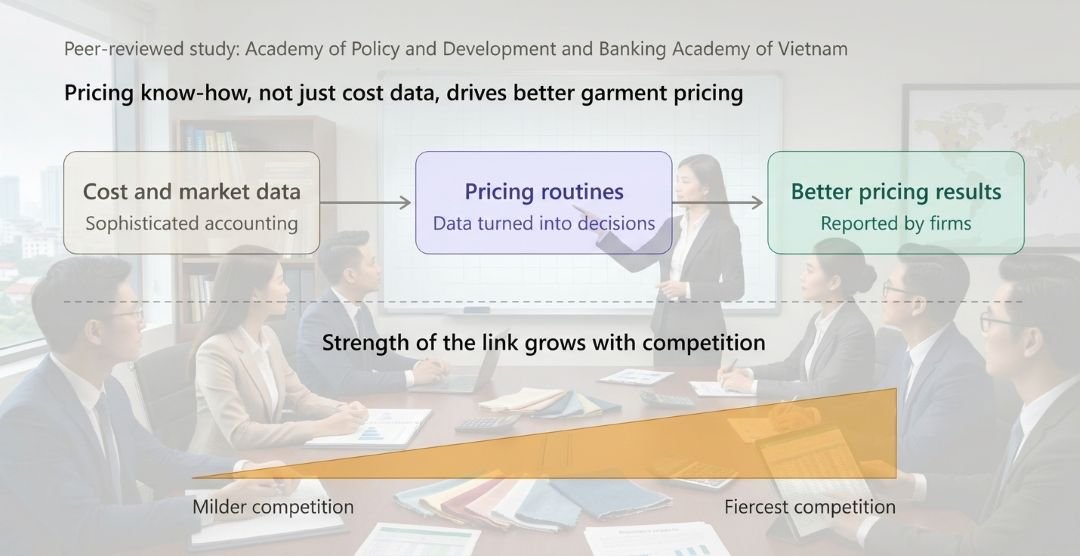
Firms with stronger pricing routines report better outcomes, and the link is stronger where competition is fiercest
TCF POST Report
A new peer-reviewed study of Vietnamese textile and garment manufacturers suggests that sophisticated cost and market accounting pays off in pricing only when a firm can turn that information into decisions. The paper was written by Hanoi-based researchers at the Academy of Policy and Development and the Banking Academy of Vietnam and appears in Acta Innovations.
The research team surveyed managers at roughly 250 textile and garment firms in production hubs including Hanoi, Ho Chi Minh City, Hai Phong, Nam Dinh, Bac Ninh, Da Nang, Dong Nai and Binh Duong. They collected 350 usable responses from 420 questionnaires distributed between 2023 and 2026. Respondents included CEOs, CFOs, chief accountants, sales and marketing heads and production managers.
Key findings
- Better accounting information goes with stronger pricing capability. Firms that make heavier use of strategic management accounting (competitor cost analysis, customer profitability analysis, target costing and value-chain costing) also reported a stronger ability to set, coordinate and adjust prices. The reported association was strong.
- Pricing capability goes with better pricing results. Firms that rated their pricing routines highly also reported better profitability, revenue, competitiveness and customer-value outcomes.
- Capability appears to be the link. The study found a significant indirect association from accounting practices through pricing capability to pricing effectiveness. This is consistent with the idea that information only helps when firms have the routines to use it.
- Competition raises the stakes. The link between pricing capability and pricing effectiveness was stronger where rivalry was more intense.
What it means for manufacturers
The authors argue that managers facing margin pressure should not simply buy more software or produce more reports. They point to pricing governance: clear decision rights, cross-functional coordination between accounting, sales, marketing and production, disciplined estimates of what customers will pay, formal discount and approval processes, and reviews of pricing decisions after the fact. Technology, they say, is infrastructure rather than a substitute for these routines.
They also note that firms working under OEM arrangements, where buyers hold much of the pricing power, may not escape that constraint. But stronger capability can improve the quality and consistency of decisions within the discretion they do have. Firms facing aggressive price competition have the strongest reason to invest.