TCF POST News Feature
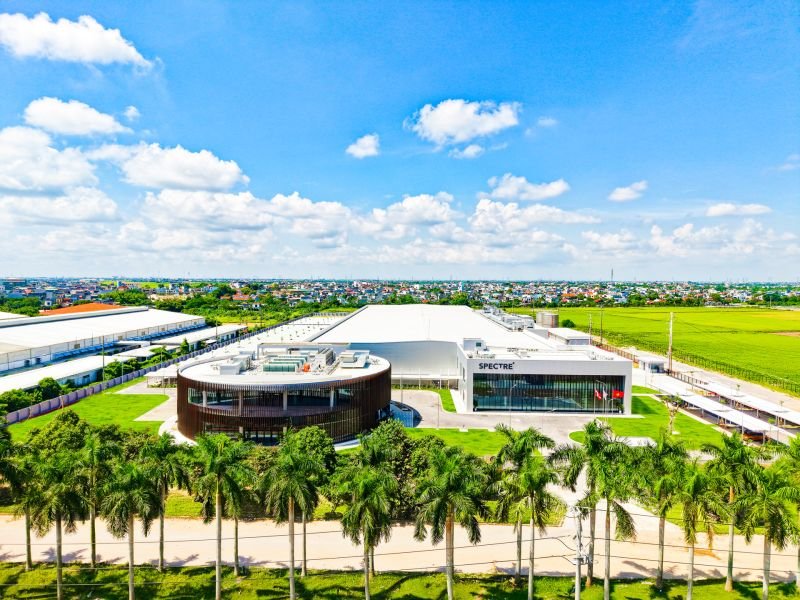
SONG TRA INDUSTRIAL PARK, HUNG YEN, Vietnam: On the morning of October 30, 2026, a ribbon was cut at Song Tra Industrial Park, and Danish garment maker Spectre Group formally opened its fourth factory in Vietnam. Spectre 2 Hung Yen is the company’s largest and most technologically advanced plant in the country, and the second it has built in this northern province. Central government representatives, local authorities, the Industrial Park Management Board, Spectre’s global leadership, general contractor SOL E&C, and other project partners attended the ceremony, along with the Ambassador of the Kingdom of Denmark.
A factory that starts saving at the roof
The story begins with the building itself. Spanning nearly 32,500 square meters, the LEED Gold-certified plant features rooftop solar panels and is designed for energy efficiency from the ground up. Spectre expects it to avoid about 1,600 tonnes of CO₂ a year compared with a conventional factory of similar size.
Water gets a second life here too. A rainwater harvesting system captures runoff from the surrounding area and puts it to work again, including for flushing toilets, which eases demand for fresh water. Inside, the plant aims to turn out 3.5 million high-tech garments a year for the outdoor and sportswear brands Spectre supplies in more than 50 countries.
Automation, starting where goods move
The most telling detail is where the machines are arriving first. Spectre is introducing automation across several stages of manufacturing, with warehousing and transportation inside the plant as early priorities, all supported by integrated IT systems. Co-owner and Chief Business Development Officer Jesper Klausen said the project’s new automation and AI investments “will represent the new standard for our factories.”

The digital backbone is already in place. Spectre recently rolled out a new enterprise resource planning (ERP) system across the whole group, linking management processes so production can run more efficiently.
On the shop floor, the company is investing in cutting technologies, more efficient use of materials and waste treatment to keep production waste to a minimum. These efforts support its 2030 targets: cutting emissions by 42 per cent in its own operations and by 25 per cent across its value chain.
Smarter machines need skilled people
More automation means more demand for technical skills, and Spectre’s leadership is blunt about it. Klausen said digitalisation is pushing up the need for skilled workers, which makes training central to the investment. CEO Lars Christensen framed it as a global shift. “As the world becomes increasingly digital, with growing demands for digital competencies, automation and smarter solutions, we need a highly educated workforce,” he said. “We see that Vietnam is also stepping up in this area and making significant progress.”
To build that workforce in-house, Spectre runs Spectre Academy, an internal training centre with development programmes for new employees and managers. All management roles, from engineering to office functions, are held by Vietnamese staff, Klausen said. The company also hopes to buy more from Vietnamese suppliers who can meet its quality standards, which would shorten transport distances and delivery times and lower the environmental impact.
The numbers behind the plant
By the company’s account, the Hung Yen plant represents a $30 million investment including machinery and technology, and will create 3,000 jobs. Provincial figures paint the project a little differently: VND 477 billion (about $18.5 million) on 5 hectares, with roughly 2,000 workers at stable operation, about VND 800 billion in annual revenue and more than VND 100 billion in contributions to the State budget. The site also offers about 9,400 square meters of factory and office space for lease.
Spectre’s total investment in Vietnam now tops $60 million. The company employs close to 6,000 people across its factories in Ninh Binh, An Giang and Hung Yen. Since opening its first Vietnamese site in 2010, it has moved all of its manufacturing to the country. Klausen noted that Spectre brings nearly 80 years of garment-making experience to the work, including 37 years in functional apparel and outdoor sportswear, with a focus on quality products and continuous innovation.
A province eager to welcome investors
For Hung Yen, the day was also a milestone. Quang Hoa, Vice Chairman of the provincial People’s Committee, said the province now hosts two Danish-invested projects worth USD 19.3 million, and described Spectre 2 as a boost for local industry, jobs and Vietnam-Denmark investment ties.
Looking ahead, Hoa pointed to Hung Yen’s newly announced 2021-2030 master plan, with a vision to 2050. The province aims to create seamless, optimal policies and infrastructure, covering housing, healthcare, education and the broader business and living environment for investors, experts and workers. It pledged to stay engaged, listen and promptly clear business obstacles along the way.