Footwear-led wholesale growth lifts operating income 71%, DTC margins remain under pressure, while debt falls 59%
TCF POST Analysis
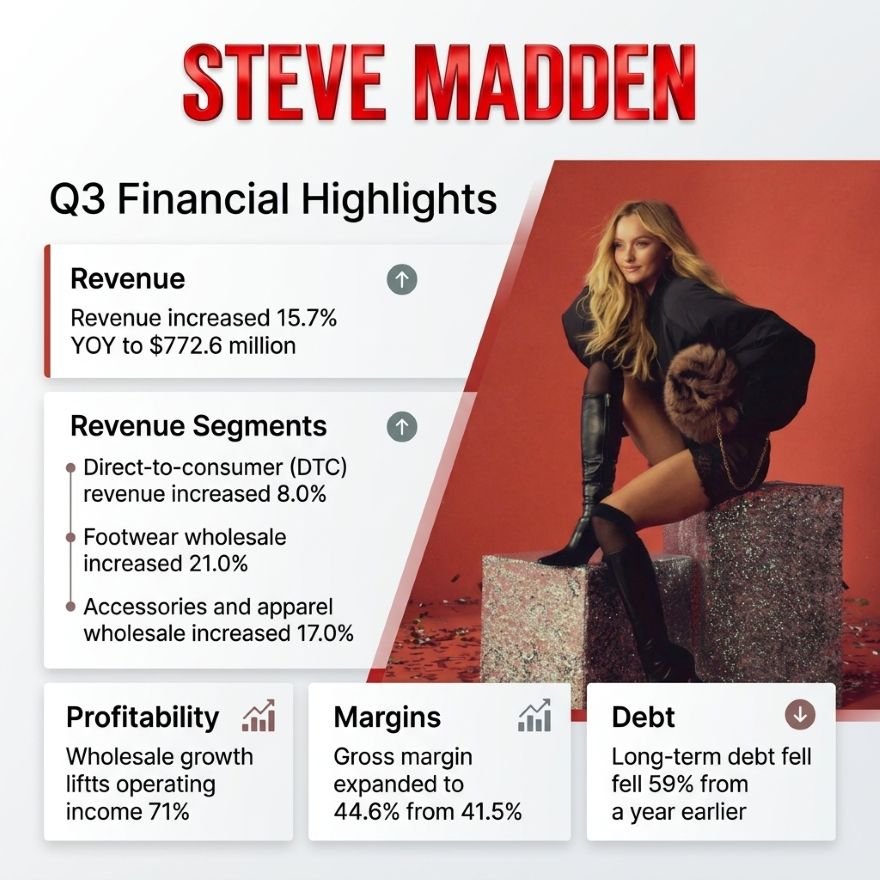
Steven Madden entered the third quarter still carrying the financial and integration burden of its 2025 acquisition of Kurt Geiger. The latest results suggest that pressure is easing. Revenue increased 15.7% year on year to $772.6 million, gross margin expanded to 44.6% from 41.5%, and GAAP operating income more than doubled.
Long-term debt fell 59% from a year earlier, while management raised the lower end of its full-year revenue growth outlook and lifted its adjusted earnings guidance.
Wholesale sales rose 19.4%, led by footwear, while direct-to-consumer (DTC) revenue increased 8.0%. The wholesale-led mix provides scale but leaves more of the business exposed to retail-partner orders, tariffs and freight costs. DTC remains the higher-margin channel, yet its adjusted gross margin declined year on year. Chief Executive Edward Rosenfeld credited "trend-right product assortments and compelling marketing" and identified the Steve Madden brand as a particular highlight.
The clearest product signal is footwear: wholesale footwear sales increased 21.0%, ahead of the 17.0% growth in wholesale accessories and apparel. Rosenfeld described the flagship Steve Madden brand as a "particular highlight" and said the wider portfolio also performed well.
The portfolio spans Steve Madden, Kurt Geiger London, Carvela, Dolce Vita, Betsey Johnson, Blondo and ATM. The company also licenses the Anne Klein name for footwear, handbags and accessories, and manufactures private-label products for retailers. Kurt Geiger, the premium British business acquired in 2025, remains strategically important, but integration is still a work in progress: the quarter included $3.9 million in pre-tax integration costs, while the company continues to identify integration and goodwill as key acquisition-related risks. Licensing income, although modest, increased to $4.7 million from $3.7 million.
Wholesale Momentum Outpaces DTC
Wholesale, which accounted for about 68% of revenue, was the principal growth engine. Sales reached $528.7 million, up 19.4%, across department stores, mass merchants, off-price retailers, shoe chains, online retailers, and specialty and independent stores. Wholesale gross margin rose to 36.8% - 410 basis points above the prior-year reported figure and 320 basis points above the prior-year adjusted margin of 33.6%. Management attributed the improvement to better underlying performance and a smaller tariff drag, partly offset by higher freight costs.
DTC generated $239.2 million, up 8.0%, and represented about 31% of revenue. Its reported gross margin improved 240 basis points to 60.7%, but that comparison masks a 120-basis-point decline against the prior-year adjusted margin of 61.9%. The company attributed the adjusted pressure to higher freight, a shift in markdown timing and deeper discounting of seasonal merchandise. Its distribution network comprises 381 company-operated stores, including 92 outlets, eight e-commerce sites and 190 international concessions.
Outlook Raised
Management now expects full-year revenue growth of 12% to 13%, compared with its previous range of 11% to 13%, raising the lower end of the outlook.