

TCF POST Report
NEW DELHI – Despite being the world’s second-largest textile producer, India’s garment export sector is facing a massive “structural” crisis, leaving billions of dollars in potential revenue on the table, according to a new industry report by the Vector Consulting Group.
The report, titled The Missing Stitch, highlights that while India holds a strong position in fabric manufacturing, it fails to convert that strength into globally competitive garment production, resulting in a significant missed opportunity estimated at $3–$7 billion annually.
The Scale of Lost Opportunity
While India is a textile powerhouse, it currently accounts for only about 4% of global textile and garment trade. The study reveals that 35%–45% of fabric manufactured in India is exported as raw material without any value addition. Instead of being finished within India, this fabric often re-enters the global market as garments produced in other countries.
Currently, India’s garment exports stand at approximately $16 billion. Experts suggest that by transforming the industry into a coordinated ecosystem, this figure could climb to $19–$23 billion using existing capacity.
Root Causes: Structural, Technical, and Managerial
Contrary to popular belief, the report argues that the issue is not primarily driven by high labor costs, trade agreements, or complex labor regulations. Instead, the “real cause” is the fragmented nature of the value chain, which manifests through several critical failures.
Technical Failures
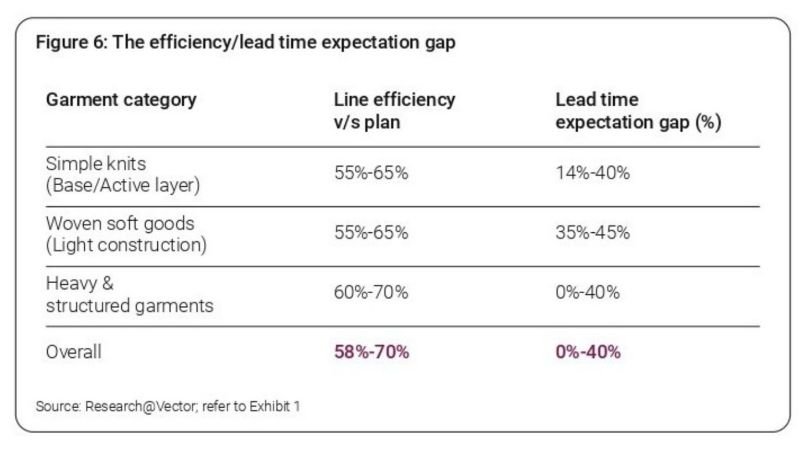
- Production Synchronization: Sewing lines operate at only 58%–70% of capacity because schedules are not integrated with upstream fabric availability, leading to idle time.
- Logistics & Margins: Due to production delays, manufacturers are often forced to air-freight up to 20% of their orders, which is a technical failure in planning that significantly erodes profit margins.
- Quality Bottlenecks: Quality issues are often identified too late, specifically at the garment assembly stage. The lack of rigorous, upstream checks at the mill level creates a ripple effect of rework, leading to poor On-Time In-Full (OTIF) performance.
Managerial Failures
- Organizational Silos: Fabric mills and garment manufacturing units operate as independent “silos” with conflicting objectives, even within the same corporate group.
- Misaligned Incentives: Managers are often incentivized based on local departmental metrics rather than global, company-wide performance, leading to behaviors that may be detrimental to the overall profitability of the garmenting unit.
- Lack of Inventory Strategy: The industry lacks “shared fabric banks” for seasonal or core products, as management has traditionally focused on “pushing” products rather than maintaining flexible, demand-driven inventories.
- Reliability Gap: OTIF performance currently ranges between 60%–80%, far below the “high 90s” required by global retailers, reflecting a systemic inability to align production with market demands.
Competing on the Global Stage
The report provides a stark comparison between India and its competitors:
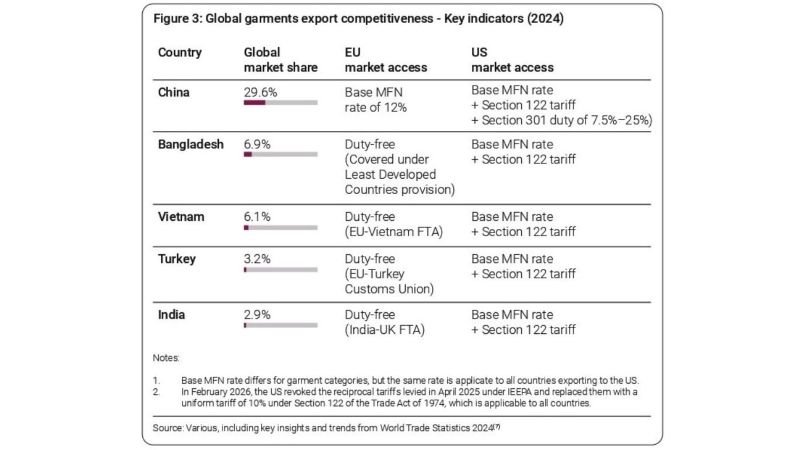
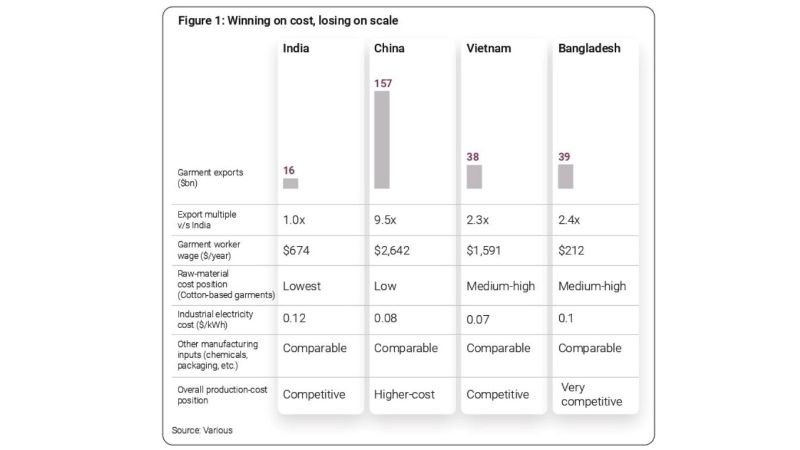
Despite China having a higher-cost structure and facing less favorable tariff regimes, it remains the world’s largest garment exporter, demonstrating that scale and coordination outweigh simple cost-based advantages.
A Path Forward: The Ecosystem Model
The report suggests that India’s next phase of growth will not come from building new factories, but by transforming the existing fragmented system into a coordinated production ecosystem.
Key recommendations include:
- Integrated Scheduling: Moving from independent planning to a synchronized process where fabric production is mapped directly to garment shipment commitments.
- Shared Fabric Banks: Establishing shared banks for core and seasonal fabrics to enable immediate production of repeat orders, a common practice for fast-fashion retailers.
- Upstream Quality Assurance: Moving quality inspections to the mill level to reduce rework and delays at the garmenting stage.
By implementing these changes, the report projects that factory operating profits could increase by 80%–200%, turning the “missing stitch” into a major engine for India’s economic growth.