

TCF POST Report
A new white paper from the Apparel Impact Institute (Aii) — Clean Heat in Textile Manufacturing: Aii Lessons on Steam Heat Pumps to Date — finds that although steam-generating heat pumps could significantly cut carbon emissions across textile production, several economic and technical obstacles are likely to slow large-scale adoption over the next few years.
Why the Economics Are Tough
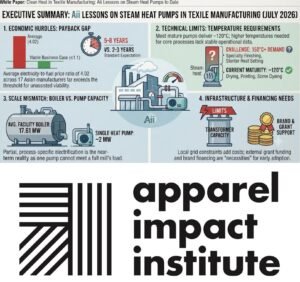
The report notes that high installation costs, difficult site integration, and electricity prices that remain expensive relative to fossil fuels are pushing payback timelines out to 5–8 years — well beyond the 2–3 year window most textile manufacturers typically require to greenlight a project. Looking at 17 factories across India, China, and Vietnam, researchers found electricity costs averaging roughly four times the cost of fuel, a ratio steep enough to undermine the standalone business case for switching.
Technical Limits
Heat pumps currently on the market perform reliably at around 120°C, which suits processes like drying and printing. However, more demanding processes — such as specialty finishing and stenter heat setting — need temperatures of 150–180°C, and systems capable of that range still lack extensive real-world performance data.
There’s also a scale mismatch: the average mill boiler produces close to 18 MW, while today’s commercial steam heat pumps max out around 2 MW. That gap means full-facility electrification isn’t realistic yet — adoption will likely happen piecemeal, targeting specific processes rather than entire plants.
Grid Constraints Add Cost
Local electrical grid limitations and transformer capacity shortfalls create further expenses and delays, making outside support — grants and brand-financed programs in particular — important for factories willing to move early.
Aii’s Recommended Approach
Rather than pushing straight for electrification, Aii recommends factories first focus on “de-steaming” and optimizing steam use to bring required temperatures under 150°C. This step alone can boost system efficiency (measured by Coefficient of Performance), and allow for smaller, cheaper equipment. Aii is aiming for 150°C closed-loop heat pump systems to reach commercial maturity by 2030, and in the meantime is offering feasibility studies, technical support, and funding through its Climate Solutions Portfolio to help close the gap.