

TCF POST Analysis
Pakistan closed fiscal year 2025-26 with all-textile exports at $17.93 billion, a total weakened by a sharp fall in June shipments even as the country’s shift toward value-added textiles continued to gain traction.
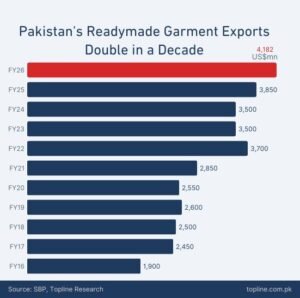
All-textile exports plunged 22.63% in June 2026 compared with the same month a year earlier, the steepest monthly decline in this report. Readymade garment (RMG) exports told a different story: the segment closed the fiscal year at $4.18 billion, up 5.5% year-on-year, standing apart from the broader textile slump.
Industry voices were upbeat despite the June setback, arguing that higher RMG shipments generate comparatively higher export earnings than the conventional basket of raw cotton, yarn and other semi-processed textile products — meaning a tilt toward garments, even in a weak month, points toward a more valuable export mix rather than a simple decline.
That shift has been building for years rather than emerging overnight: over the past decade, readymade garment exports more than doubled, rising from $1.97 billion in FY16 to $4.18 billion in FY26, a compound annual growth rate (CAGR) of 7.8% that points to steady, structural progress up the value chain.
But the headline decline in June obscures a more interesting split running underneath it — between a textile sector that is losing ground on bulk basics even as it gains ground on higher-value apparel, and a raw-material import bill that moved in a direction the finished-goods numbers don’t fully explain.
All Textiles Overview
No sector illustrates the gap between the monthly and annual pictures better than Textile & Leather, which still accounts for well over half of all goods exports.
In June alone, the sector’s exports fell 17%, to $1,337 million from $1,620 million — a steeper drop than the national export decline. Yet for the full year, textile exports were essentially flat, at $18,975 million against $18,941 million a year earlier, a technical increase of less than half a percentage point. The sector effectively absorbed a rough final month without denting its annual performance, suggesting the June weakness reflects timing, order scheduling, or a short-term shock rather than a structural loss of competitiveness — though the report itself doesn’t specify a cause, and nothing in the data pins down which of those explanations is correct.
The product-level detail explains how that balance was struck. Bulk, high-volume categories are under sustained pressure:
- Bedlinen, table and kitchen linen (HS 6302) — the single largest textile export line — fell 22% in June and was flat for the year at $4,411 million, essentially unchanged from $4,413 million.
- Men’s suits, trousers and jackets (HS 6203) dropped 18% in June and finished the year down 4%, at $3,087 million.
- Knitwear and jerseys (HS 6110) fell 27% in June, one of the sharpest single-month declines in the top commodity list, though the full year closed flat at $826 million.
- Leather apparel accessories (HS 4203) dropped 20% in June and also closed the year flat, at $621 million.
Against that, a smaller set of higher-value or intermediate-goods lines expanded:
- Women’s suits, dresses and ensembles (HS 6204) rose 10% in June and surged 42% for the year, to $807 million — the standout performer in the entire export basket.
- Cotton yarn (HS 5205) grew 5% in June and 14% annually, to $750 million, pointing to firmer demand for intermediate textile inputs even as finished bulk goods soften.
- Woven cotton fabrics (HS 5209) rebounded 20% in June after a weaker stretch, closing the year down just 1%, at $761 million.
Read together, this is a wider pattern than a single product swing: four separate bulk or mid-tier apparel lines posted double-digit June declines while still closing the year roughly flat, and three lines tied more closely to value-added or intermediate production — women’s apparel, yarn, and woven fabric — either grew or held up better.
That consistency across several HS codes, rather than one outlier line, is what makes the “reallocation” story more than a coincidence. But the scale still matters: the $807 million annual gain in women’s apparel does not come close to offsetting the combined annual value sitting in the linens and men’s suits categories alone, which together still total well over $7 billion.
The shift in composition is real; on the numbers in this report, it remains a rebalancing at the margin, not a replacement.
What the import side of textiles says
The report’s import tables cover the same HS universe from the other direction, and one figure stands out against the export story.
Raw cotton, neither carded nor combed (HS 5201) — the core input for the yarn and fabric lines that are actually gaining ground — fell 40% for the full year, to $1,570 million from $2,624 million, even as June alone showed a modest 2% increase to $217 million.
On the sector level, Textile & Leather imports overall were essentially flat to down for the year (-3%), even as June imports in the sector rose 22%.
That’s worth pausing on: a 40% annual drop in cotton imports sits awkwardly next to a textile export basket that, on the finished-goods side, barely moved and, on the yarn and fabric side, grew.
The report doesn’t explain the gap, and this analysis won’t guess at one — it could reflect lower global cotton prices, reduced import volumes, a shift toward inputs not captured under this HS code, or something else entirely. But it is a genuine inconsistency between the input and output sides of the same trade, and it’s the kind of detail a report on the textile segment specifically should flag rather than skip past.
The bottom line
Two trends are doing most of the work in this month’s data.
First, June’s shock — a 9.6% national export drop, led by a 17% decline in textiles that touched at least four separate major product lines — looks like a sharp, short-term disruption rather than a change in trend, since the twelve-month totals for both goods and the textile sector are far steadier.
Second, the sector’s raw-material import bill moved in a direction that doesn’t square neatly with its export performance, a mismatch the report’s own numbers surface but don’t resolve.
The clearest strategic signal remains the divergence within textiles itself: bulk linens, trousers, knitwear and leather accessories — the traditional volume anchors of Pakistani exports — are losing ground, while women’s apparel, cotton yarn and woven fabric are gaining it.
If that shift continues, it would mark a gradual move up the value chain even as overall export volumes stay under pressure. But at current dollar values, the gain is still a fraction of the loss, and the cotton-import discrepancy is a reminder that this report’s numbers raise at least one question about the sector’s input base that the data alone can’t answer.