

TCF POST Analysis
The performance of Pakistan’s exports for the 11 months from July to May 2025–2026 shows a contraction in total exports, contrasted by the resilient performance of the textile sector.
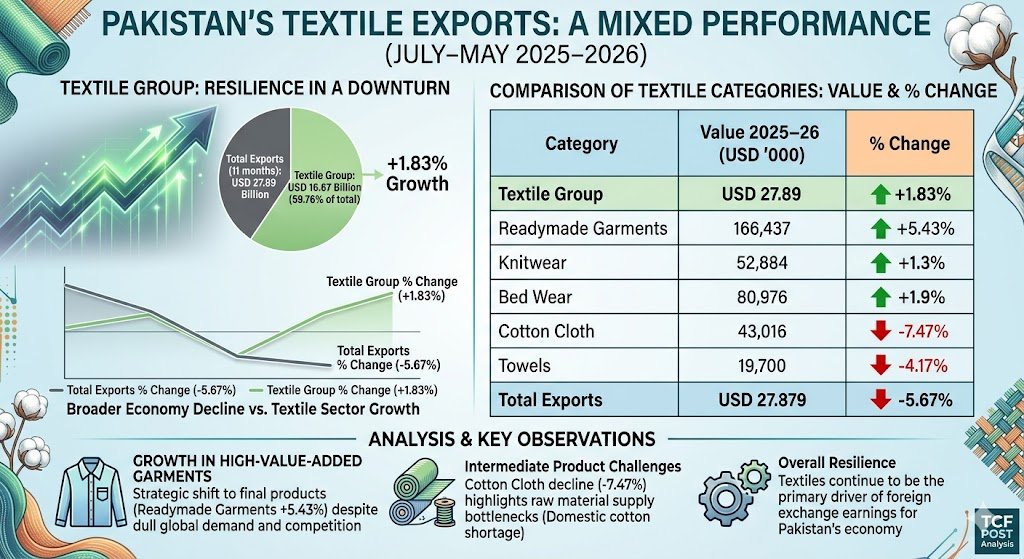
During this period, Pakistan’s total exports reached approximately USD 27.89 billion, a 5.67% decline compared to the same period in the previous fiscal year (July–May 2024–2025). In the same timeframe, the Textile Group demonstrated notable resilience, recording modest growth of 1.83%. Textiles continue to be the backbone of Pakistan’s export economy, accounting for approximately 59.76% of total exports.
The overall performance of the textile sector is quite satisfactory, particularly considering that it occurred during a period when the export of Cotton Cloth—a traditional and major category—experienced a significant year-on-year decline of 7.47%. Industry observers note that a dearth in domestic cotton supply is the primary reason behind this contraction in the cotton cloth segment.
Comparison of Textile Categories
In a mixed performance scenario, high-value-added garments showed significant growth, while some intermediate products faced challenges.
| Category | Value 2025–26 (USD ‘000) | Value 2024–25 (USD ‘000) | % Change |
| Total Exports | 27,888,198 | 29,563,035 | -5.67% |
| Textile Group | 16,665,525 | 16,365,322 | +1.83% |
| Readymade Garments | 3,973,019 | 3,768,432 | +5.43% |
| Knitwear | 4,602,044 | 4,555,345 | +1.03% |
| Bed Wear | 2,902,868 | 2,839,508 | +2.23% |
| Cotton Cloth | 1,560,345 | 1,686,309 | -7.47% |
| Towels | 995,341 | 995,423 | -0.01% |
Strategic Outlook
Despite dull demand in EU and US markets and stronger competition from other major Asian garment exporters, the effective performance of Readymade Garments (5.43% growth) and Knitwear (1.03% growth) indicates a strong shift toward higher-value-added final products.
While the broader economy struggled with a decline in total export volume, the textile industry’s ability to achieve growth—particularly in garments—highlights its continued importance as a primary driver of foreign exchange earnings.
However, the reliance on raw material availability remains a critical bottleneck. Had the Cotton Cloth segment maintained its performance or shown growth instead of a 7.47% decline, the Textile Group would have undoubtedly achieved significantly higher overall export growth, further cushioning the economy against the broader downturn in total exports.