

TCF POST Report
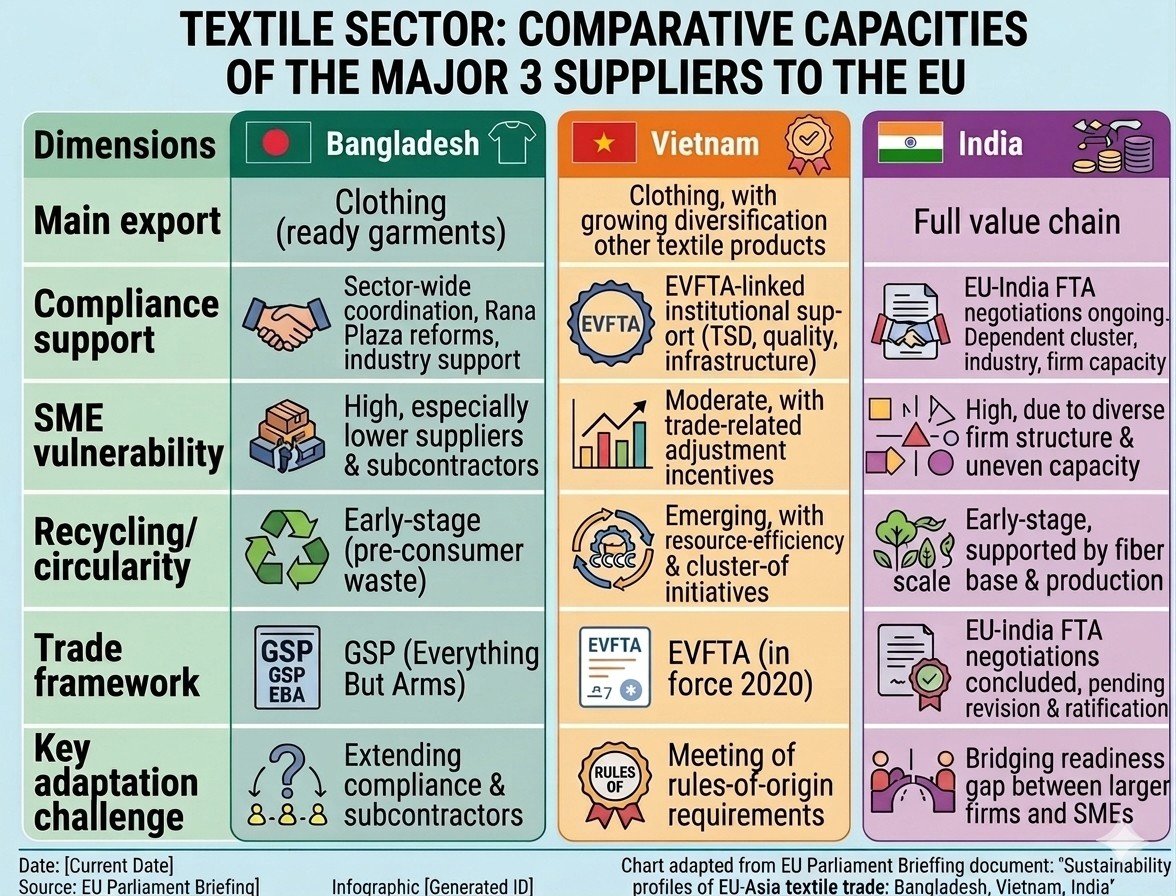
As the European Union aggressively shifts its sustainability, traceability, and circularity mandates from voluntary corporate pledges into hard trade law, it views Asia’s three major garment sourcing destinations—Bangladesh, Vietnam, and India—as still requiring significant structural improvements, with each displaying distinct strengths and weaknesses.
A newly released European Parliament briefing document, titled “EU trade in textiles: Import and export flows,” observes that the era of relying solely on cheap labor and raw volume is coming to an abrupt end.
The report forewarns that market access into the lucrative EU bloc is no longer just a matter of tariff margins; instead, it is increasingly dictated by domestic industrial depth and the capacity to trace a garment from fiber to retail shelf.
While the document utilizes data up to 2023 for comparative analysis among the three nations, its executive summary addresses the contemporary scenario, pointing out that the geopolitical and regulatory landscape for Asia’s dominant textile exporters is undergoing a massive structural shift.
Bangladesh: Compliance Structures and Export Adaptation
The briefing document notes that post-Rana Plaza institutional reforms have successfully overhauled safety frameworks in larger factories, significantly boosting international buyer confidence. However, smaller, lower-tier subcontractors are still being squeezed by volatile orders and narrow margins, leaving them highly exposed to the upcoming EU compliance shock.
Bangladesh is scheduled to graduate from the LDC list this year, and the EU has offered a soft landing via a three-year transition period, though a regulatory cliff awaits thereafter. The EU authority intends for Bangladesh to qualify for the $GSP+$ scheme, but doing so requires not only ratifying 32 international conventions but also satisfying stricter EU “rules of origin” for imports.
The EU points out that Bangladesh’s knitwear sector stands out as a core strength, with domestic spinners successfully supplying about 85% of the yarn required for export-oriented knitwear manufacturing. However, the woven garment sector remains highly vulnerable, with local mills supplying only around 40% of the fabric used in woven garments.
Vietnam: The EVFTA Blueprint for Supply-Chain Integration
Operating under the EU-Vietnam Free Trade Agreement (EVFTA) since 2020, Hanoi has successfully utilized a predictable bilateral framework to drive deep capital investment into certification infrastructure and product diversification.
However, the EVFTA imposes strict, agreement-specific origin rules and cumulation provisions, forcing Vietnam to localize a sufficient number of its production stages. Despite these hurdles, the briefing observes that Vietnamese Small and Medium Enterprises (SMEs) display only “moderate” vulnerability compared to regional peers like Bangladesh and India.
Today, Vietnam’s primary challenge is no longer basic factory compliance, but rather the escalation of EU demands into digital product passports, granular sustainability characteristics, and complex data traceability.
India: Strong Value Chain and Diversity, but Uneven Readiness
India sits in a unique position, possessing a fully integrated, domestic value chain that spans the entire production spectrum from raw natural and synthetic fibers to finished garments.
The commercial landscape for Indian exporters shifted dramatically with the official conclusion of the EU-India Free Trade Agreement (FTA) negotiations in January 2026. Awaiting final signature and ratification, this FTA’s commercial potential is massive, especially since the EU is already India’s second-largest export destination for textiles and apparel, right behind the USA.
However, the EU sees India’s readiness as deeply uneven; large, integrated conglomerates are actively experimenting with circular-economy projects and digital traceability, while SMEs—which still dominate the labor-intensive segments—face proportionately higher compliance costs and weaker administrative capacity.
Compliance is the EU’s Condition for the Commercial Relationship
Ultimately, the European Parliament’s assessment underscores a critical macroeconomic reality: compliance capacity is no longer determined by an individual factory’s cost-effective capacity, but by systemic, institutional infrastructure.