TCF POST Report
21 October 2026 -Bangladesh remains the most competitive apparel and footwear producer outside China, and its lead has grown, according to an updated ranking from credit insurer Coface. The new US tariff component penalised Bangladesh’s main Asian rivals more than it penalised Bangladesh. Bangladesh scores 71.5, ahead of Cambodia (64.1) and Pakistan (61.9).
The biggest movements lie further down the table. Vietnam would rank third on fundamentals alone but drops to 16th once US tariffs are counted. Madagascar and Jordan made the largest gains since July 2025, rising 20 and 19 places to 6th and 9th. Lesotho now ranks fourth.
China still leads exports, but its share is falling
China remains the world’s largest clothing and footwear exporter, but its share of global exports keeps declining. Coface cites rising labour costs and buyers’ push to diversify supply chains. Some US tariffs have been removed, but Chinese goods still face higher duties than those of several competitors.
Tariffs widened Bangladesh’s lead and cut Vietnam’s
The ranking scores countries on four pillars: business environment, workforce competitiveness, social and environmental criteria, and the strength of the textile industrial ecosystem. This edition adds a US tariff component.
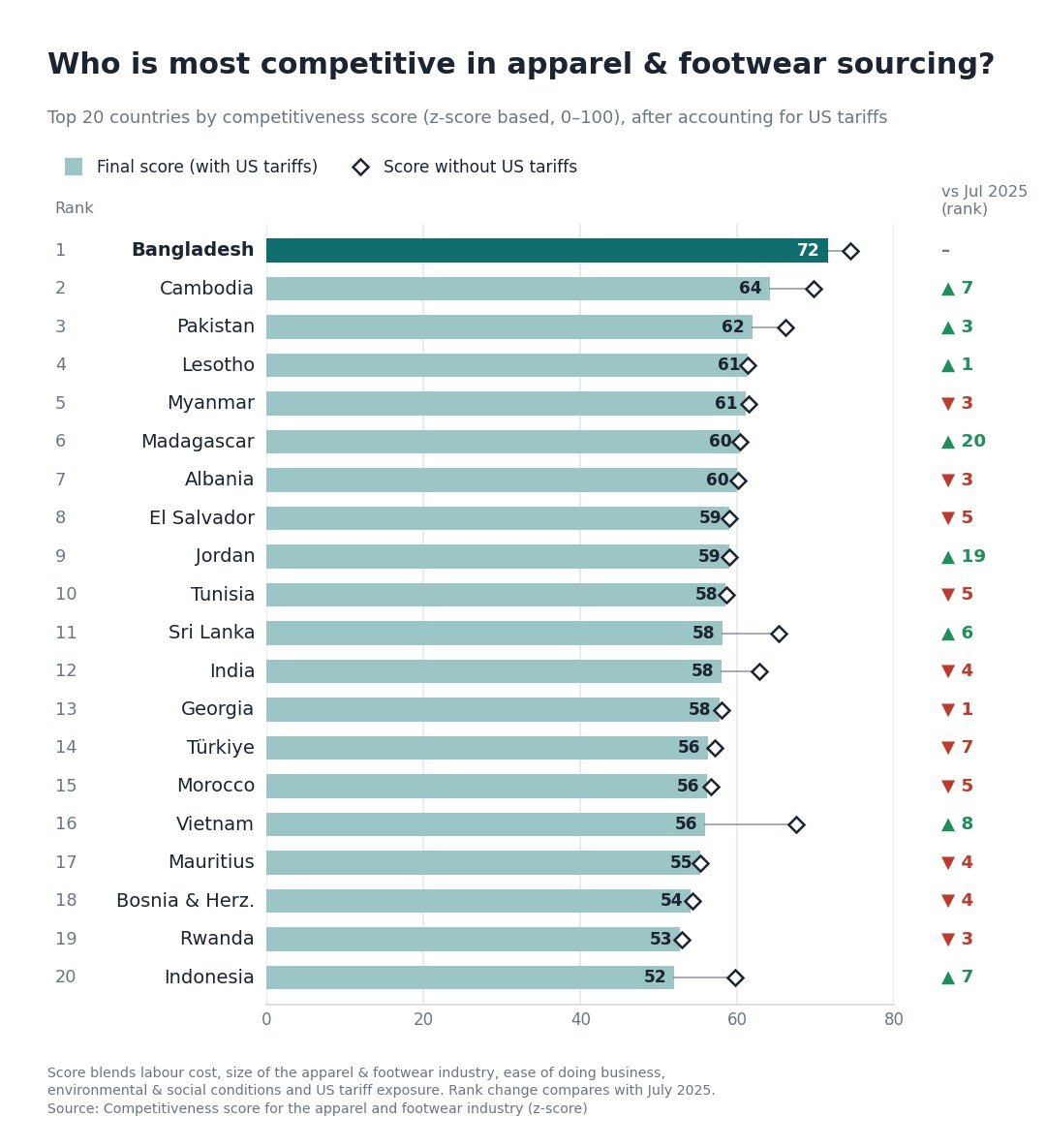
Without that component, Bangladesh would lead Cambodia by 4.8 points. With it, the gap is 7.4. Bangladesh’s own score still fell 2.9 points.
Vietnam lost 11.6 points and 13 places. Indonesia lost 7.7 points, falling from 11th to 20th, and Sri Lanka lost 7.1, dropping from 5th to 11th. Cambodia lost 5.6 points, India 4.8 and Pakistan 4.2. Lesotho, Madagascar, Jordan, El Salvador and Mauritius took no penalty, so their final scores equal their pre-tariff scores.
Since July 2025, Vietnam (+8), Cambodia (+7), Indonesia (+7), Sri Lanka (+6) and Pakistan (+3) have also moved up. The biggest fallers are Türkiye (-7), then El Salvador, Tunisia and Morocco (-5 each).
Bangladesh’s strength is scale, not cost
Bangladesh scores 99.9 on both the apparel share of its exports and its export size. Its wage score (66.3) trails Rwanda (69.6), Sri Lanka (68.5), India (68.0) and Madagascar (67.9). It also has clear weak spots: logistics (34.7, against 70.9 for India and 66.8 for Vietnam), power reliability (27.0) and working conditions (24.2). Only Myanmar scores lower on working conditions, at 12.0.
A bunched middle, and a dependence on the US
Places 3 to 7 are separated by under two points: Pakistan (61.9), Lesotho (61.4), Myanmar (61.1), Madagascar (60.3) and Albania (60.0). A small shift in tariffs could reorder them.
Coface’s exposure indicator is high for the tariff beneficiaries: 75.2% for El Salvador, 72.1% for Jordan, 49.1% for Lesotho and 33.1% for Madagascar, against 9.8% for Bangladesh. Their gains rest on near-zero tariff vulnerability, while the big Asian suppliers score between 24 and 31 on that measure. A change in US policy could undo those gains quickly.
What it means for sourcing
Coface economist Eve Barre says the tariff changes could strengthen several Asian and African suppliers but confirm that moving away from China is a long-term structural trend. Labour cost no longer decides sourcing on its own. Market access, trade policy, industrial depth and economic stability now carry equal weight, and buyers are favouring countries that combine competitiveness, capacity and access to major consumer markets.