

TCF POST Analysis
Effective 27 June 2026, the Colombian government has reinstated a 35% ad valorem tariff on footwear imports, applicable for five years.
This measure targets imports from non-FTA countries—a category that includes Colombia’s primary footwear suppliers: the Chinese Mainland, Vietnam, and Indonesia.
This policy, designed to protect domestic manufacturers from a surge in low-cost imports, fundamentally alters the competitive landscape for Asian exporters and necessitates urgent strategic adjustments.
Context and Policy Drivers
The reinstatement follows the expiration of a previous temporary tariff system at the end of 2025. Between January and June 2026, Colombia’s Most-Favoured Nation (MFN) rates were temporarily set at 15% (for footwear) and 10% (for uppers).
The government’s decision to re-apply the 35% duty—backed by updated, higher FOB price thresholds—is driven by:
- Surging Import Volumes: Non-FTA footwear imports grew by 13.1% in 2024 and 24.7% in 2025. Imports of footwear uppers saw even more dramatic growth (78.2% in 2024; 93.4% in 2025).
- Protectionist Reindustrialization: The policy aligns with Colombia’s broader “reindustrialization” objectives, aiming to shelter local producers and MSMEs from perceived unfair competition and price-based pressure from Asian manufacturing hubs.
Impact on Asian Market Dominance
Asian suppliers currently hold the overwhelming majority of the Colombian market share:
- Chinese Mainland: 56.2%
- Vietnam: 26.3%
- Indonesia: 12.8%
By contrast, the only major supplier with an active Free Trade Agreement (FTA), Brazil, held only 8.4% of the market in 2025. This creates a structural disadvantage for Asian exporters, who now face a 35% cost premium that FTA-partner countries av
The new tariff structure imposes severe pressure on Asian supply chains:
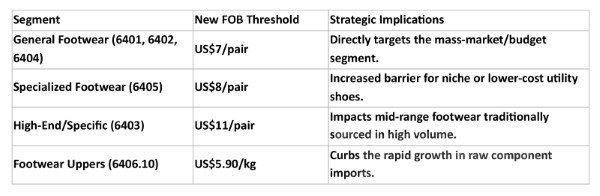
Increased Regulatory Scrutiny: Colombian customs is expected to heighten inspection of declared FOB values to prevent “under-billing” (the practice of artificially lowering declared values to stay above the price thresholds