

TCF POST Special Report
New empirical research published today has cast a sobering light on the race for industrial sustainability in emerging Asia. It has revealed that the economic returns from green building and energy efficiency investments are far from guaranteed.
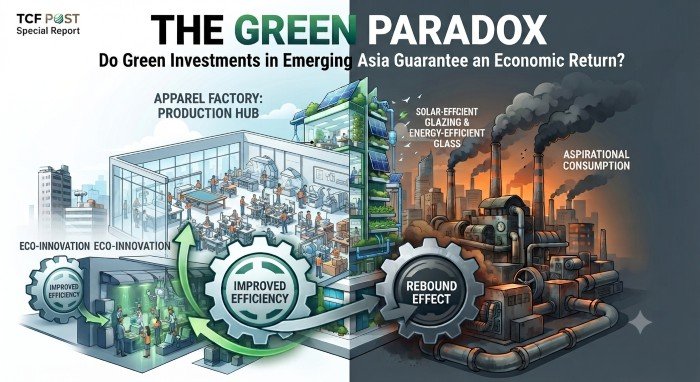
In many instances, these well-intentioned climate policies are inadvertently triggering a “Green Paradox,” where efficiency improvements fail to reduce aggregate emissions and, in some cases, serve to accelerate them.
The study, titled “The Green Paradox in Emerging Asian Economies: Do Green Building and Energy Efficiency Fuel the Rebound Effect or Drive Eco-Innovation?”, was conducted by a team of economists.
The team was led by Dr. Emmanuel Uche of the College of Economic and Management Sciences, University of South Africa, Pretoria, and Dr. Kingsley I. Okere of the School of Economics and Finance at the University of the Witwatersrand, Johannesburg.
Their research, which appears in the journal Sustainability, provides a rigorous, multi-method econometric analysis covering 14 emerging Asian economies between 2000 and 2023.
A Structural Reality Check
For the 14 emerging Asian economies—including textile-heavy nations such as Bangladesh, Pakistan, and Vietnam—the drive toward sustainable infrastructure is colliding with the realities of rapid industrial growth.
While green building certifications and efficiency mandates are widely promoted, the researchers found that these efforts often struggle against the “rebound effect.”
In the textile and garment sectors, efficiency gains frequently lower the implicit cost of energy services. When businesses or households see these cost savings, they often respond with “aspirational consumption”—respending the saved capital on additional energy-intensive goods or increasing the utilization of efficient equipment. Consequently, the anticipated environmental and economic benefits are often partially or fully offset.
Moving Beyond the Efficiency Myth
The persistent assumption that “greener” is automatically “more profitable” is a dangerous oversimplification for policymakers in emerging markets. As the data analyzed by Drs. Uche and Okere shows, there is no linear path to decarbonization.
- The Threshold Problem: Investing in green buildings yields diminishing returns; while initial investments can spark eco-innovation, there is a “critical threshold” beyond which these benefits are suppressed.
- Innovation vs. Consumption: Policy cannot rely on efficiency mandates alone, as these often serve to stimulate energy demand rather than suppress it.
- Governance as the Linchpin: The most critical lesson is that technological potential does not automatically translate into practice. Without strong regulatory enforcement and the rule of law, green investments are prone to being absorbed by the rebound effect.
The “Green Paradox” serves as a necessary warning: in economies with high industrial output and, at times, subsidized energy, policy interventions must be surgical.
The researchers argue that leaders must stop viewing energy efficiency as a stand-alone solution and start integrating it into a broader framework that includes carbon pricing, R&D innovation funds, and, most importantly, the strengthening of institutional quality.
The transition to a low-carbon textile sector is not merely a technical challenge of upgrading infrastructure; it is an institutional challenge of managing human behavior and economic incentives.
Until governance and demand-side management are given as much weight as green building certifications, the Green Paradox will continue to undermine the region’s climate ambitions.