

TCF POST Report
TOHOKU — A groundbreaking study published in the Journal of Industrial Textiles is set to reshape the future of luxury textiles. Researchers at Tohoku University have discovered that by enriching the diet of silkworms with plant-derived cellulose nanofibers (CNFs), they can produce “super silk” that significantly outperforms conventional material.
Solving the Age-Old Weakness of Silk
For over 4,000 years, silk has been prized for its beauty, strength, and biocompatibility. However, its utility in apparel has long been hindered by a notable vulnerability: it tends to shrink and lose its shape after repeated exposure to moisture.
The research team, comprised of Camille Moreau, Hiroki Kurita, Zhenjin Wang, Lovisa Rova, Genki Kobayashi, Mathilde Dubois, Julian Reinhart, and Fumio Narita, has developed a practical, environmentally friendly solution that addresses this issue at the source. By simply adding CNFs to silkworm feed, the team produced silk fibers with:
- 50% greater tensile strength.
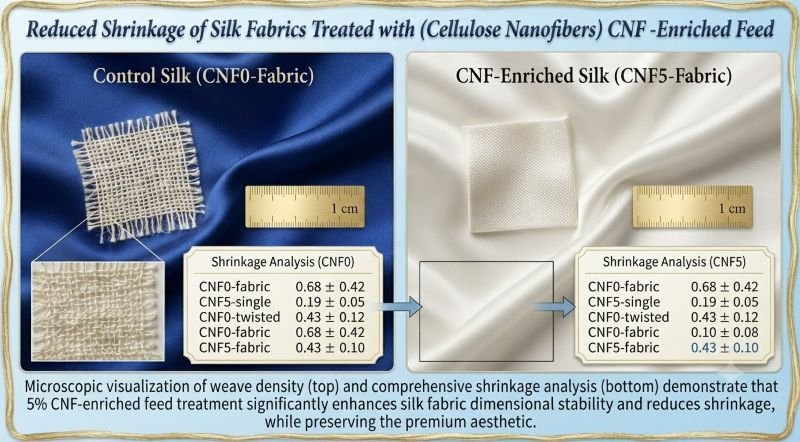
- Reduced shrinkage after wetting and drying to less than one-quarter of that seen in untreated silk.
Impact on Fashion and Apparel
These findings are particularly significant for the fashion and apparel industries because the performance enhancements persist even after the fibers are processed into yarn and woven into fabrics. This suggests that the material is viable for use in high-end, durable consumer products.
Unlike other methods that might rely on toxic chemical treatments or require extensive overhauls to production processes, this approach is both sustainable and effective.
“Our goal was to improve silk while preserving its natural advantages,” says Associate Professor Hiroki Kurita. “We were excited to find that simply changing the silkworms’ diet produced silk that is both stronger and much more dimensionally stable in wet environments. We hope this sustainable approach will contribute to the development of next-generation functional textiles”.
Beyond the Runway
While the fashion implications are profound, the versatility of this new silk extends well beyond clothing. “Silk is not just for fashion — it is also used in a plethora of different industries you might not initially think of,” explains Kurita. “For example, silk can be used in a medical setting as surgical sutures or a biomaterial to promote wound healing”. By proving that small, early-stage modifications in silk production can lead to major improvements in finished textiles, this research