

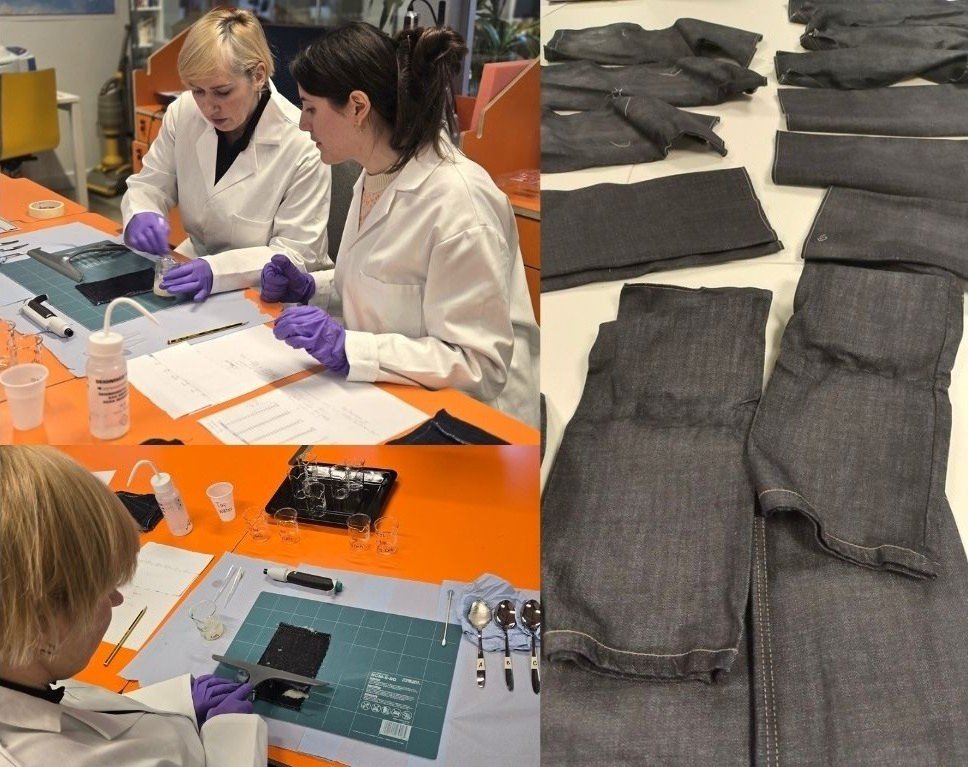
Innovate UK-backed collaboration between LaundRE, PlantSea and Arts University Bournemouth points to a bio-based route away from microplastic-shedding coatings
TCF POST Special Report
A UK research collaboration has completed an early-stage feasibility study testing seaweed-derived coatings as a sustainable alternative to the synthetic polymer finishes widely used across denim production — a sector under mounting pressure over its contribution to microplastic pollution.
The two-month project, delivered between February and March 2026, brought together circular denim-washing specialist LaundRE Ltd (project lead), biotechnology firm PlantSea Ltd, and the Plastics Innovation and Curation (PlastIC) Research Centre at Arts University Bournemouth (AUB). It marks PlastIC’s first successful UK Research and Innovation (UKRI) bid.
The problem it targets
Conventional denim finishing relies heavily on petrochemical-based plastic coatings to deliver specific washes, textures and durability. Industry data has long linked these coatings to microplastic shedding during laundering and wear — a growing regulatory and reputational liability for denim brands as scrutiny of textile microplastics intensifies globally.
What the project tested
Rather than pursuing a fully validated commercial solution, the collaboration set out to establish whether seaweed-based bio-polymers could function as a viable substitute within existing industrial finishing infrastructure — a critical detail for any brand or mill weighing adoption costs.
Key strands of work included:
Formulation trials — laboratory-scale development of seaweed-derived coating formulations suitable for textile application.
Application testing — trialling the coatings on denim substrates using LaundRE’s industrial pad-coating and nebulising systems, rather than bespoke lab equipment.
Performance assessment — evaluating adhesion, flexibility and wash response using digital microscopy and colour/gloss measurement to gauge surface consistency.
Process compatibility — identifying how the new formulations interact with current finishing lines, and what parameters would need adjusting for scale-up.
PlantSea supplied the seaweed-derived materials and formulation expertise; LaundRE ran the application trials on its industrial equipment; AUB provided analytical testing and material characterisation.
Academic and industry voices
The research was carried out by AUB PhD candidate Joanne Swift, whose doctoral work centres on biodegradable fabric treatments and circular fashion, under the supervision of Dr Jon Burgess and Dr Elena Castagnotto, who contributed research leadership and technical data analysis.
Swift described the project as a direct extension of her academic focus into a commercial testing environment, noting it allowed her to apply research on biodegradable treatments and circular fashion to a live industrial finishing process. She said the aim was to establish whether seaweed-derived materials could offer a functional, eco-friendly alternative to plastic coatings without sacrificing the quality expected of finished jeans.
Why it matters for the industry
For denim brands and mills, the study’s significance lies less in a finished product and more in the proof of process compatibility — the idea that a bio-based coating could, in principle, be dropped into existing pad-coating and nebulising lines rather than requiring costly retooling. That is typically the first hurdle sustainable-materials innovations must clear before mills will consider piloting them at commercial scale.
The project’s framing as an “early-stage feasibility study” is a deliberate signal: the team is not yet claiming a market-ready replacement. The research partners are now analysing the collected data on adhesion, flexibility and wash performance to determine next steps, which are expected to shape a follow-on phase of development.
Look ahead
The collaboration is a notable example of the “triple helix” model increasingly favoured by UKRI funding — pairing an SME with commercial finishing capability (LaundRE), a specialist materials innovator (PlantSea), and an academic research centre (AUB’s PlastIC) to move sustainability research more quickly from lab bench to factory floor.
Further technical findings from the project are expected as the research partners complete their analysis of the trial data. If the seaweed-coating approach proves scalable, it could offer denim manufacturers a route to reduce microplastic shedding without overhauling existing finishing infrastructure — a combination that would appeal to both sustainability targets and capital expenditure constraints alike.