

ISTANBUL — For years, global apparel brands treated sustainable fiber substitution as a simple plug-and-play solution. Drop in an eco-friendly alternative like hemp, slap a green label on the hangtag, and call it a day.
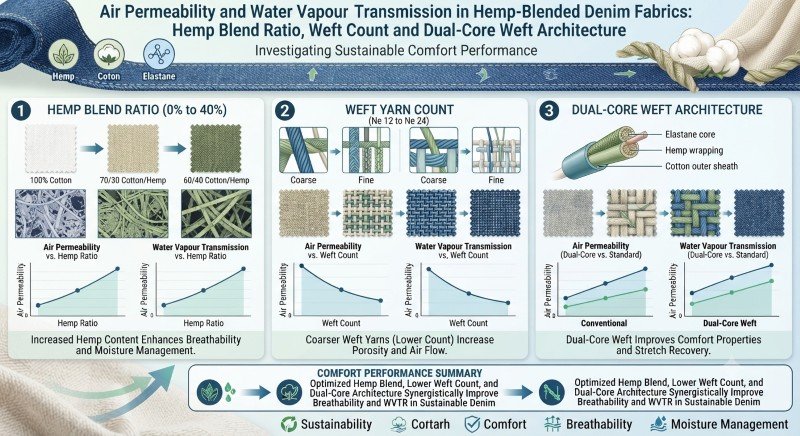
New research from Çukurova University textile engineers Yılmaz Erbil and Semira Koçak proves that achieving true high-performance comfort demands a sophisticated, microscopic alignment of natural fibers, yarn architecture, and structural density.
“Weft architecture and fabric structure were more strongly associated with comfort behavior than fiber composition alone,” Erbil and Koçak stated.
Analyzing eleven industrial denim variants, the researchers provide fashion executives, sourcing directors, and business minds with an empirical wake-up call and an actionable blueprint for the future of technical apparel.
The Material Reality: Air vs. Vapor
The core revelation centers on how fabrics manage the body’s microclimate. As Erbil and Koçak note in their findings, air permeability (breathability) and the water vapor transmission factor (WVPf) exhibit a weak, non-significant correlation.
In plain terms: Maximum airflow does not equal maximum moisture evaporation. Fabrics that let air rush through do not automatically excel at moving sweat away from the skin.
Key performance outputs and expert insights from the research include:
- Peak Airflow (Type 8): Leveraging advanced dual-core weft designs on a cotton/hemp warp configuration, the team hit a record-shattering air permeability of 252.96 mm/s, maximizing convective airflow for hot-climate wearers.
- Peak Vapor Transfer (Type 10): Conversely, moisture diffusion and evaporation hit a zenith at a WVPf of 204.28 in fine dual-core variations.
- The Structural Catalyst: Dual-core weft designs averaged higher air permeability than rigid ones (174.72 vs. 124.88 mm/s). However, the authors emphasize that this performance is largely driven by mass, sett, and yarn geometry rather than fiber composition alone.
- The Hemp Reality: Multiple regression analysis proved that hemp content alone is not a statistically reliable predictor of air permeability or vapor transmission once yarn count and fabric sett are accounted for.
- Mechanical Trade-offs: High-stretch variants delivered up to 37.2% elasticity (Type 4), while single-core constructions (Type 7) exhibited higher fabric stiffness. Peak stretch rarely aligned with peak breathability, forcing designers to weigh movement comfort against thermal transport.
Strategic Implications for Industry Leaders
For business leaders shaping the future of global apparel, these technical insights translate directly into market segmentation, marketing integrity, and operational efficiency:
- Strategic Product Segmentation: The era of the “one-size-fits-all” eco-fabric is officially over. Forward-thinking brands must deploy Type 8-style fine dual-core architectures for high-airflow, active-breathability denim lines, while reserving Type 9/10 configurations for collections focused on skin-side vapor control.
- Rethinking Sustainable Marketing: Commercial leaders must pivot away from marketing hemp as a standalone miracle fiber. True commercial viability requires precise weft counts and fabric density controls backed by transparent, data-driven storytelling.
- Optimizing Manufacturing Efficiency: Mill operators can streamline production costs and bypass heavy, resource-intensive conventional processes. Prioritizing mass reduction and dual-core weft engineering captures booming consumer demand for high-performance eco-denim without ever sacrificing structural integrity.