

TCF POST Report
DHAKA: Asia’s leading textile and apparel exporting countries are entering a new phase of global competition in which labour standards, wage equity and regulatory compliance are becoming as important as manufacturing costs, according to a new academic study.
The study, Evaluating Wage Disparities and Labor Policies in the Global Textile Industry – A Path Towards Equitable Worker Welfare, was conducted by Mazed Islam, Senior Lecturer, Sustainable Fashion and Textiles, Department of Fashion and Textiles, Winchester School of Arts, University of Southampton, UK and Jepy DewanSenior Assistant Secretary, Ministry of Water Resources, Bangladesh and published in the South Asian Journal of Social Sciences and Humanities .
The study argues that although China, Bangladesh, India and Vietnam remain the backbone of global apparel sourcing, their long-term competitiveness will increasingly depend on labour governance rather than low-cost manufacturing alone. It says growing international due diligence requirements and rising buyer expectations are reshaping sourcing decisions across the industry.
Low labour costs remain a competitive advantage—but also a strategic risk
The study finds that competition among Asian textile-exporting countries has largely become a race to minimise labour costs, encouraging governments and manufacturers to prioritise investment attraction over worker welfare. While statutory minimum wages vary across the region, actual earnings often remain below living wage levels and, in some cases, below legal minimums because of weak enforcement.
Among the region’s major sourcing destinations, Bangladesh continues to offer one of the world’s lowest garment wage structures, making it highly attractive to international buyers. However, the study notes that the country’s revised minimum wage covers only about 38% of an estimated living wage, while the declining share of basic salary in total earnings raises concerns over workers’ purchasing power and income security.
Vietnam is presented as a contrasting model. Average textile wages of around US$400 per month, with regional minimum wages ranging from US$139 to US$200, suggest the country is increasingly competing through productivity, manufacturing capability and higher value-added production rather than ultra-low labour costs.
India, meanwhile, offers relatively higher wage levels but faces considerable regional disparities because minimum wages are set at the state level. The resulting differences in labour costs across manufacturing clusters add complexity to sourcing decisions for global buyers.
Comparative wage levels across major Asian textile-exporting countries
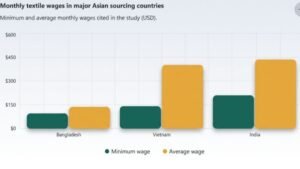
The wage comparison illustrates the different sourcing models emerging across Asia. Bangladesh remains the region’s lowest-cost manufacturing base, Vietnam combines higher wages with stronger productivity, while India’s comparatively higher wage levels reflect its more diversified manufacturing landscape. The findings suggest that competitiveness is gradually shifting from labour-cost arbitrage towards productivity, workforce quality and operational efficiency.
Gender inequality remains a structural weakness
Gender disparity is identified as one of the textile industry’s most persistent structural challenges. Although women make up the majority of garment workers across Asia, they remain concentrated in low-skilled production jobs with limited career progression, while technical, supervisory and management positions continue to be dominated by men.
The study attributes the wage gap to occupational segregation, unequal access to higher-paying jobs and career interruptions linked to marriage, maternity and childcare. It also notes that female workers often face weaker social protection and fewer opportunities for skills development.
Gender wage disparity in selected Asian textile-exporting countries
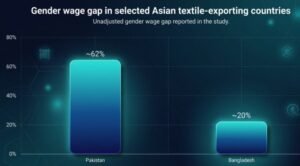
The study reports an unadjusted gender wage gap of 64.5% in Pakistan and 22% in Bangladesh, highlighting persistent inequality even in countries where women account for the majority of the apparel workforce. The authors argue that narrowing these disparities through equal-pay enforcement, greater career mobility and improved workplace protections is becoming increasingly important as international buyers strengthen ESG and human rights requirements.
Weak enforcement threatens sourcing credibility
Rather than inadequate legislation, the study identifies weak implementation as the principal challenge across many Asian exporting countries. Bangladesh is cited as the primary example, where labour inspections, enforcement capacity and penalties remain insufficient to ensure compliance. Although authorities carried out more than 43,000 labour inspections during fiscal 2021–22, only a small proportion targeted garment factories, while many manufacturers had yet to fully implement revised wage structures.
The research also finds that voluntary corporate social responsibility (CSR) programmes have delivered only limited improvements because intense pricing pressure from international buyers continues to restrict suppliers’ ability to provide living wages.
Labour governance is becoming a sourcing differentiator
According to the study, sourcing decisions are no longer driven solely by price, quality and delivery. New regulatory frameworks, including the European Union’s Corporate Sustainability Due Diligence Directive (CSDDD), are compelling brands to scrutinise labour practices throughout their supply chains. The United States has also continued to pressure Bangladesh to strengthen labour standards following the suspension of GSP benefits after the Rana Plaza disaster.
Analysis
The study suggests that the competitive landscape for Asian textile exporters is undergoing a structural shift. While low labour costs remain an important advantage, they are no longer sufficient to secure long-term sourcing opportunities. Buyers are increasingly evaluating labour governance, wage transparency, regulatory compliance and gender equality alongside manufacturing capability.
Among the major exporters, Vietnam appears best positioned to benefit from this transition because it combines comparatively higher wages with stronger productivity. India’s challenge is to reduce regional wage disparities while modernising its manufacturing base. Bangladesh, despite retaining one of the world’s strongest cost advantages, faces mounting pressure to strengthen labour law enforcement, improve wage structures and narrow gender inequality to maintain buyer confidence.
Overall, the research concludes that the next phase of global apparel sourcing will be determined less by which country offers the cheapest labour and more by which can deliver competitive manufacturing supported by credible labour standards, equitable wages and responsible supply-chain practices.