

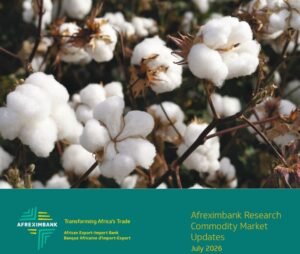
TCF POST Special Report
A tightening global cotton market is creating fresh sourcing opportunities for Asian textile manufacturers while presenting African cotton-producing nations with a chance to strengthen their position in the global supply chain. However, analysts warn that unless African exporters move beyond raw fibre shipments into spinning and textile manufacturing, they risk losing competitiveness to larger and more integrated suppliers such as Brazil.
According to the July 2026 commodity market update by the African Export-Import Bank (Afreximbank), cotton has emerged as one of the best-performing agricultural commodities during the first half of 2026. ICE front-month cotton futures have climbed about 35 percent from February lows to around 80.5 US cents per pound, ending a prolonged bearish cycle that began in 2023. The recovery has been underpinned by tightening supplies, improving textile demand, weather-related production risks and geopolitical disruptions affecting energy markets.
For textile manufacturers across Asia, the report suggests that the market is entering a fundamentally different phase. After two years of global oversupply, worldwide cotton production is projected to decline to 116 million bales in the 2026/27 season, down from 122.7 million bales a year earlier, while mill consumption is forecast to increase to approximately 122 million bales. Demand is therefore expected to exceed production, reducing global inventories to their lowest level since 2018/19 and pushing the global stocks-to-use ratio down from 63.8 percent to 58.4 percent.
Asian demand becomes the market’s driving force
The report identifies Asia—not supply—as the principal engine of the current market recovery.
China remains the world’s dominant cotton consumer, accounting for more than one-third of global mill consumption despite the rapid expansion of textile manufacturing in India, Bangladesh, Pakistan and Vietnam. China’s cotton mill consumption is forecast to reach 41.5 million bales in 2026/27, the highest level since 2010/11, driven by government policies encouraging domestic consumption, inventory rebuilding and resilient textile production.
For Asian apparel manufacturers, this signals sustained raw material demand rather than speculative buying. Beijing’s strategy to stimulate household spending, including subsidies for home textiles across nearly half of China’s provinces, is expected to translate into stronger downstream consumption of apparel and textile products, supporting mill operations throughout the region.
The report also highlights China’s continuing industrial transformation in Xinjiang, where spindle capacity has expanded by 59.5 percent since 2020 while weaving capacity has surged more than 327 percent. The region’s cotton-to-textile conversion rate has reached 45 percent, with spinning mills operating above 90 percent utilisation, significantly higher than the national average.
For competing textile hubs including Bangladesh, India, Pakistan and Vietnam, stronger Chinese consumption is likely to support regional fibre demand rather than weaken it, as Asia’s integrated textile supply chains continue to rely on cross-border yarn, fabric and garment production.
West African cotton retains strategic importance
The report identifies West Africa as maintaining a favourable position with Asian buyers despite production challenges.
Cotton originating from Benin, Burkina Faso, Côte d’Ivoire and Mali continues to command demand among Asian spinning mills because of its fibre quality, traceability and relatively low contamination levels—attributes increasingly valued by mills producing higher-quality yarns for export markets.
For Asian buyers, these characteristics provide sourcing advantages at a time when tighter global inventories are increasing competition for premium cotton. The report suggests that West African origins remain attractive not because they offer the largest volumes but because they consistently meet quality specifications required by spinning mills.
However, production trends across Africa present a growing concern. Cotton output in Chad, Cameroon and Mali has declined to around 1.3 million bales from approximately 1.9 million bales in 2021/22 due to adverse weather, rising input costs and persistent productivity constraints. Lower exportable surpluses could limit Africa’s ability to capitalise fully on stronger international prices.
Brazil intensifies competition for Asian sourcing
While African cotton enjoys quality advantages, the report argues that Brazil has become the continent’s biggest competitive challenge.
Having overtaken the United States as the world’s largest cotton exporter, Brazil benefits from large-scale commercial farming, efficient logistics and competitive production costs. Record exports are expected again during the 2026/27 season, allowing Brazil to strengthen relationships with major Asian buyers through reliable, large-volume shipments that many smaller African exporters struggle to match.
For procurement managers in Asia, this creates a sourcing trade-off. Brazilian cotton offers supply consistency and logistical efficiency, while West African cotton continues to deliver recognised quality, traceability and lower contamination. The report suggests future purchasing decisions will increasingly balance these competing advantages as global supplies tighten.
African producers urged to move up the value chain
Afreximbank argues that the current price recovery offers Africa an opportunity that extends beyond higher raw cotton exports.
Rather than remaining suppliers of lint cotton, the report recommends accelerating investment in domestic spinning, textile manufacturing and apparel production. It warns that without value addition, African producers will remain vulnerable to competition from larger exporting nations despite their fibre-quality advantages.
To support this transition, Afreximbank is backing cotton-processing special economic zones in Cameroon, Chad and Mali while pursuing similar initiatives in Kenya, Rwanda and Nigeria. In Nigeria alone, the bank has committed up to US$2 billion to modernise the cotton and textile sector. The strategy combines industrial infrastructure, trade finance, quality certification and supply-chain development to create integrated textile manufacturing ecosystems.
The report cites Benin’s Glo-Djigbé Industrial Zone as an example of the value-creation potential. Cotton that previously generated around US$40 million through raw fibre exports could produce as much as US$800 million when processed into finished garments, illustrating the economic gains available through local manufacturing rather than commodity exports alone.
Outlook remains constructive for textile buyers
The report expects cotton prices to remain supported through the remainder of 2026 as tighter inventories, recovering Asian mill consumption and continued weather-related production risks offset downside pressures. However, weaker consumer spending, improved harvests in the United States or Brazil, easing geopolitical tensions that reduce energy costs, or renewed substitution towards synthetic fibres could moderate the rally.
For the textile and apparel industry, the report points to a structural shift rather than a temporary price rebound. Asian manufacturers are likely to compete more aggressively for quality cotton as inventories tighten, while African exporters face a strategic choice between remaining raw material suppliers or investing in downstream textile production to capture a greater share of global value creation.