

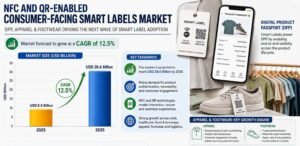
Global NFC and QR-enabled smart-label market set to surge from $8.9 billion in 2025 to $28.6 billion by 2035, with Digital Product Passports emerging as a major new driver for apparel and footwear traceability
TCF POST Report
The global smart-label industry is heading for a major expansion as the European Union’s Digital Product Passport (DPP) initiative pushes textile, clothing and footwear manufacturers toward digitally identifiable and traceable products.
The global market for NFC and QR-enabled consumer-facing smart labels, valued at US$8.9 billion in 2025, is projected to reach US$28.6 billion by 2035, representing a 12.5% compound annual growth rate. QR code-based labels alone accounted for 52% of the market in 2025, while product authentication and anti-counterfeiting represented another 29.3%.
The emergence of the Digital Product Passport could provide an additional structural boost to that growth, particularly in the textile, clothing and footwear industries. Under the EU’s Ecodesign for Sustainable Products Regulation (ESPR), textiles are among the priority product groups for which sector-specific DPP requirements are being developed.
For Asian manufacturers supplying European brands, this could turn what was once a relatively simple garment label into a digital gateway to product information.
DPP creates a new market for smart labels
A Digital Product Passport is essentially a structured digital record connected to a physical product. QR codes, NFC tags and RFID technologies can provide the link through which consumers, brands, supply-chain companies and regulators access product information.
That makes DPP particularly relevant to the smart-label industry.
Instead of merely displaying a brand name, size or care instructions, a smart label can connect a garment or pair of shoes to information about its materials, origin, manufacturing and sustainability characteristics.
The European Parliament has identified DPP as a potential mechanism for improving traceability, transparency and circularity in the textile industry.
This creates a direct commercial opportunity for smart-label manufacturers: as more products require machine-readable digital identities, demand for the physical technologies that connect those products to their digital records is likely to increase.
Asia stands at the centre of the opportunity
The impact will be particularly significant across Asia, home to many of the world’s largest textile, apparel and footwear manufacturing centres.
Bangladesh, China, India, Vietnam, Pakistan and other Asian production hubs supply garments, textiles and footwear to global brands and retailers. As European buyers prepare for more stringent product-level information requirements, suppliers will increasingly need systems capable of generating, collecting and transmitting reliable data.
The challenge is therefore much bigger than printing a QR code on a label.
Manufacturers will need to establish digital systems capable of connecting information from different stages of the supply chain—from fibre and yarn to fabric, dyeing, finishing, garment manufacturing, logistics and, eventually, recycling.
A QR code or NFC tag becomes the visible entry point, but the real value of the DPP lies in the data infrastructure behind the label.
EU regulation could accelerate adoption
The EU’s regulatory direction is one of the strongest forces behind this transition.
The ESPR is designed to improve the environmental sustainability and circularity of products placed on the EU market. For textiles, the emerging DPP framework is expected to make product information accessible throughout the product lifecycle, supporting areas such as repair, reuse, resale and recycling.
Industry analysis indicates that the final textile-specific delegated act is expected to be developed through the EU regulatory process, making the precise timetable and requirements important issues for brands and suppliers to monitor.
For Asian exporters, the significance is clear: even though the manufacturers may be located thousands of kilometres from Europe, the requirements of the European market can influence how products are designed, manufactured, labelled and documented at the factory level.
QR technology has an early advantage
The existing market data suggest that QR technology is particularly well positioned to benefit.
QR-based labels represented 52% of the global smart-label market in 2025, according to ResearchAndMarkets. The report attributes their leading position partly to their low additional cost and compatibility with existing printing processes.
That is important for the apparel industry, where millions of garments can be produced in a single production cycle.
A QR code can be printed directly onto or incorporated into a garment label without requiring major changes to conventional label-production systems.
NFC and RFID, meanwhile, can offer additional capabilities, including product authentication, automated identification and supply-chain tracking.
The technologies are therefore not necessarily competing for a single application. Different brands and manufacturers could use QR, NFC, RFID or combinations of technologies depending on the product, cost and information requirements.
Smart labels move beyond authentication
Anti-counterfeiting remains an important market driver.
The ResearchAndMarkets study estimates that product authentication and anti-counterfeiting accounted for 29.3% of the smart-label market in 2025 and is forecast to grow at a 12.8% CAGR through 2035.
But DPP expands the potential role of these technologies.
A digital product identity can potentially serve several functions at once: authentication, traceability, consumer information, sustainability disclosure and lifecycle management.
This means brands may increasingly view smart labels not as an additional packaging expense but as part of their digital product infrastructure.
Clothing and footwear could become major applications
The supplied market study identifies apparel and fashion as a distinct end-use segment alongside pharmaceuticals, food and beverages, consumer goods, luxury goods and electronics.
The implications for clothing and footwear are considerable.
A digitally connected garment could provide information about fibre composition, manufacturing location, recycled materials and care requirements. Over time, the same digital identity could support resale, repair and recycling.
For footwear, where products often combine multiple materials and components, digital product information could become particularly valuable for understanding composition and supporting end-of-life recovery.
The biggest challenge is not the label
For Asian textile manufacturers, the cost and technical difficulty of DPP may not lie primarily in the QR code, NFC tag or RFID chip.
The more difficult issue is obtaining accurate, standardised and verifiable data from fragmented supply chains.
A garment manufacturer may purchase yarn from one supplier, fabric from another, dyes and chemicals from additional suppliers and accessories from several other companies. Building a reliable digital record therefore requires cooperation across multiple tiers of the supply chain.
Research on DPP implementation in textiles has identified challenges including fragmented data, technological limitations and the complexity of collecting reliable information across supply chains.
For smaller factories, the transition could be especially challenging because they may lack sophisticated enterprise systems and dedicated digital-data teams.
A new competitive factor for Asian exporters
The DPP transition could eventually add a new dimension to competition among Asian textile-producing countries.
For decades, manufacturers have competed primarily on price, quality, delivery speed, compliance, production capacity and design capabilities.
Digital traceability could increasingly become another competitive factor.
Factories able to provide clean, structured and verifiable product data may become more attractive to global brands seeking to comply with increasingly demanding regulatory and sustainability requirements.
For countries such as Bangladesh, India, Vietnam, Pakistan and China, investment in digital supply-chain infrastructure could therefore become as strategically important as investment in manufacturing efficiency.
Smart labels could become the physical infrastructure of DPP
The projected growth of the smart-label market and the emergence of DPP are closely connected, although they should not be treated as the same market.
Smart labels provide the physical and machine-readable connection to a product’s digital identity. DPP provides the information framework and regulatory purpose behind that identity.
As DPP requirements expand, the demand for reliable product identifiers is likely to increase.
That could create opportunities not only for traditional label manufacturers, but also for NFC and RFID suppliers, QR technology providers, software companies, traceability platforms, cloud-data providers and supply-chain technology firms.
The ResearchAndMarkets report already describes a moderately consolidated competitive landscape involving companies such as Avery Dennison, Zebra Technologies, CCL Industries, Checkpoint Systems and Smartrac, with investment continuing in security, analytics, cloud connectivity and digital packaging.
From label to digital identity
The significance of DPP for the smart-label industry is ultimately that it could change the economic value of the humble product label.
A label that once served mainly as a source of basic product information could become the entry point to a product’s digital identity.
For Asia’s textile, clothing and footwear manufacturers, that transformation is likely to be felt directly through their relationships with international brands and markets.
With the smart-label market projected to rise from $8.9 billion to $28.6 billion over the next decade, and DPP pushing the fashion industry toward product-level traceability, the label itself is becoming a strategic technology.
The next generation of garments and footwear may not simply carry a label—they may carry a digital identity.