

TCF POST Special Report
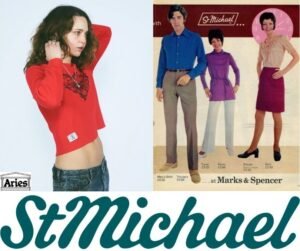
London- Marks & Spencer is not simply bringing back St Michael. Through its collaboration with London streetwear label Aries, the retailer is attempting something more ambitious: turning one of the most recognisable symbols of British high-street fashion into a contemporary cultural asset for a new generation. When Marks & Spencer launches its M&S x Aries St Michael collection on August 20, it will be reviving a name that once represented something very different from fashion hype.
St Michael was introduced by M&S in 1927 and formally registered as a trademark in 1928. The name grew out of M&S’s relationship with Leicester hosiery manufacturer N. Corah & Sons, whose own St Margaret brand had already established a reputation for quality. Simon Marks agreed on St Michael as an alternative name for products supplied directly to M&S. The name also carried a likely personal association with Michael Marks, M&S’s co-founder and Simon Marks’s father.
By the 1950s, St Michael had evolved from a supplier-specific label into the defining own-brand mark of M&S. For the following half-century, it appeared across an extraordinary breadth of merchandise, from clothing and underwear to accessories and homewares. It became less a fashion brand than a guarantee of what M&S wanted British consumers to associate with its products: quality, reliability and value.
Then, in 2000, St Michael disappeared.
The decision was part of a broader attempt to modernise M&S and reposition the retailer. Yet what was discarded by the business gradually acquired a different meaning outside it. As fashion moved towards vintage, archival clothing and resale, St Michael began to look less like an outdated private-label brand and more like an authentic piece of British fashion history.
That reversal is at the heart of the 2026 collaboration.
From supermarket label to resale discovery
The remarkable part of the St Michael story is that M&S did not create the current revival from scratch. The market did.
Younger consumers began discovering older St Michael garments through resale platforms, where pieces from previous decades could be bought as vintage fashion rather than as remnants of an old department-store wardrobe. In 2021, Retail Gazette reported that almost 16,000 St Michael-tagged clothing items were listed on eBay and about 6,000 on Depop, with many pieces selling for relatively modest prices.
British Vogue subsequently identified vintage M&S, particularly St Michael, as an increasingly sought-after category among fashion insiders. eBay’s global fashion leadership pointed to the attraction of M&S’s quality basics and higher-end materials such as leather, cashmere and wool.
That is a significant shift in fashion economics. A label originally designed to communicate consistency and value has acquired cultural value precisely because it was never designed to be fashionable in the contemporary sense.
The resale market has effectively rewritten its meaning.
For older consumers, St Michael can evoke dependable everyday clothing: dresses, knitwear, underwear, coats and menswear bought because they were expected to last. For younger shoppers, the same label can signify authenticity, rarity and an accidental vintage aesthetic.
This generational split creates an unusual opportunity for M&S. It can sell heritage to people who remember it while simultaneously introducing the same heritage to consumers who have discovered it without necessarily understanding its original place in British retail.
The trend has now expanded beyond clothing. A recent Guardian report on the renewed collecting of vintage British shopping bags noted that searches for old supermarket carrier bags rose by 35% in 2026, with M&S’s historic St Michael bag among the objects attracting attention.
In other words, the nostalgia surrounding M&S is no longer confined to garments. Everyday retail ephemera itself is becoming fashion material.
Why Aries?
This is where the collaboration becomes strategically interesting. M&S could have simply relaunched St Michael as a heritage line. Instead, it has chosen Aries, a London label associated with streetwear, outsider culture, graphics and subcultural references.
Founded by Sofia Prantera and graphic artist Fergus Purcell in 2009, Aries grew from Prantera’s background in street culture and her Central Saint Martins training, with influences ranging from London’s rave culture to punk, hand-dyeing, printing and hand-finished garment construction. The business is privately owned and self-funded.
That creative background gives Aries a useful role. It is not being asked to reproduce the past. It is being asked to disrupt it. The resulting 26-piece collection covers womenswear, menswear and accessories, with prices ranging from £10 to £150. Pinstripe tailoring sits alongside striped shirts, ties, tracksuits, hoodies, graphic sweatshirts, knitwear, slip dresses and cardigans. There is even a matching cardigan-and-brief combination.
The collection brings together St Michael crests, the angel motif, Penny Bazaar references, sporting and collegiate imagery and Aries’s own Temple logo. M&S’s familiar visual language is therefore not being preserved behind glass; it is being turned into graphic fashion.
Sofia Prantera’s approach is particularly revealing. Rather than treating M&S’s archive as a catalogue of nostalgic references, she describes the process as taking familiar symbols and rearranging them into something new. The archive provided the raw material; Aries provides the cultural reinterpretation.
That distinction matters- A conventional heritage revival says: remember what we used to be-The Aries collaboration says: this is what that heritage can become now.
The archive becomes a design resource
M&S is leaning heavily into its archive in 2026, but the St Michael project sits within a much wider fashion strategy. The retailer is celebrating a century of fashion with an archive exhibition featuring 100 previously undisplayed pieces, tracing M&S’s fashion history from its early years through to contemporary retail.
More significantly, M&S will make its first London Fashion Week appearance on September 18 with a “see now, buy now” womenswear and menswear collection. The retailer says the show will reinterpret iconic M&S fashion moments in a more elevated and directional way while retaining its emphasis on quality, accessibility and value.
The timing makes the Aries collaboration more than a standalone capsule. It is part of a coordinated attempt to reposition M&S fashion from dependable high-street utility towards cultural relevance.
The company has been pushing trend-led product drops and social-media-friendly fashion while trying to attract younger customers without abandoning its established base. The Guardian reported that M&S has increased its share of national clothing sales to just over 10%, while its fashion strategy has helped shift perceptions among younger shoppers.
The St Michael-Aries collaboration therefore functions almost like a bridge between two versions of M&S-One is the M&S remembered by previous generations-The other is the M&S that wants to participate in contemporary fashion culture.
Making the ordinary collectible
Perhaps the most commercially intriguing object in the collection is not a garment at all. Aries has transformed the familiar M&S green carrier bag into a soft green leather accessory. The retailer is effectively taking an object associated with everyday shopping and elevating it into a fashion collectible. That is a classic fashion-industry manoeuvre: change the context and you change the perceived value.
An ordinary carrier bag becomes a handbag- A discontinued private label becomes a graphic-An old department-store symbol becomes streetwear.
A memory becomes a product.
There is precedent. The source material draws a comparison with Anya Hindmarch’s 2007 “I’m Not A Plastic Bag”, a limited-edition shopping bag created for Sainsbury’s that reportedly sold 20,000 units within an hour.
The commercial lesson is straightforward: fashion does not always create desire by making something unfamiliar. Sometimes it creates desire by making something extremely familiar feel unfamiliar again.
The risk of nostalgia
There is, however, a tension in the strategy.
St Michael was successful because it stood for consistency. Its strongest emotional association is with quality and trust, not experimentation. The Aries interpretation deliberately challenges that.
For a consumer who remembers St Michael as a marker of classic M&S clothing, seeing its symbols placed on oversized streetwear, graphic sweatshirts or a matching brief-and-cardigan set may feel almost contradictory.
But that friction may be precisely the point.
Aries brings cultural credibility with a fashion audience that M&S cannot simply purchase through advertising. M&S, in return, gives Aries access to an unusually rich archive and a mass-market platform.
The partnership consequently operates as an exchange of assets: M&S supplies heritage, scale and recognition; Aries supplies subcultural credibility, design language and contemporary fashion authority.
That is potentially more valuable than either party simply launching another seasonal collection.
St Michael’s second life
There is another reason the revival is significant.
The first modern St Michael comeback in 2021 was relatively cautious. M&S introduced only a small number of menswear pieces carrying the vintage label, including a rugby shirt and sweatshirt. At the time, the retailer was responding to the unexpected popularity of vintage St Michael clothing among younger shoppers.
Five years later, the proposition has changed dramatically.
The label is no longer being tested quietly.
It is being given a designer collaboration, a 26-piece capsule, a broader product mix and a place within M&S’s centenary fashion narrative.
That progression suggests M&S has learned something important from the resale market: heritage does not necessarily have to be preserved unchanged to retain value.
Indeed, in contemporary fashion, the opposite can be true.
The more successfully a brand translates its history into a new cultural language, the more relevant that history can become.
A new formula for the British high street
The deeper significance of M&S x Aries is therefore not simply that an old logo has returned. It is that M&S is experimenting with a new formula for the high street: heritage + collaboration + scarcity + cultural reinterpretation + accessible pricing.
The £10-£150 price architecture is central to that proposition. It creates a fashion entry point far below traditional luxury collaboration territory while retaining the excitement associated with a limited-edition designer project. That approach is particularly relevant at a time when consumers are increasingly comfortable moving between full-price fashion, vintage and resale. M&S itself has now entered resale through an eBay partnership, offering pre-loved clothing, footwear and accessories and extending the lifecycle of its products.
The irony is compelling: M&S is simultaneously monetising its heritage in the primary market and supporting the resale ecosystem that helped make that heritage valuable in the first place.
St Michael’s story has therefore come full circle.
It began as a quality mark attached to mass-market clothing. It disappeared when M&S wanted to look modern. It returned because younger consumers discovered its past. And now it is being redesigned to help define M&S’s future. For a retailer celebrating 100 years of fashion, that may be the most appropriate anniversary statement of all.
St Michael is no longer simply a label from M&S’s past. Through Aries, it is becoming a test of whether British retail heritage can be converted into contemporary fashion currency without losing the quality and accessibility that created its reputation in the first place.
The answer will be visible when the collection reaches M&S stores and online on August 20 — and, potentially, when the same pieces begin appearing on the resale platforms that helped revive St Michael in the first place.