

TCF POST Report
North Carolina State University, Drexel University, Georgia Tech and UMass Lowell have been chosen as core partners in a 10-year Department of War initiative aimed at rebuilding and modernizing textile manufacturing in the United States to support the defense industry. The program, called FutureTEX, includes $36 million in first-year funding and carries a ceiling of $480 million over the next decade.
The initiative brings together industry, government, university and nonprofit partners to advance manufacturing technologies for military and civilian textiles, with a focus on workforce development and the modernization of manufacturing facilities and equipment to strengthen U.S. competitiveness. NC State will spearhead the overall effort, working alongside Drexel, Georgia Tech, UMass Lowell, Gaston College and the nonprofit Industrial Sewing and Innovation Center (ISAIC) as core partners.
A Shrinking Domestic Industry
The initiative responds to a decades-long decline in U.S. textile manufacturing. According to Georgia Tech researcher Sundaresan Jayaraman, who has worked on defense textile issues since the 1980s, nearly 70% of clothing purchased by Americans was once made domestically. That figure has fallen to around 3% amid globalization, shifting trade policy and cheaper overseas labor.
Federal law still requires that all military clothing and textiles be produced domestically, but officials involved in FutureTEX say the erosion of the industrial base threatens more than apparel.
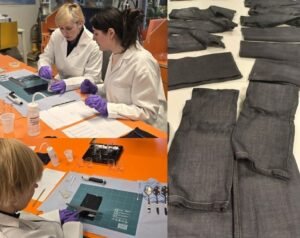
“It’s a matter of national security, economic resilience, and workforce development,” Jayaraman said. “A pair of jeans may seem insignificant in the big picture. But creating durable, reliable pants requires specialized skills and manufacturing expertise. If those skills disappear, the nation risks losing its ability to quickly produce critical equipment for soldiers.”
Textiles used for defense purposes extend well beyond clothing to include carpets, drone composites, parachutes and other military-essential materials.
How the Program Will Be Run
NC State is working with Gaston College to establish a new nonprofit organization that will take over administrative oversight of FutureTEX. That organization will be headquartered at Gaston College’s Kimbrell Campus in Belmont, North Carolina, with regional hubs in:
- Raleigh, North Carolina (NC State)
- Philadelphia (Drexel University)
- Lowell, Massachusetts (UMass Lowell)
- Atlanta (Georgia Tech)
David Hinks, FutureTEX’s chief strategic partnerships officer and dean of NC State’s Wilson College of Textiles, said the goal is to build an ecosystem that doesn’t yet exist.
“FutureTEX is focused on creating a cutting-edge national ecosystem for defense textiles that simply doesn’t exist today,” Hinks said. “This will involve commercializing applied research to help American textile manufacturing meet the needs of both the warfighter and the domestic textile industry.”
The initiative is actively recruiting industry partners and has already drawn well over 100 letters of support from industry organizations.
What Each University Brings
NC State’s Wilson College of Textiles, the only college in North America dedicated exclusively to textiles, will lead overall coordination and commercialization efforts. NC State Chancellor Kevin Howell pointed to the state’s long history with both the military and the textile industry as a foundation for the university’s role.
Drexel University will host the Philadelphia hub at its Center for Functional Fabrics, which operates a 10,000-square-foot manufacturing facility and has supported federal advanced-manufacturing programs for more than a decade. Drexel’s team will develop digital modeling and design tools, including AI-driven design platforms and digital twin technology, and is also developing a passive-energy “Exoskin” technology aimed at preventing injuries during physical activity.
“Drexel embraces new models of innovation that eliminate borders between traditional disciplines,” said Genevieve Dion, director of the Center for Functional Fabrics. “FutureTEX brings together a collaborative group dedicated to securing the future of textiles across the U.S. supply chain.”
Georgia Tech, working through its School of Materials Science and Engineering, will draw on expertise from across campus, including its Manufacturing Institute, Supply Chain and Logistics Institute, and Institute for Robotics and Intelligent Machines. Researchers Jayaraman and Sungmee Park — known for creating the “Smart Shirt,” an early garment that combined textiles and electronics — will lead the university’s efforts, including assessing manufacturers’ capabilities so government agencies can quickly identify companies able to scale production during emergencies.
UMass Lowell will serve as the initiative’s Massachusetts hub, expanding access to its Fabric Discovery Center, which covers the full materials-to-product pipeline — from polymer development and fiber spinning to fabric formation, functional coatings, printed electronics and advanced manufacturing. The university will also contribute workforce-development programs for veterans through its existing Vets RISE initiative.
“Textile manufacturing is deeply woven into the history of Lowell and UMass Lowell, and today we are building on that legacy by helping shape the future of advanced manufacturing,” said UMass Lowell Chancellor Julie Chen.
Looking Ahead
Organizers describe FutureTEX not as an attempt to revive labor-intensive textile mills of the past, but as an effort to build a modern, technology-driven manufacturing ecosystem using automation, AI and advanced materials. Applications are expected to reach beyond clothing into aerospace composites, protective gear for service members, wearable electronics and medical textiles.
“FutureTEX can help rebuild a critical sector and create a stronger, more resilient future for American manufacturing,” Jayaraman said. “Bringing manufacturing and advanced technology back to our country will allow us to train more workers, strengthen domestic supply chains, and ensure the United States remains globally competitive for generations to come.”