
TCF POST Report
VIETNAM — Saitex, a denim manufacturer with operations in Vietnam and the United States, has published its 2025 Impact Report, showing higher fabric output alongside lower electricity, water and carbon intensity at its fabric mill, while several apparel-side metrics and energy-infrastructure issues moved in the opposite direction.
The company, founded in 2001, operates as a group of businesses including Saitex Apparel Manufacturing in Vietnam and the U.S., Saitex Fabric Mill, upcycling unit STELAPOP, employment initiative REKUT and Atelier & Repairs. Its Vietnam operation spans five facilities with a stated capacity of 18,000 pieces per day and around 3,500 jobs; its Los Angeles site provides a smaller manufacturing base. Corporate materials list overall group manufacturing capacity at 6 million garments a year.
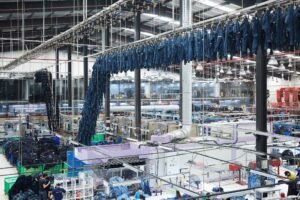
At the fabric mill, production increased 22% in 2025. Over the same period, electricity consumption per metre fell 22%, from 4.0000 kWh/m to 3.1094 kWh/m, and CO₂ emissions per metre fell 20%, from 3.31 kg CO₂e/m to 2.65 kg CO₂e/m. Water consumption per metre fell 9%, to 0.0400 m³ from 0.0439 m³, and waste per metre fell 24%.
The mill’s renewable electricity share held at 64%, including 19% generated by on-site solar; Saitex said it had corrected a prior reporting error that overstated the 2024 solar share. The mill is running at roughly 75% of capacity, and the company’s target is 100% renewable electricity there by 2030.
Results at the apparel operation were mixed. Waste per garment fell 6.67%, from 0.90 kg to 0.84 kg, which the company attributed partly to new enzymatic formulations used alongside existing stone alternatives, while production declined only 0.54% over the same period. Water use per garment rose 6.99% and wastewater discharge rose 5.8%, which Saitex attributed to an RO-filter upgrade and increased demand for garment-dyed and vintage-washed styles. Steam consumption per garment rose 18.2% and gas consumption rose 2.13%, driven by a shift toward garment dyeing, heavier fabrics and 3D or coating effects.
On water infrastructure, Saitex is building a staged closed-loop wastewater system, with the first module designed to return 60–70% of treated water to production and the remainder sent for further treatment at the industrial park. The company said the module’s start has been delayed from a planned November 2025 date to mid-2026 because of permitting and construction, and it is targeting 60% recycled water for mill production by 2027.
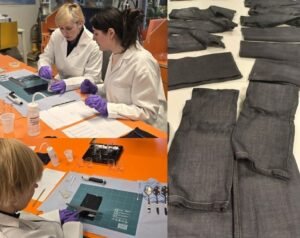
On waste, 94% of material at the mill was recycled in 2025 — fabric waste converted into carpets, and fiber and yarn waste processed into new open-end yarns — with 4% incinerated and 2% sent to landfill. About 40% of sludge from the apparel operation was repurposed into bricks for garden walkways and concrete retaining blocks. Sister company STELAPOP converted 8,086 kg of denim offcuts into 600 boards during 2025, used for furniture at Barneys New York in Ginza and at Keio University, and for promotional materials for Mercedes-Benz.
Saitex has produced Cradle to Cradle Certified® Gold denim garments since 2019, initially for G-Star RAW and, since 2023, for Polo Ralph Lauren; its mill is also a bluesign® System Partner. Certified production volumes declined in 2025 — Cradle to Cradle Gold Material Health production fell 60% and bluesign-certified production fell 30%, which the company attributed to lower purchasing demand. Saitex said about 85% of its denim fabric production aligns with the chemistry requirements for those certifications regardless of certified order volume.
The company has conducted life-cycle assessments since 2019, extending the practice to its fabric mill in 2022. By July 2025, it said 100% of apparel and mill production data had been migrated to the Made2Flow platform. The average share of primary data underlying fabric LCAs at the mill reached 78%; for garments, the figure was 62%, which the company attributed partly to nominated fabric suppliers not always providing exact production data.
Saitex also flagged unresolved constraints. The mill’s steam supply still depends on an industrial park sludge boiler it does not control. The company said it lacks battery storage at its industrial park, limiting its ability to capture excess solar generation, which reportedly peaks near 100% at midday but falls to 25–30% in the early morning and evening; Saitex said it had obtained storage-system quotes but found them too costly to pursue independently, and that access to Direct Power Purchase Agreements remains difficult for a company of its size.
On the social side, Saitex’s REKUT initiative, which focuses on employment for people with disabilities, spent 2025 building a network of 21 partner organizations — including NGOs, state-affiliated associations, orphanages and vocational centres — ahead of a planned 2026 rollout at mill departments. The Clean Water Project — Anh Chị Em completed six wells in the Tra Bong District in 2025, with five more planned after Tết 2027. The company’s on-site regenerative farm produced 6,518.9 kg in 2025, up 295.8% year-on-year, entirely donated to employees. Following the January 2025 Los Angeles wildfires, Saitex launched Forever L.A., a 28-piece upcycled capsule made with partners Save Khaki, EDWIN USA and Atelier & Repairs, with 100% of proceeds directed to five wildfire-relief organizations.
The 2025 report ties Cradle to Cradle-certified production to G-Star RAW and Polo Ralph Lauren, and separately identifies Ralph Lauren as a Vietnam apparel customer that included Saitex in an independent living-wage study during the year. Outside the report, Saitex has previously been publicly linked to brands including Madewell, Everlane, J.Crew, Zara, Target, Eileen Fisher, Outerknown, Calvin Klein Jeans, Tommy Hilfiger, American Eagle and Gap; a 2024 FashionNetwork profile specifically cited Madewell, G-Star RAW, Everlane and Polo Ralph Lauren. The impact report itself does not publish a complete current customer roster.
In the U.S., Saitex operates what it calls a 90/10 model, with roughly 90% of production based in Vietnam and 10% in Los Angeles. In a 2025 white paper, the company argued that targeted incentives, rather than tariffs alone, would be needed to expand U.S. apparel manufacturing employment while preserving the cost position of its Vietnam operations.
Saitex became the first certified B Corp factory in Asia in 2019, according to Forbes, at a time it was described as the only large-scale denim manufacturer to hold B Corp certification. In its Asia-focused The Business of Doing Good report, Economist Impact included Saitex among 12 companies it identified as “Trust Builders,” citing the company’s technology-based transparency and traceability practices.
Saitex’s stated targets include 100% renewable energy in apparel manufacturing by 2028, 100% renewable energy at the mill by 2030, expanded closed-loop water recycling, and higher utilization of existing mill capacity. The company has said the storage, boiler-dependency and power-purchase-agreement issues identified in the report are largely infrastructure and policy constraints outside a single factory’s control.