

South Korean Fashion Giant Targets $2.2B in International Sales Within Five Years
TCF POST Special Report
SEOUL — South Korean fashion platform MUSINSA is turning Southeast Asia into a major front of its international expansion, combining rising demand for K-fashion with local retail partnerships, offline stores and rapidly growing cross-border e-commerce.
The strategy marks a shift from MUSINSA’s roots as Korea’s leading online fashion platform toward becoming an international fashion operator and distribution ecosystem for Korean brands. Its Southeast Asian push now covers Vietnam, Indonesia and the Philippines, with Thailand identified as another expansion market. Japan and China are emerging as the two principal pillars of its overseas business.
Southeast Asia becomes the next major expansion zone
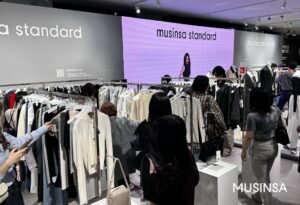
Vietnam is a key priority. MUSINSA has partnered with ACFC (Au Chau Fashion and Cosmetics Co.), a subsidiary of Imex Pan Pacific Group (IPPG), under an exclusive distribution agreement to develop MUSINSA STANDARD. IPPG operates more than 1,200 stores and manages more than 100 global brands in Vietnam, while ACFC operates more than 280 stores with 28 global fashion brands.
The opportunity is already evident online: transaction volume in MUSINSA Global Store’s Vietnam business increased about 40% annually on average between 2023 and 2025.
Indonesia is another major target. MUSINSA has partnered with PT Mitra Adiperkasa (MAP), the country’s largest retail group, which operates more than 4,000 stores across over 80 cities and represents more than 150 global brands. With a population of about 280 million, Indonesia is Southeast Asia’s largest consumer market. MUSINSA’s online transaction volume there rose approximately 70% year on year in the first half of the year, strengthening the case for offline expansion.
The Philippines represents a third growth market. MUSINSA has partnered with ACX Holdings, an Ayala Group distribution platform, and plans to establish offline operations beginning with a MUSINSA STANDARD store at Glorietta in Makati. Transaction volume in the Philippines increased about 50% annually on average from 2023 to 2025.
Thailand is also on the broader roadmap, turning the Southeast Asian strategy into a multi-market regional network rather than a series of individual launches.
Japan and China provide the proof point
Japan has emerged as MUSINSA’s strongest overseas market. Transaction volume increased 145% year on year in 2025, while monthly sales surpassed ₩10 billion for the first time in October. Pop-up stores launched since 2023 have helped the company test consumer response and connect its digital customer base with physical retail.
China has provided another strong signal. Two MUSINSA stores in Shanghai attracted more than 100,000 visitors in 26 days. The company plans additional stores in China and a MUSINSA location in Japan, indicating a shift from marketplace-led exporting toward direct retail operations.
These markets are also giving MUSINSA experience in localisation, merchandising, store formats and integrating online and offline demand—knowledge that can support its Southeast Asian rollout.
Local partnerships lower the barriers
A defining feature of MUSINSA’s regional strategy is its reliance on established local partners rather than building distribution networks from scratch.
In Vietnam, ACFC/IPPG brings fashion distribution and retail expertise; in Indonesia, MAP provides a nationwide retail network and experience managing global brands; and in the Philippines, ACX Holdings connects MUSINSA with Ayala Group’s established distribution infrastructure.
The model enables MUSINSA to localise assortment and marketing while retaining control of its K-fashion proposition.
Exporting an ecosystem, not just clothes
MUSINSA’s international opportunity extends beyond its own MUSINSA STANDARD products. The company connects more than 10,000 Korean fashion brands through its broader platform, giving independent and emerging labels access to consumers and distribution channels that would otherwise be difficult to establish individually.
That positioning reflects MUSINSA’s evolution from a sneaker-focused online community founded in 2001 into a fashion-content platform, marketplace and broader fashion ecosystem. It now serves more than 16 million members and connects consumers with more than 10,000 brands.
Beauty adds another growth engine
Beauty is becoming an additional component of MUSINSA’s international strategy. Overseas transaction volume in its beauty business increased 161% in 2025, according to the Korea Herald report. Its private-label beauty brand Oddtype, which began overseas expansion in Japan in 2024, has since entered Malaysia, Vietnam and Singapore, with the United States and Australia planned.
The move broadens MUSINSA’s proposition from fashion into beauty and lifestyle, while creating additional routes for Korean brands to reach international consumers.
Financial strength backs the expansion
The international push is supported by a significantly larger domestic business. MUSINSA recorded consolidated 2024 GMV of $3.29 billion, revenue of $907 million, operating profit of $75 million and net income of $51 million. Q1 2025 revenue reached $212.3 million, up about 12.6% year on year, while operating profit rose 24% to $12.8 million and net income more than doubled to $11.4 million.
More recent figures point to continued acceleration. Consolidated 2025 revenue reached ₩1.4679 trillion, up 18.1%, while operating profit rose 36.7% to ₩140.5 billion. In Q1 2026, revenue reached ₩363.6 billion ($242 million), up 24.1%, while exports surged about 11.9 times year on year to ₩15.3 billion.
The export growth is particularly significant because it indicates that international business is becoming a more visible contributor to MUSINSA’s overall expansion.
Global business to cross $170 million
MUSINSA’s international business has expanded rapidly. By early 2026, cumulative global sales had reached approximately ₩240 billion ($170 million), with sales growing roughly threefold annually. Its global operation spans 13 regions, features more than 4,000 Korean fashion brands and has generated cumulative sales of more than three million items.
The company launched its Global Store in 2022, but overseas growth has accelerated as Korean fashion gains international recognition. Its strategy is also moving beyond online transactions into physical retail, converting digital demand into more durable local brand presence.
Building a scalable K-fashion model
MUSINSA’s Southeast Asian strategy is therefore more than a retail rollout. It is building a repeatable model linking Korean brands, its digital platform, local distribution partners, physical stores, consumers and cross-border repeat purchases.
Southeast Asia is well suited to the strategy, combining strong Korean cultural influence with young consumers, expanding middle-class spending and growing digital commerce.
Vietnam, Indonesia and the Philippines are consequently not simply new sales territories; they are test markets for MUSINSA’s wider ambition to build global infrastructure for K-fashion.
From Korean platform to Asian fashion powerhouse
MUSINSA’s international trajectory increasingly resembles that of a regional fashion infrastructure company rather than a conventional Korean retailer.
Japan has demonstrated the potential of its cross-border digital model, China is testing its ability to build physical retail at scale, while Southeast Asia offers a combination of youthful consumers, rising middle-class demand and strong Korean cultural affinity. Beauty adds another avenue for international engagement.
The next challenge is scale. MUSINSA must demonstrate that the consumer response seen in Japan and China can be replicated across highly diverse Southeast Asian markets without compromising profitability or operational discipline. Its use of major local partners suggests an effort to reduce execution risk.
If successful, MUSINSA could offer a new model for Korean fashion’s internationalisation—not simply exporting individual labels, but building an ecosystem through which K-fashion reaches Asia and, ultimately, the wider global market.