

TCF POST Report
The latest import data from the Office of Textiles and Apparel (OTEXA) reveals a significant shakeup in the US fashion supply chain. Rather than a minor, seasonal blip, American brands are fundamentally restructuring where their clothes are made.
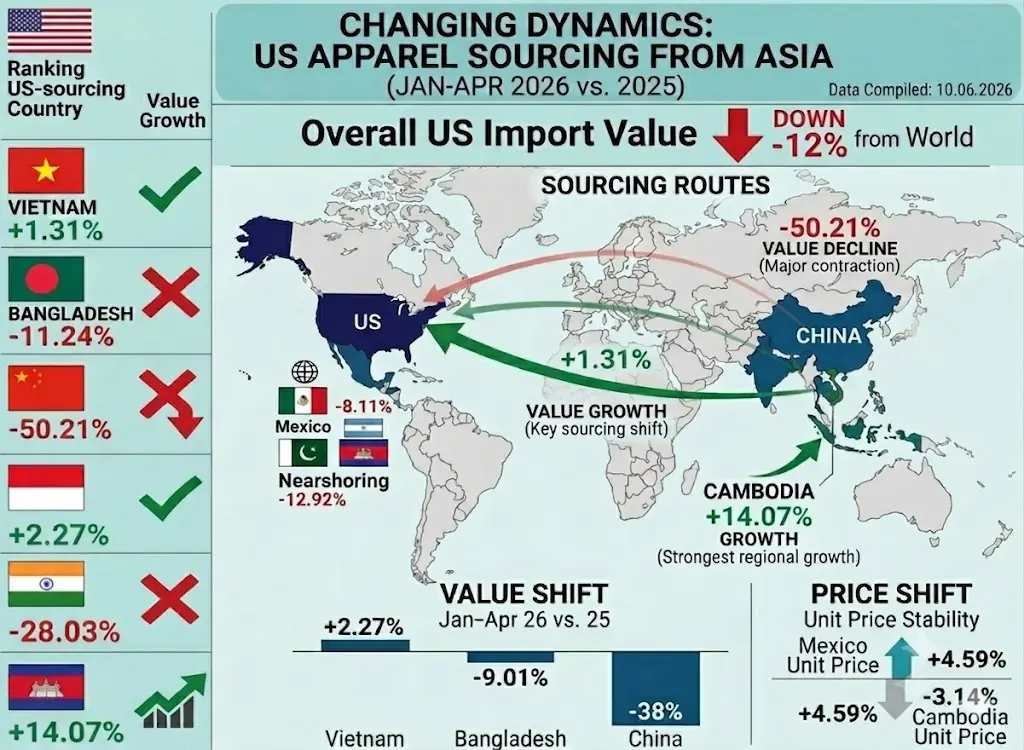
As total global apparel imports to the US dropped by 12% in the first four months of the year to $23,077.49 million, the dynamics are changing for Asian apparel manufacturing sources.
While traditional giant China faces pullbacks, the resilient Vietnam continues gaining. Among other Asian alternatives, Indonesia and Cambodia are increasing their market shares. Unexpectedly, Bangladesh, India, and Pakistan are facing fresh troubles with declines in shipments to the US market.
The Great China Retreat Acceleration
The most dramatic story in the data is the ongoing, aggressive retreat from China. US brands are actively unwinding their reliance on Chinese factories, with cumulative export values slashed exactly in half—down 50.21% to $2,174.87 million for Jan–Apr.
The monthly data for April highlights just how steep this drop has become:
- Shipment values plummeted 36.48% to $484.01 million.
- Volume tanked by 28.41% to 344.30 million SME.
- Unit prices dropped 11.28% to $1.41/SME as factories tried—and failed—to retain buyers with cheaper rates.
Vietnam Emerges as the New Anchor
While China stumbles, Vietnam has officially solidified its status as the primary stabilizer for major US apparel brands. Defying the broader global decline, Vietnam’s cumulative four-month export value actually grew by 1.31% to $5,155.87 million, with volume expanding by 2.69%.
In April, Vietnam comfortably outpaced both China and Bangladesh in total value ($1,186.86 million), absorbing the market downturn with remarkable resilience while maintaining a healthy unit price of $3.41/SME.
Unanticipated Headwinds for South Asia
The market squeeze has also caught up with major South Asian suppliers, who are now facing double-digit contractions.
Bangladesh
Long a critical partner for US apparel, Bangladesh saw its steady upward trajectory stumble.
- April: Export value fell 17.21% to $627.00 million, and volume decreased by 16.54%.
- Jan–Apr: The cumulative numbers show a slightly milder but steady downward trend, with export values dropping 11.24% to $2,646.24 million.
India & Pakistan
South Asian neighbors faced an even steeper uphill battle as buyers pulled back due to shifting cost dynamics.
- India: April value plunged by 30.39% ($342.64 million), bringing its year-to-date cumulative value down 28.03%.
- Pakistan: Suffered a parallel trajectory, with April value dropping 29.46% to $141.77 million and cumulative four-month value down 12.18%.
The Outliers: Cambodia and Indonesia Win on Volume
In stark contrast to the widespread regional slump, Cambodia and Indonesia have found a winning playbook. Both nations successfully captured fresh market share by offering aggressive volume growth and competitive pricing to keep their factories busy.
| Country | April Value Growth (YoY) | April Volume Growth (YoY) | April Unit Price | Unit Price Change |
| Indonesia | +11.60% ($417.78M) | +16.26% (107.55M SME) | $3.88 | -4.01% |
| Cambodia | +4.38% ($316.84M) | +17.47% (112.82M SME) | $2.81 | -11.14% |
Cambodia’s strategy has been particularly aggressive. By slashing its unit prices by 11.14%, it highly incentivized US buyers. This low-pricing strategy paid off over the four-month window, supercharging Cambodia’s cumulative export value by a staggering 14.07% ($1,404.19 million).
Indonesia followed a steadier but highly successful path, enjoying a 2.27% increase in cumulative value ($1,637.69 million) while maintaining a more premium unit price point.
The Bottom Line
The American apparel landscape is undergoing a permanent realignment. US brands are rapidly moving away from China and selectively shifting orders to stable regional players like Vietnam, or price-competitive alternative hubs like Cambodia and Indonesia. For manufacturers across Asia, the message is clear: flexibility, pricing strategy, and stability are the new keys to surviving the US market