

TCF POST Analysis
For decades, international sportswear brands viewed China primarily as a manufacturing powerhouse. Today, that narrative has been flipped on its head. As global giants report explosive growth, China has cemented its status as the most critical engine of their revenue strategies—a laboratory where the world’s most successful brands are redefining themselves as premium lifestyle retailers.
A convergence of rising consumer demand for premium technical apparel and surging participation in outdoor and racket sports has seen companies like On Holding, Amer Sports, Asics, and Yonex post record-breaking financial results.
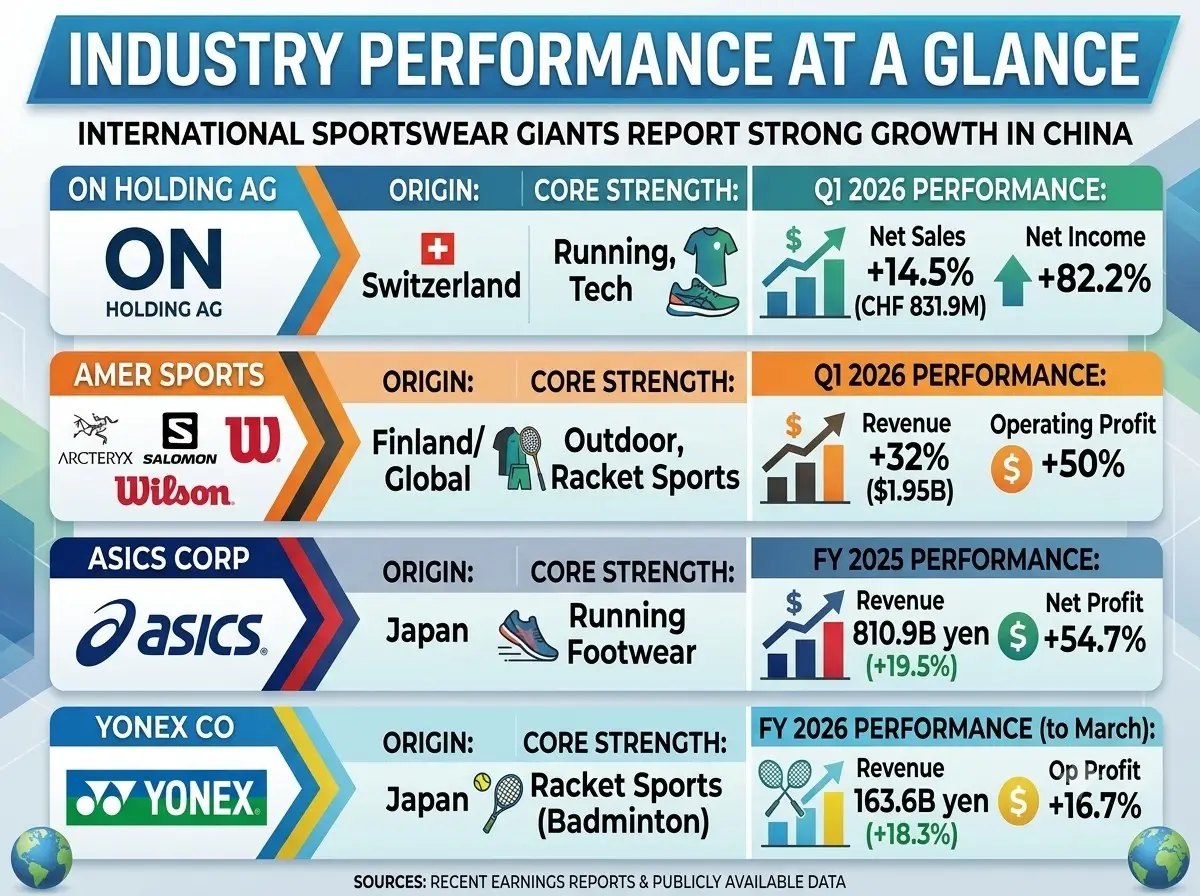
Industry Performance at a Glance
- On Holding AG: Based in Switzerland, the company achieved a 14.5% increase in net sales and an 82.2% surge in net income in the first quarter of 2026, underscored by its focus on running footwear and performance technology.
- Amer Sports: Representing brands like Arc’teryx and Wilson, the company reported a 32% rise in revenue and a 50% increase in operating profit for the same period, bolstered by its strength in outdoor and racket equipment.
- Asics Corp: In Japan, the company recorded an impressive fiscal year 2025, with revenue climbing 19.5% and net profit growing by 54.7% through its emphasis on performance running footwear.
- Yonex Co.: The company saw its revenue rise by 18.3% for the fiscal year ending in March 2026, maintaining its dominance in the badminton market.
The Strategic Shift in China
While these brands maintain strong global footprints, their performance in China is outpacing other regions, signaling a structural shift in approach.
- On Holding AG: Asia-Pacific sales jumped 44.4%, now accounting for over 20% of total revenue. Notably, the brand’s apparel penetration in China has reached 30%—far exceeding its 6% global average—reflecting a Chinese consumer appetite for high-margin, high-tech fashion.
- Amer Sports: Betting heavily on the “premium outdoor” trend, the company is rapidly expanding its store network, with plans for dozens of new Arc’teryx and Wilson locations across top-tier Chinese cities this year.
- Asics: The brand is focusing on localization, utilizing China-exclusive colorways and limited-edition product drops to capture a larger share of the performance running market, where they see significant “room for expansion”.
- Yonex: For this manufacturer, China is the undisputed heart of its badminton business. With badminton accounting for more than 60% of total brand sales globally, the company leverages grassroots marketing programs to solidify its dominance in racket sports.
Comparative Market Dynamics
- Premiumization vs. Volume: Unlike global markets, where competition is often focused on price-cutting and volume, the Chinese market is proving exceptionally lucrative for brands that position themselves as premium and technical. Amer Sports’ gross margins in China, bolstered by its direct-to-consumer (DTC) store strategy, demonstrate that Chinese consumers are increasingly willing to pay a premium for high-quality gear.
- Apparel as an Entry Point: In markets like the U.S. or Europe, a brand’s fame might rest solely on footwear, but in China, brands are successfully using apparel as a primary entry point. On Holding’s success highlights how firms are rebranding as “lifestyle-performance” hybrids to capture the Chinese middle class.
- Technical Dominance: While major players battle for the mass market, specialized brands like Yonex and Arc’teryx are winning by owning specific sub-categories. These segments provide higher barriers to entry and stronger brand loyalty than general lifestyle sportswear.
The “China-for-China” Strategy
To succeed in the Chinese market, international giants have moved beyond selling “global” products, adopting a “China-for-China” strategy. This involves localized product development, specialized retail, and digital integration that differs from their operations in North America or Europe.
1. Hyper-Personalization
International brands are actively tailoring offerings to local tastes.
- China-Exclusive Editions: Brands like Asics and Under Armour create region-specific colorways and limited-edition launches to align with local cultural aesthetics and build “prestige” among collectors.
- Tailored Fits and Needs: Brands like Nike have introduced products specifically for the Chinese market, such as apparel lines engineered for local women’s fitness preferences.
- The “Test and Chase” Model: Companies use data-driven insights to quickly test new product features in specific Chinese cities before a broader rollout, allowing them to respond to trends with agility.
2. From Sales to “Experience”
In China, stores have evolved into “Community Hubs” rather than purely transactional spaces.
- Premium Flagships: Brands are pivoting toward high-end, ground-floor locations in major shopping centers (like Shanghai’s Grand Gateway 66) to offer a luxury-retail experience.
- Interactive Environments: Under Armour’s “smart community spaces” serve as examples of blending retail with multimedia technology, allowing customers to engage with the brand’s spirit.
- Omnichannel Integration: Brands have upgraded their digital infrastructure to ensure mobile apps, livestream shopping, and in-store inventory are fully synchronized, creating a frictionless path to purchase.
3. Digital Ecosystems and Grassroots Marketing
Digital marketing in China operates within a unique ecosystem (e.g., WeChat, Douyin, Little Red Book).
- Livestreaming: This is a vital sales channel, with brands using live streamers to showcase products and answer consumer questions in real-time.
- Grassroots Community Building: Yonex and others invest in local clubs and amateur events to build long-term relationships with the local sports community rather than relying solely on global celebrity endorsements.
- Esports and Local Culture: Recognizing the influence of Gen Z, brands are partnering with local gaming influencers and integrating marketing with local lifestyle trends to remain relevant.
China is No Longer Just a Manufacturing Hub
As global sportswear and sport-goods giants continue to report double-digit growth in the region, the industry consensus is clear: China is no longer just a manufacturing hub or a secondary sales region; it is the laboratory where the world’s most successful sportswear brands are testing their future as premium lifestyle retailers.