


TCF POST Analysis
In the global apparel landscape, the distance between an $18 pair of jeans and the rarefied atmosphere of a luxury fashion house is usually measured in decades of brand equity and thousands of dollars in markups. However, as GU—the younger, bolder sibling of Uniqlo—celebrates its 20th anniversary, it is attempting to collapse that distance entirely.
By appointing former Marni creative director Francesco Risso as its new Creative Director, GU is not merely engaging in a routine marketing stunt; it is conducting a radical experiment in democratic design. Is this GU’s attempt to balance high-fashion aspirations with the realities of global mass-market retail?
Beyond the Coating of Marketing
Viewing GU’s new direction as a superficial marketing campaign may miss the strategic shift occurring beneath the surface. While traditional collaborations often function as transient “hype” generators, GU is treating the luxury-to-mass-market pipeline as a repeatable business model.
Industry strategist Achim Berg noted this mission as a calculated attempt to test the limits of how far a mass-market brand can be “elevated”. By integrating Risso’s “luxury logic”—a rigorous approach to narrative, craft, and original vision—GU is attempting to transform these design principles into a permanent quality signal for the consumer.
Freedom vs. Function
The goal of GU, according to its leadership, is to evolve from a follower to a global brand that resonates on an emotional level. Tadashi Yanai, Chairman and CEO of Fast Retailing, has identified GU as the “key driver” for the group’s next phase of growth.
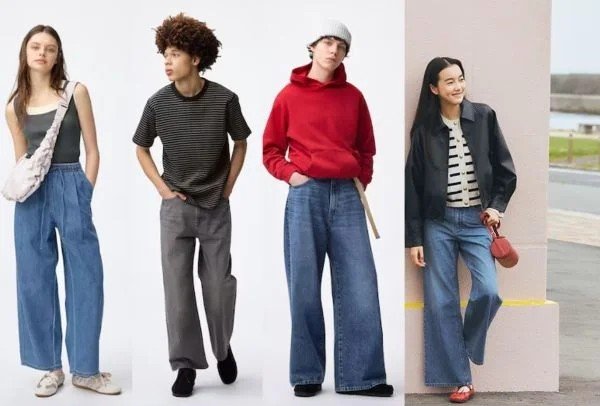
For the brand, the mission is twofold: a pivot from function to expression. GU President Tomokazu Kurose emphasizes that the new collections balance “expressive design with a high level of refinement,” aimed at surprising customers with price points that seem incongruous with the quality of the aesthetic.
Francesco Risso himself frames this as a “conversation” rather than a commercial transaction. By designing clothing that is “grounded and accessible, yet also leaves space for imagination,” Risso is attempting to define a new wardrobe reality: one where everyday utility does not preclude individual expression.
Why the Industry is Betting on Denim
The current industry-wide obsession with denim collaborations—ranging from Gap’s partnership with Hailey Bieber and Harlem’s Fashion Row to Levi’s experimental couture fusion with Christelle Kocher—reveals a broader shift in fashion dynamics.
The denim collaboration is the industry’s “great equalizer”. As a wardrobe staple, denim provides a blank, universal canvas that is both instantly recognizable and infinitely malleable. For luxury designers like Kocher or Risso, working with denim is an exercise in “Couture-à-Porter,” where the challenge is to infuse the mass-produced garment with the soul of high fashion. For brands like GU and Gap, these collaborations serve as a vital tool to generate “Cultural Currency” to help brands move beyond commodity pricing and mitigate the “expectation gap,” as brands can signal quality to a consumer base that is increasingly savvy about aesthetics.
The Verdict: A High-Stakes Evolution
GU’s move is not without risk. Whether this “luxury talent” can truly translate into a repeatable value model will be determined in the next few quarters.
However, if GU succeeds, it will have successfully proven that “freedom”—the very meaning of the brand’s name—can be engineered. It is a bold bet that the future of fashion will not be found in the exclusivity of the runway, but in the ability to make the luxury experience a daily, accessible reality for the masses.