

TCF POST Report
DHAKA, Aug. 10, 2026 — A new study by researchers from Bangladesh, Japan and Norway has demonstrated a route for converting jute fiber into a high-performance cellulose-based biocomposite, opening a potential new value-addition pathway for Bangladesh’s natural-fiber industry and broader sustainable-materials sector.
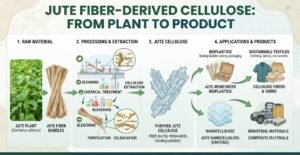
Published in Scientific Reports, the research developed films from jute fiber-derived cellulose (JFC), biodegradable polybutylene succinate (PBS) and small quantities of titanium dioxide (TiO₂) nanoparticles. The findings show how jute can be processed beyond conventional fiber applications into engineered cellulose materials with improved mechanical, water-resistance and biodegradation properties.
Jute is particularly attractive for such applications because it is a renewable, relatively low-cost natural fiber widely produced across South and Southeast Asia. The study notes that jute typically contains 59–72% cellulose, making it a suitable feedstock for cellulose-based composites, films and other higher-value materials.
From jute fiber to engineered material
The researchers extracted cellulose from raw jute through an alkaline peroxide treatment, recovering approximately 650 grams of cellulose from 1 kg of raw jute, equivalent to about 65% cellulose recovery. The extracted cellulose was subsequently processed into films and combined with PBS and TiO₂ to improve functional performance.
The technology delivered a substantial improvement over uncoated jute-cellulose films. While the uncoated material recorded tensile strength of about 8.2 MPa, the best-performing composite, containing 0.5 mg of TiO₂, achieved a Young’s modulus of 0.33 GPa, ultimate tensile strength of 33 MPa and elongation of 19.7%.
| Jute-cellulose composite | Performance |
| Young’s modulus | 0.33 GPa |
| Tensile strength | 33 MPa |
| Elongation at break | 19.7% |
| Water contact angle | 87.6° |
| Biodegradation | Up to 73% after 45 days |
PBS coating also increased the material’s water contact angle to 87.6°, improving resistance to immediate wetting and indicating potential for flexible packaging and other applications requiring improved water resistance.
Why the research matters to textiles
Although the experiment itself focuses on cellulose films and biocomposites rather than finished textile fabrics, its implications extend into the natural-fiber and textile value chain.
The research points to a shift from treating jute primarily as a conventional natural fiber toward using its cellulose as a higher-value engineered material. The paper also cites research into cellulose nanocrystals from jute fibers and by-products, natural-fiber composites and chemical modification of lignocellulosic textile fabrics.
This creates a potential bridge between jute cultivation, fiber processing, textile manufacturing, chemical processing and advanced materials. For Bangladesh, such a pathway could help move part of the jute industry from commodity-oriented natural-fiber products toward higher-value cellulose-based materials.
The textile connection also extends to circularity. The cited literature includes work on converting post-consumer cotton textiles into bio-based packaging materials, suggesting a broader opportunity to connect cellulose-rich natural fibers and textile waste with emerging circular-material applications. However, these cited studies are background research rather than experiments conducted in the present paper.
Sustainability potential remains promising but unproven
The composites demonstrated encouraging biodegradation performance. Samples containing 1.0 mg and 2.5 mg of TiO₂ reached 62% and 73% biodegradation, respectively, after 45 days under controlled aerobic composting conditions.
The researchers, however, caution against interpreting these results as proof of full commercial biodegradability. The 45-day test does not establish compliance with the EN 13432 benchmark of 90% biodegradation within 84 days.
The study also stops short of claiming that the material is ready to replace conventional plastics commercially. Further research is needed on thermal properties, water-vapor and oxygen transmission, barrier performance, antibacterial and UV-blocking properties and full life-cycle assessment.
Bangladesh jute sector gains a potential new value chain
The research used jute obtained from Latif Bawany Jute Mills in Dhaka and involved Bangladesh Jute Mills Corporation, the Ministry of Textiles and Jute, Mawlana Bhashani Science and Technology University and research institutions in Japan and Norway.
For Bangladesh’s jute sector, the significance therefore extends beyond developing another jute-based product. The research points toward potential value chains around cellulose extraction, functional fiber modification, biodegradable polymers and bio-based composites.
The approach is also aligned with biomass valorization, circular-economy and bioeconomy principles, according to the study.
For the textile industry, this could eventually mean a broader role for jute cellulose—not only as a source of conventional natural fibers but also as a feedstock for advanced sustainable materials.
The immediate commercial opportunity remains to be proven. But the research strengthens the case for positioning Bangladesh’s jute sector at the intersection of natural fibers, sustainable textiles, circular materials and advanced bio-based manufacturing.