
TCF POST Report
The International Apparel Federation (IAF) has stated that the apparel industry’s greatest losses occur not primarily in manufacturing costs, but in systemic inefficiencies—including overproduction, excess inventory, markdown cycles, lost capital, and operational friction across supply chains.
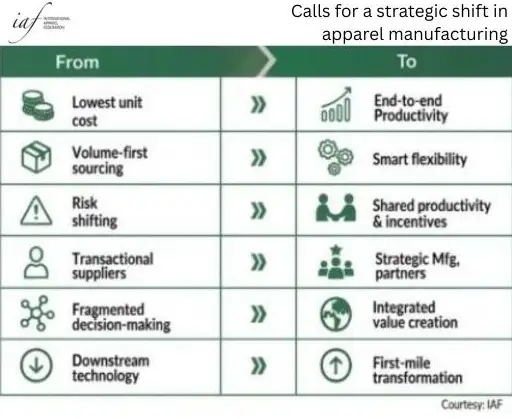
The IAF Business Innovation Committee (BIC), in its newly launched manifesto, points out that the industry faces growing pressure from market volatility, digital transformation, sustainability requirements, and evolving business models. Consequently, the “Manifesto for Smart, Productive and Sustainable Apparel Manufacturing” calls for a fundamental shift from traditional lowest-unit-cost sourcing toward end-to-end productivity, capital efficiency, resilience, and smarter supply chain collaboration.
“The future competitiveness of apparel manufacturing will depend on the ability to align production more closely with demand, reduce inventory risk, and create value through smarter, more collaborative systems,” said Matthijs Crietee, Secretary General of the IAF.
Cem Altan, Immediate Past President of the IAF, added that because the industry is currently under pressure from multiple directions, incremental improvements are no longer enough.
Core Concepts of the Manifesto
A central concept of the Manifesto is smart flexibility—the capability to align production, planning, information, and incentives more closely with real demand. The document highlights the growing importance of:
- Postponement strategies
- Upstream technology applications
- Integrated textile-apparel collaboration
- New commercial models that better align incentives across the value chain
The Manifesto also emphasizes the strategic role of manufacturers as orchestrators of flexibility and value creation, rather than as interchangeable suppliers operating under purely transactional relationships.
Three-Phase Implementation Framework
To support implementation, the Manifesto introduces a practical framework based on three phases:
- Define – Establish a shared direction and core principles.
- Enable – Advance pilots, demonstrations, experimentation, and implementation.
- Standardize – Build a common language, unified metrics, and scalable industry practices.
This initiative builds on the IAF–ITC study, Under the Banyan Tree: Buyers and Suppliers in Fashion, and adopts the 5C Framework—Contracts, Capital, Capacity Building, Commons, and Creator Market—as a lens for collective action.
Conclusions and Driving Collective Action
The Paradigm Shift: The industry must transition away from a reliance on the lowest unit cost and move toward end-to-end productivity, capital efficiency, and resilience.
Defining Total System Productivity: This requires shifting production closer to demand in timing and, where relevant, geography to lower inventory risk. Smart flexibility acts as a design principle that restores profitability by improving forecast responsiveness over time.
The Role of Manufacturers: Manufacturers must be viewed as orchestrators of flexibility, productivity, and value creation rather than interchangeable suppliers.
Upstream Technology Migration: Technology for smart flexibility is moving upstream, embedding higher productivity across supply chain partners through stronger planning, forecasting, and operational coordination.
SME Inclusivity: Small and medium-sized manufacturers are essential to industrial capability, innovation, entrepreneurship, and inclusive transformation.
Textile-Apparel Integration: Industrial productivity requires stronger integration between the apparel and textile manufacturing sectors, recognizing that downstream prosperity begins upstream through aligned goals, integrated planning, and shared purpose.
The Path Forward: The IAF will advance this industry agenda through its committees, partnerships, and initiatives, using the 5C framework to guide collective learning and adoption.
The IAF invites manufacturers, brands, textile producers, technology providers, investors, policymakers, and industry associations to engage with the Manifesto and contribute to the transition toward smart, productive, and sustainable apparel manufacturing.
As the global federation of apparel manufacturers, brands, and their associations, the IAF represents the apparel industry across more than 40 countries. Through industry dialogue, partnerships, and collaborative initiatives, it works to strengthen the competitiveness, sustainability, and resilience of the global apparel sector.