

TCF POST Desk
HANOI — Despite earning $18.8 billion in exports (a 5.6% YoY increase) during the first five months of 2026, Vietnam’s apparel sector is actively ditching ruinous price wars to prepare for a volatile second half of the year, as they see the period and later global market will remain volatile and changing.
The Vietnam Textile and Apparel Association (VITAS) has directed members to strengthen long-term systemic defenses by weaponizing “non-price competitiveness.” This means aggressively climbing the value chain away from simple assembly toward high-margin, high-intellect business models like FOB (Free on Board) and ODM (Original Design Manufacturer).
Short-Term Strategy: Action Plan for H2 2026
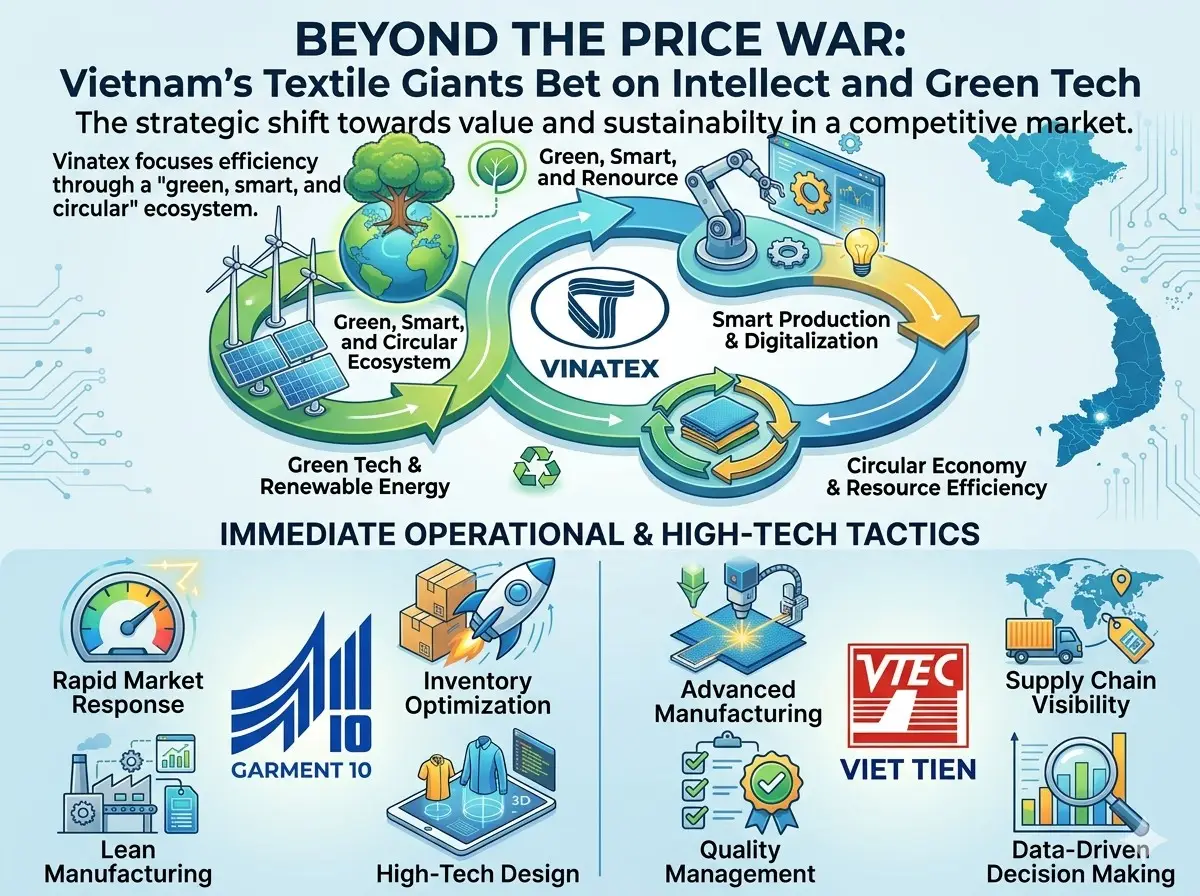
To survive the year-end crunch and manage abrupt market contingencies, industry heavyweights like Garment 10 and Viet Tien are deploying immediate operational and high-tech tactics:
- Immediate Deliveries: The absolute top priority is completing July and August 2026 sea freight orders on time and with the right quality.
- The Q4 Race: Actively racing to secure Q4 2026 orders amid a highly variable market.
- AI & Agile Manufacturing: Integrating AI into supply chain management to optimize operating costs on the fly. This agility allows automated facilities to rapidly recalibrate assembly lines to handle small-batch, high-complexity orders with the ultra-short production lead times demanded by European and American buyers.
Long-Term Strategy (2026–2030): Deep Efficiency & ESG
Vinatex, the country’s leading state-owned textile group, is abandoning sheer volume growth to focus on in-depth efficiency through a “green, smart, and circular” ecosystem:
- Carbon Tracking & Clean Energy: Implementing carbon footprint measurements for ESG compliance and investing in rooftop solar to cut grid dependence.
- Automation & Smart Factories: Deploying automation apps to drive precision and factory-floor output.
- ESG Compliance: Subsidiary units like Hoa Tho, Det May Hue, and Phong Phu are systematically building smart-factory models to satisfy the strict ESG mandates of global Western brands.