

TCF POST Report
Kumasi, Ghana: Compliance with international labour, safety and environmental standards has evolved from a regulatory obligation into a key competitive advantage for apparel-exporting countries, with Asian manufacturers setting the pace while emerging African economies continue to strengthen their compliance frameworks, according to a recent systematic review published in the African Journal of Applied Research.
The study, “Global Best Practices in Apparel Manufacturing: A Systematic Review of Compliance and Challenges in Emerging Economies,” was conducted by Dr. Siaw S. D. of the Department of Creative Arts and TVET, Wesley College of Education, Kumasi, Ghana.
The researcher analysed 1,236 publications before synthesising evidence from 36 studies, making it one of the most comprehensive reviews of compliance practices in apparel-producing emerging economies.
Compliance Drives Competitiveness
The review concludes that factories adopting internationally recognised standards—including ISO, SA8000, BSCI and ILO conventions—have strengthened buyer confidence, improved workplace safety, enhanced operational efficiency and secured greater access to premium export markets. However, small and medium-sized enterprises (SMEs) continue to face financial and institutional barriers to achieving full compliance.
International buyers remain the strongest catalyst for compliance through supplier audits, codes of conduct and remediation programmes. Government reforms, technical training, digital compliance systems and collaboration among regulators, brands and development agencies have also accelerated improvements across emerging economies.
Six Countries Illustrate Different Paths to Success
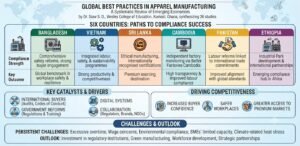
The comparative assessment highlights six apparel-producing countries that demonstrate distinct approaches to strengthening compliance.
| Country | Compliance Strength | Key Outcome |
| Bangladesh | Comprehensive factory safety reforms and strong buyer engagement | Global benchmark in workplace safety and export resilience |
| Vietnam | Integrated labour, safety and sustainability programmes | Strong productivity and supply-chain competitiveness |
| Sri Lanka | Ethical manufacturing and internationally recognised certifications | Reputation as a premium sourcing destination |
| Cambodia | Independent factory monitoring through Better Factories Cambodia | High transparency and improved labour compliance |
| Pakistan | Labour reforms linked to international trade commitments | Improved alignment with global labour standards |
| Ethiopia | Industrial Park development and international partnerships | Emerging compliance hub in Africa |
Among these countries, Bangladesh has achieved the most dramatic transformation in factory safety following major industry reforms, while Vietnam has developed one of the region’s most balanced compliance ecosystems by integrating labour standards, occupational safety and productivity. Sri Lanka has differentiated itself through an ethical manufacturing model, whereas Cambodia remains internationally recognised for transparent factory monitoring. Pakistan and Ethiopia continue to make progress through policy reforms and international partnerships.
Why Compliance Matters
Drawing on the work of leading international scholars, the review argues that compliance performance is shaped by global value-chain relationships and institutional capacity.
Gary Gereffi and colleagues demonstrate how buyer governance influences supplier behaviour, while Goerzen, Iskander and Hofstetter show that sustained pressure from international brands and organisations drives improvements in social compliance.
The review also cites Burdon and Sorour, whose institutional theory explains why firms adopt internationally recognised compliance systems, and Crane, De Bakker, Rasche and Ponte, who emphasise the importance of collaboration among governments, brands, labour organisations and civil society in strengthening sustainability governance.
Challenges Persist
Despite significant progress, the study identifies persistent challenges, including excessive overtime, wage-related concerns, environmental compliance, shortages of skilled compliance professionals and limited financial capacity among SMEs. Climate-related heat stress is also emerging as a growing occupational safety issue for apparel-producing countries.
Outlook
The review concludes that countries investing in stronger regulatory institutions, green manufacturing, workforce development and long-term partnerships with international buyers will be best positioned to attract investment, expand exports and remain competitive in the global apparel market. Compliance, it argues, has become a strategic business asset rather than merely a regulatory requirement.