

TCF POST Report
Bangladesh’s ready-made garment (RMG) exports posted a slight decline in the first month of FY2026-27, marking a reversal from the robust double-digit growth recorded in the same period of the previous fiscal year, according to the latest data from the Export Promotion Bureau (EPB).
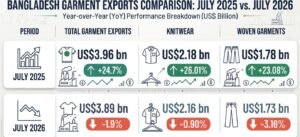
Combined exports of knitwear and woven garments—the country’s two largest export categories—stood at US$3.89 billion in July 2026, down 1.9% from US$3.96 billion in July 2025. The modest contraction follows an exceptional performance a year earlier, when apparel exports surged 24.7% year-on-year, adding nearly US$784 million in export earnings compared with the same month of the previous fiscal year. The latest figures suggest that while Bangladesh’s apparel sector remains on a strong footing, the rapid growth momentum seen at the beginning of FY2025-26 has eased.
Knitwear outperforms woven garments
Knitwear once again emerged as the stronger-performing apparel segment despite the overall slowdown. Exports reached US$2.16 billion in July 2026, only marginally lower than US$2.18 billion recorded a year earlier, translating into a 0.90% decline. The relatively limited fall indicates that knitwear has remained more resilient amid softer global demand and continues to underpin Bangladesh’s apparel exports.
The picture was less encouraging for woven garments. Exports fell to US$1.73 billion from US$1.78 billion, registering a 3.16% year-on-year decline. The sharper contraction suggests that the woven segment has come under greater pressure from subdued international demand and increasingly competitive sourcing markets.
The latest performance stands in sharp contrast to July FY2025-26, when knitwear exports expanded by 26.01% and woven garments by 23.08%, fuelled by strong buyer demand and a healthy flow of export orders. Together, the two sub-sectors generated almost US$4 billion in export earnings during the month, highlighting the remarkable recovery momentum with which Bangladesh entered the previous fiscal year. The comparison illustrates how export growth has shifted from rapid expansion to a phase of consolidation while maintaining historically high shipment values.
Home textiles emerge as the bright spot
Outside the apparel sector, home textiles continued to distinguish themselves as the strongest-performing textile category. Exports rose to US$77.86 million in July 2026 from US$68.08 million a year earlier, registering a 14.37% year-on-year increase. The segment had also recorded 13.24% growth in July FY2025-26, making it one of the few textile sectors to sustain double-digit growth over two consecutive years. The continued expansion points to resilient overseas demand and an improving global market position for Bangladeshi home textile products.
Mixed performance across other textile products
Performance across the remaining textile categories was mixed, with growth slowing in some segments while others slipped into negative territory.
Exports of specialized textiles (HS 58-60) edged up 2.99% to US$30.96 million in July 2026 after posting a much stronger 12.84% growth in the corresponding month of the previous fiscal year. Within the category, exports of special woven fabrics declined 10.70%, while knitted fabrics contracted 3.54%, reversing the positive growth recorded a year earlier. The figures indicate that demand for higher-value intermediate textile products has softened despite remaining broadly stable overall.
Cotton and cotton products recorded the weakest performance among all textile categories. After registering only 0.30% growth in July FY2025-26, exports contracted 14.42% year-on-year to US$39.71 million in July 2026 from US$46.40 million a year earlier. The steep decline points to weakening demand for cotton yarn, fabrics and other intermediate products in international markets.
Exports of headgear and caps also lost momentum. After recording a strong 20.67% growth in July FY2025-26, the category declined by 5.84% in July 2026, with export earnings slipping to US$29.52 million. The reversal suggests that the exceptional growth achieved in the previous year has not been sustained.