

TCF POST Report
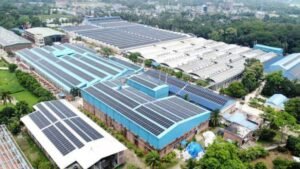
Dhaka — August 20, 2026. Bangladesh’s ready-made garment (RMG) sector, which generates roughly 85% of the country’s export earnings, is running at just 30–40% of capacity because of chronic grid instability and gas shortages — even as a new study finds its factory rooftops could host nearly 1.8 gigawatts of solar power. Today at the 5th Bangladesh-China Renewable Energy Forum, researchers from the Centre for Policy Dialogue (CPD) presented a factory-by-factory investment map designed to turn that rooftop potential into real projects, with an eye toward Chinese capital.
A Widening Gap Between Demand and Supply
The pressure on garment makers to go green is mounting from two directions at once. On one side, energy shortages are throttling production. On the other, international buyers — including H&M, Inditex, Walmart, Gap and M&S — are attaching binding decarbonization requirements to their sourcing contracts, and the EU’s Corporate Sustainability Due Diligence Directive will require 35% renewable power procurement by 2035.
Yet a survey of 878 factories in Gazipur and Narayanganj found that only 3% of the electricity used by garment factories currently comes from renewable sources, despite estimates that rooftop solar could cover 14% of the sector’s demand. The CPD study argues that Chinese EPC (engineering, procurement and construction) and RESCO (renewable energy service company) firms have the capital and technology to close that gap — but have lacked the factory-level data needed to invest with confidence. Filling that gap is the purpose of the new research.
The industry the study is targeting is large and geographically concentrated. Of 3,320 RMG and textile factories mapped nationally, Dhaka accounts for 1,247, Gazipur for 1,124, and Narayanganj for 500 — together housing the large majority of the country’s garment production. Most of these units are small: 2,420 factories employ fewer than 1,000 workers, versus 698 medium-sized factories and just 201 classified as large (3,000+ workers).
Mapping Nearly 3,300 Factories
Using satellite building data cross-referenced with a national factory census, researchers built a database estimating usable rooftop area and solar capacity for each factory, then modeled electricity demand using a machine-learning model trained on a 350-factory survey sample. To identify actual rooftops, the team downloaded the Google Open Buildings dataset, isolated Bangladesh-specific records, and matched candidate building polygons to each factory’s known location — extracting usable roof area and building height for each site rather than relying on generic satellite estimates.
The resulting national estimate: roughly 1,768 megawatts-peak (MWp) of rooftop solar potential across the sector, built from 9.7 million square metres of usable rooftop area (at a density of 1 kWp per 5.5 m²). That potential splits unevenly across factory sizes: small factories (2,420 of them) account for 484.7 MWp across 2.67 million m² of roof space; medium factories (698) for 637.0 MWp across 3.50 million m²; and large factories (201) for 646.5 MWp across 3.56 million m². In other words, large and medium factories — fewer than a third of all sites — hold nearly two-thirds of the total rooftop solar potential, because their larger, more uniform roofs generate far more capacity per factory than the smaller sheds typical of small units.
That 1,768 MWp garment-sector figure sits within a wider range of industrial estimates produced by other agencies. IDCOL’s rooftop roadmap puts total RMG and textile rooftop solar potential at 2,815 MWp — about 78% of Bangladesh’s entire industrial rooftop solar capacity — requiring an estimated Tk 12,669 crore (roughly USD 1.03 billion) in investment. A narrower, near-term IDCOL survey identifies 879 MWp of priority RMG candidates across 1,016 companies (out of more than 9,000 industrial units nationally), needing about Tk 5,100 crore in capital. IEEFA’s validation, which accounts for structural integrity, load sanctions and dust-shading losses, puts total industrial rooftop potential at 3,500–4,000 MWp, and as high as 5,000 MWp under a wider definition. The CPD study’s own estimate is more conservative than most of these because it is built bottom-up from real, matched rooftop geometry rather than top-down assumptions.
Researchers validated their demand model against the make-up of the wider industry: their 350-factory survey sample tracks the national population closely by factory type (34.6% knit in the sample versus 34.2% nationally; 30.3% versus 30.4% woven; 17.4% versus 17.1% sweater factories) and by size and geography, giving the team confidence that conclusions drawn from the sample generalize to all 3,320 factories.
Each factory was then scored and sorted into an “investability tier” — Investment-Ready, Investable with Support, Needs Structural or Regulatory Intervention, or Not Viable — based on a composite of technical roof-to-demand fit, financial debt-service coverage, and contextual factors such as export exposure and premises type. Large factories fared best: 34 of the 61 large factories studied are already Investment-Ready. Small factories, which make up the vast majority of the industry, carry nearly all of the cases still needing structural or regulatory fixes, and their financing needs — an estimated $75.7 million in aggregate capital — are the largest of any size tier despite each installation being individually cheaper. Geographically, Gazipur stands out with the highest existing-solar adoption rate among major districts (43%), consistent with early-mover clustering there, while Dhaka carries the largest raw count of factories still needing intervention.
The Money Question
The economics currently favor solar on paper: generation costs of about 3.04 BDT per kWh sit at under half the utility grid tariff, according to the CPD analysis. But financing access, not generation cost, is the sector’s real bottleneck. A companion survey found 94% of early adopters financed their systems entirely out of pocket, rather than through debt — a sign that formal lending channels have yet to open up meaningfully for rooftop solar. Two financing structures currently dominate the market: CAPEX ownership, largely backed by IDCOL loans covering up to 80% of project cost at 5–6% interest through Bangladesh Bank-linked commercial banks; and OPEX/RESCO models, in which a third-party developer owns the system and sells power back to the factory under a long-term agreement, financed through a mix of developer capital and green refinancing. Installed CAPEX capacity currently outweighs OPEX capacity more than five to one (64,813 kWp versus 12,760 kWp), suggesting outright ownership remains far more common than third-party RESCO ownership so far.
The study’s sensitivity testing underscores how fragile the current bankability picture is. The baseline median debt-service coverage ratio across the factory population sits at 1.26x — just above the 1.25x threshold banks typically require. That means the whole population is balanced on a knife’s edge: modeling shows that if commercial lending rates rise from a blended 9.8% to 10.5% or higher, the “Investment-Ready” tier disappears entirely, with projects shifting into lower tiers instead. Access to concessional or green refinancing, the report concludes, doesn’t just improve returns — it determines whether an investable tier exists at all.
What’s Working, What’s Stuck
The report holds up the Ha-Meem Group’s phased rooftop rollout — 12.2 MWp installed in 2024, with a further 17 MWp commissioned this year — as a model for the sector. At its Kaliganj facility, solar now fully covers daytime electricity load between 10 a.m. and 3 p.m., and feeder-level load-shedding has stopped altogether. The project drew on concessional financing at 5–7% interest, including a 20% principal waiver worth roughly Tk 7.2 crore for on-time delivery.
But Ha-Meem’s experience also illustrates where projects still get stuck once they’re built. Its second phase, a 17 MW addition, has been unable to connect to the grid while awaiting SREDA equipment and inverter approval — a wait of about two and a half months. Bidirectional metering existed between the factory and its local utility, but not between that utility and the national grid operator, leading to billing errors on power fed back into the system. The company’s own lessons for scaling include executing in phased portfolios to absorb the green-finance learning curve, backing EPC contractors with performance guarantees rather than relying solely on long linear warranties that prorate heavily after year 15, and settling grid metering arrangements before installation begins rather than after.
Factory managers and EPC/RESCO investors interviewed for the study point to a similar list of frictions: high financing costs and collateral demands for small and mid-sized factories, slow and opaque SREDA approvals, a buyer-imposed rule requiring 20% of rooftop space be kept clear for “helicopter evacuation” that researchers say has no basis in official fire code, aging or undocumented roof structures built before 2013 safety reforms, and inconsistent net-metering procedures across the country’s different distribution utilities. On the investor side, only 25–30% of evaluated leads convert into signed contracts, and currency risk on BDT-denominated power purchase agreements adds another layer of caution for foreign capital.
Policy Tailwinds
Government policy has moved to encourage adoption. Bangladesh’s Renewable Energy Policy 2025 targets 20% renewable electricity by 2030, rising to 30% by 2040, with a decade of corporate tax exemption for renewable energy producers (plus five years of partial exemption). A National Rooftop Solar Programme announced in July 2025 targets 2,000–3,000 MW of rooftop capacity nationwide. Updated net-metering guidelines raised the sanctioned-load ceiling to 100% of a factory’s approved capacity and removed a prior 10 MW cap, while a December 2025 circular made rooftop solar mandatory for larger buildings and set minimum installation requirements for bigger industrial power users. Export-processing zones, previously excluded from national rooftop solar rules, are now covered as well, with BEZA and BEPZA empowered to set zone-specific settlement terms. SREDA, the sector’s lead regulator since 2014, oversees equipment approval and energy audits and acts as the appellate authority for utility delays — though researchers note its approval processes remain a persistent source of delay for factories of all sizes.
What Comes Next
The CPD researchers frame their factory-level database as the missing link for Chinese investors weighing entry into Bangladesh’s solar market: rather than relying on broad national estimates, EPC and RESCO firms can now identify specific investment-ready or near-ready factories to approach directly. Their recommendations include blended concessional-and-Chinese-capital financing facilities through IDCOL, faster SREDA interconnection approvals, and pooling smaller factories in knitwear hubs like Narayanganj into larger, more bankable clustered projects to attract investment that wouldn’t otherwise reach individual small factories.