

TCF POST Report
BRUSSELS — The European Union is stepping up its green transition for the fashion and retail sectors. Under the newly implemented Ecodesign for Sustainable Products Regulation (ESPR). The initiative seriously aims to overhaul how garments are designed, marketed, and managed throughout their lifecycle, backed by overwhelming support from stakeholders.
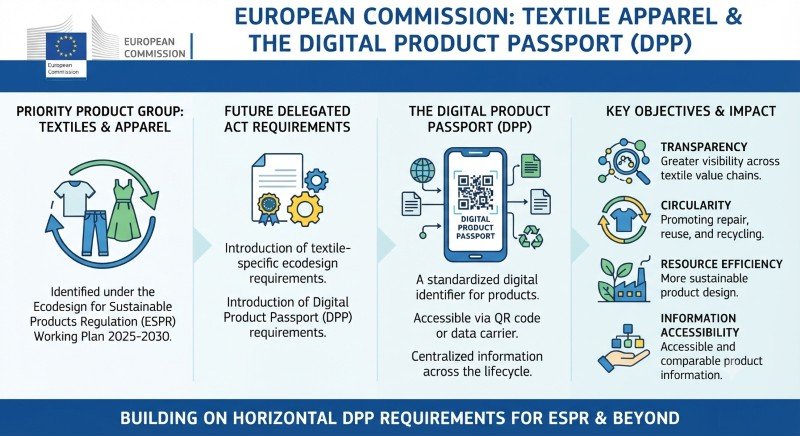
A new European Commission communication has noted that “Working Plan 2025–2030, textile apparel has officially been designated as the number one priority product group for sweeping circularity mandates and the introduction of DPP (Digital Product Passports)
Why Textile Apparel?
While the European textile sector remains a powerhouse—comprising 194,000 companies and generating an annual turnover of €166 billion (evenly split between broader textiles and clothing)—its environmental toll is severe.
According to EU life-cycle assessments, textile consumption ranks:
- 4th highest in negative impacts on the environment and climate change.
- 3rd highest for water and land use globally.
As the largest textile product subgroup in terms of apparent consumption—reaching 4.85 billion kg in 2019 (compared to 3.28 billion kg for home textiles and 3.55 billion kg for technical textiles)—apparel represents a massive market size valued at roughly €78 billion (out of a total €142 billion European market size for textiles and footwear). The sector offers high potential for improving product lifetime extension, maximizing material efficiency, and dramatically curbing resource depletion.
The Digital Product Passport (DPP): A New Era of Transparency
A cornerstone of the ESPR framework for textiles is the introduction of the Digital Product Passport (DPP). The DPP will act as a digital identity card accessible via a data carrier on the product itself (such as a QR code) and at online points of sale.
The passport is designed to create end-to-end value chain transparency, allowing:
- Businesses to objectively substantiate the circular and sustainable claims of their products.
- Consumers to make informed, trustworthy purchasing decisions.
- Downstream operators to easily access data supporting efficient repair, resale, reuse, and recycling.
- Authorities to seamlessly verify regulatory compliance and conformity assessments.
What Data Will the DPP Require?
While exact parameters will be finalized in upcoming legislation, expected data requirements include:
- Product identification characteristics and origin information.
- Fibre composition (coordinating with the ongoing review of the Textile Labelling Regulation).
- Guidelines supporting use, repair, maintenance, and upgrading.
- End-of-life instructions, including disassembly, refurbishment, and recycling pathways.
- Identification of responsible economic operators across the supply chain.
Who is Accountable?
The upcoming obligations will apply directly to market players:
- Primary Duty Holders: Manufacturers, producers, and importers placing or putting textile apparel into service within the EU market must ensure a compliant DPP is available.
- Distributors & Dealers: Must verify that a DPP accompanies the products they handle.
- Suppliers & Service Providers: Obligated to furnish accessible, relevant data up the chain.
Implementation Roadmap
The regulatory timeline is moving swiftly to turn policy into practice:
- Q4 2027: Planned formal adoption of the specific ESPR Delegated Act for textiles.
- Post-Adoption: Rollout of targeted technical specifications, compliance guidelines, and implementation mechanisms to assist businesses.
These information requirements will function in direct synergy with broader EU measures—including the recently introduced bans on the destruction of unsold consumer apparel—cementing circularity as a strict legal requirement for doing business in the European single market.