
Country’s biggest apparel manufacturer brings waterless dyeing technology to commercial scale, in a move that could reshape a $100 billion global denim industry.
TCF POST Report
For more than a hundred years, making a pair of jeans blue has meant making it thirsty. Dyeing and finishing a single pair consumes roughly 75 litres of water — a cost so baked into denim production that it has long been treated as unavoidable, the price of authenticity.
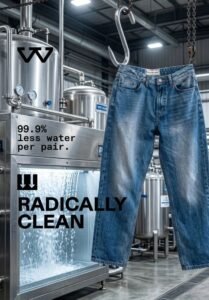
WTRLSS, a US- and Switzerland-based biotech company, says that assumption no longer holds. Its newly launched digital denim dyeing technology cuts that water requirement down to two tablespoons — a reduction of up to 99.9% — while also slashing energy consumption by 90%.
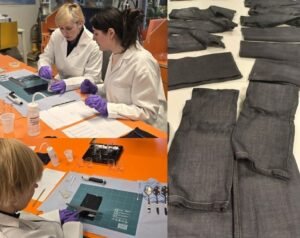
The company has now taken the technology out of the lab and onto the factory floor, partnering with Ha-Meem Group, Bangladesh’s largest apparel manufacturer and one of the world’s top denim producers, on a commercial production pilot.
A Century-Old Process, Reinvented
Traditional denim dyeing relies on a multi-step wet and dry process — repeated soaking, rinsing, and treatment that consumes enormous volumes of water and generates wastewater that must then be treated or discarded. WTRLSS replaces that entire sequence with a single-step digital dyeing process, built on what it calls MultiActiv™ chemistry, which the company says eliminates ten separate steps from conventional production.
“For more than a century, the industry has accepted that authentic denim comes with an enormous environmental cost. We’ve proven it doesn’t have to,” said Dr. Mickael Mheidle, WTRLSS’s Chairman and chief scientist. “By combining bioscience with digital technology, we’ve created a fundamentally new way to create denim. This is about the digital transformation of one of fashion’s oldest and most resource-intensive industries.”
Formerly known as Lab Denim, WTRLSS is headquartered in Los Angeles with a European base in Basel, Switzerland. The waterless system was years in development before reaching commercial readiness, and while denim is the starting point, the underlying technology is designed to extend further — the company says it can also be applied to cotton, jute, bamboo, and linen.
Not Just an Environmental Pitch — A Commercial One
WTRLSS is framing the technology as more than a sustainability upgrade. Because the process is no longer tied to large volumes of water, denim manufacturing becomes far less location-dependent, opening the door to near-shoring and production closer to the markets a brand serves — a shift with real implications for supply chain cost and speed.
“We believe there is a better way to dye denim, that doesn’t force manufacturers to choose between quality, cost, and sustainability,” said CEO Dustin White. “That’s why we’ve built WTRLSS, to give brands a faster, more flexible, and more efficient way to manufacture their denim products. Improving how denim is dyed is not just an environmental challenge; it’s a commercial imperative.”
Beyond the water savings themselves, manufacturers stand to cut costs tied to wastewater treatment and recycling — expenses that have historically been part of the fixed cost of doing business in denim.
Bangladesh Takes the Lead
For years, Ha-Meem Group has been sourcing quality denim stocks to major US and European brands and retailers including GAP, JCPenney, KOHL’S, PVH and NEXT. So, this group’s decision to pilot the technology places Bangladesh — already a global garment manufacturing hub — at the front of this shift.
“WTRLSS enables us to deliver world-class authentically finished denim while eliminating decades of water waste,” said Ha-Meem Group director Sajid Azad. “Ha-Meem Group is proud to be first to bring this technology to commercial scale and prouder still that Bangladesh is leading the way.”
Imteaj Hossain, Head of Group Strategic Planning & Digital Transformation at Ha-Meem Group, echoed the significance of the shift: “The new dyeing technology has the potential to reduce water use by up to 99.9%, which is a very important step towards more sustainable denim production. At Ha-Meem Group, we are always looking for better ways to work and improve through technology and innovation.”
Industry Reaction: Promising, But Questions Remain
The reception from within the industry has been cautiously enthusiastic. One industry executive described the shift as “a truly fascinating development for the denim industry,” noting that moving from conventional dyeing to digital post-weave colorization could fundamentally transform how denim is manufactured. The same executive flagged the questions that typically follow any new industrial process at this stage: scalability, cost, shade reproducibility, and performance at full industrial volume.
Those are the questions that will determine whether WTRLSS’s technology becomes a genuine industry standard or remains a high-profile pilot. But with one of the world’s largest denim manufacturers already running production through the system, the technology has cleared a threshold few sustainable-fashion innovations reach — real factory floors, real output, at commercial scale.
Why It Matters
Denim’s water footprint has long been one of fashion’s most visible sustainability liabilities, frequently cited in criticism of the industry’s environmental impact. A process that claims to cut that footprint by nearly 100% — if it holds up at scale, across shades, fabrics, and price points — would address one of the sector’s most persistent criticisms without requiring brands to compromise on the product itself.
For now, the pilot in Bangladesh is the test case the rest of the industry will be watching.