

TCF POST Analysis
India’s textile and apparel policy is increasingly framed around a broader industrial mission: to make the sector globally competitive through environmentally friendly processing standards and technology, while improving quality, strengthening market access and supporting long-term growth, says the latest statement from the country’s Ministry of Textiles.
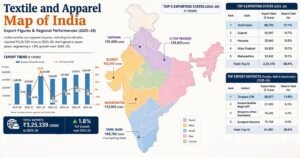
The scale of the challenge is reflected in the latest export figures. India’s exports of textiles and apparel, including handicrafts, reached ₹3,25,339 crore (about US$37.4 billion) in 2025–26, compared with ₹3,19,573 crore in 2024–25. The figure represents a 1.8% year-on-year increase, up from ₹2,49,250 crore (about US$28.6 billion) in 2019–20.
The government’s data combines textiles, apparel and handicrafts and therefore does not provide separate national export values for textiles and apparel. The more useful reading is to examine how its mission is being applied across the textile manufacturing base and apparel-export ecosystem.
TEXTILES | Vying for a Globally Competitive Manufacturing Base
The textile side of the strategy is centred on manufacturing capacity, technology, infrastructure, raw materials, sustainability and industrial clusters.
As of March 31, 2026, 36,00,012 MSMEs were registered and active in the textile sector under NIC codes 13 and 14. Between April 2023 and March 2026, 24,73,634 textile MSMEs were registered, while 7,894 units were reported to have shut down.
This large manufacturing base provides the foundation for the government’s objective of making Indian textiles more competitive through technology, standards and modernisation.
Export growth seems to be recovering, but the trajectory remains uneven
India’s export performance shows a recovery to a new high, but also considerable movement over the seven years. Exports declined from ₹2,49,250 crore in 2019–20 to ₹2,33,304 crore (about US$26.8 billion) in 2020–21 before rising sharply to ₹3,31,330 crore in 2021–22. They then fell to ₹2,94,289 crore in 2022–23 before recovering to ₹2,97,004 crore in 2023–24, ₹3,19,573 crore in 2024–25 and ₹3,25,339 crore in 2025–26. The latest figure is therefore the highest in the series, although the 1.8% increase in 2025–26 represents a more moderate pace of expansion than the sharp post-2020–21 rebound.
Export capacity is concentrated in major textile states
Tamil Nadu was the largest exporting state in 2025–26 with ₹68,792 crore (about US$7.9 billion), followed by Gujarat at ₹50,947 crore, Haryana at ₹35,060 crore, Uttar Pradesh at ₹34,829 crore and Maharashtra at ₹32,842 crore. The distribution highlights the importance of established production and export clusters. It also supports the government’s emphasis on integrated parks, infrastructure and cluster development as mechanisms for strengthening the industrial base.
Under the Textile Cluster Development Scheme, 50 projects have been sanctioned and 33 completed, while the programme also supports common effluent-treatment facilities and processing infrastructure. The Integrated Textile Parks programme has an approved Government of India share of ₹1,838.96 crore (about US$211.4 million) across the listed projects, of which ₹1,536.02 crore had been released and utilised.
Raw-material competitiveness is part of the strategy
The draft highlights measures affecting both cotton and man-made-fibre inputs. The government has temporarily exempted cotton imports under Customs Tariff Heading 5201 from customs duty from June 1 to October 31, 2026. It has also temporarily exempted key MMF-chain inputs including PTA and MEG, while rationalising GST rates in the MMF chain.
Sustainability is built into the textile mission
The Tex-Eco Initiative, announced in the Union Budget 2026–27, focuses on circular-economy technologies, textile-waste management, recycling, sustainable packaging and recycled fibres. The draft also identifies an ESG Task Force and initiatives addressing hazardous chemicals, greenhouse-gas emissions, textile waste and circular business models. These measures directly correspond with the government’s stated vision of making the Indian textile industry globally competitive using environmentally friendly processing standards and technology.
APPAREL | Strengthening Export Clusters and Market Access
The apparel side of the strategy is particularly visible in India’s major ready-made-garment export districts. Tiruppur recorded ₹38,677 crore (about US$444.6 million) in combined textile, ready-made-garment and handicraft exports in 2025–26, followed by Gautam Buddha Nagar at ₹21,095 crore, Bengaluru Urban at ₹16,205 crore and Gurugram at ₹15,104 crore. Tiruppur stands well ahead of the other leading districts, while Gautam Buddha Nagar, Bengaluru Urban and Gurugram form the next tier. The data illustrates the geographic breadth of India’s textile and apparel export network.
Market diversification is a central export strategy
The government has adopted an export-promotion and market-diversification strategy covering 40 priority countries. The draft states that 16 FTAs are already in force, including the India–UK Comprehensive Economic Trade Agreement. It also says negotiations with the European Union have been concluded and that India has signed an FTA with New Zealand.
The government has also extended RODTEP and RoSCTL through September 30, 2026, and launched the Resilience & Logistics Intervention for Export Facilitation (RELIEF) scheme. Together, these measures form part of the export-support and market-access framework outlined in the draft.
MSMEs | Scale Accompanied by Reported Closures
The textile MSME data provides another dimension to the industry’s development. The government reports 7,894 textile MSME closures between April 2023 and March 2026, affecting 59,374 jobs. Gujarat recorded 1,402 closures, Tamil Nadu 1,309 and Maharashtra 1,276. At the same time, 24,73,634 textile MSMEs were registered during the three-year period. The raw draft therefore shows both a very large MSME base and a much smaller number of reported closures.
THE MISSION | From Manufacturing Scale to Global Competitiveness
The government’s policy framework extends across manufacturing, infrastructure, skills, technology, sustainability and trade. It includes PM MITRA Parks, the PLI Scheme for Textiles, the National Technical Textiles Mission, SAMARTH, cluster-development programmes, export incentives, market-access initiatives and logistics support. Vision of the government is to make the Indian textile industry globally competitive using environmentally friendly processing standards and technology. Its stated mission includes improving product quality, building world-class manufacturing infrastructure, increasing exports and creating employment.
This mission provides the connecting thread across the different programmes. For textiles, the emphasis is on manufacturing capability, infrastructure, technology, raw materials, processing and sustainability. For apparel, the emphasis is more visible through export districts, market access, trade agreements, export-support schemes and logistics.
India’s textile and apparel exports reached ₹3,25,339 crore in 2025–26, establishing a new high in the seven-year series provided in the draft. But the government’s stated mission goes beyond export volume. It seeks to build a textile industry that is globally competitive, technologically stronger, environmentally responsible and capable of producing quality products, while strengthening infrastructure, market access, exports and employment. The government is India is seeking to convert its existing textile and apparel manufacturing strength into a more globally competitive industry.