

TCF POST Analysis
MUMBAI, Aug. 8, 2026 — Pantaloons remained the largest growth engine for Aditya Birla Fashion and Retail Ltd. (ABFRL) in the first quarter of fiscal 2027, as the fashion group delivered double-digit consolidated revenue growth despite softer occasion-led demand and rising raw-material, logistics and wage costs.
ABFRL reported Q1 FY27 revenue of Rs. 2,026 crore, up 11% year on year, while EBITDA stood at Rs. 167 crore, broadly stable against Rs. 169 crore a year earlier. However, EBITDA margin declined to 8.2% from 9.3%, reflecting lower other income and investment in newer businesses including OWND and Galeries Lafayette.
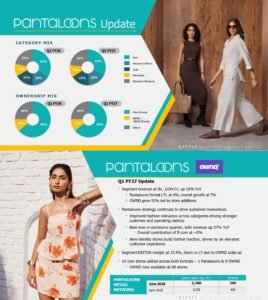
Pantaloons led the performance, generating Rs. 1,204 crore in revenue, up 10% YoY, with segment EBITDA of Rs. 192 crore. Its segment EBITDA margin was 15.9%, compared with 17.1% a year earlier. Pantaloons delivered 4% like-for-like growth and 7% overall format growth, while e-commerce revenue jumped 37% YoY.
The quarter nevertheless reflected a mixed demand environment. ABFRL said occasion-led demand moderated as Adhik Maas disrupted peak wedding-related consumption, although broader demand remained broadly in line with previous quarters across categories and channels. At the same time, inflation in raw materials, logistics and wages emerged as a key monitorable for the business.
Pantaloons anchors ABFRL’s apparel growth
Pantaloons continues to operate as ABFRL’s broadest mass-to-masstige apparel platform, covering men’s, women’s western, women’s ethnic, kids and non-apparel categories. Its e-commerce business recorded its strongest quarter, with revenue increasing 37%, although online still represented approximately 5% of the format.
ABFRL added 10 stores across Pantaloons and OWND during Q1, including nine OWND stores. OWND was available at 88 stores by the end of June. Pantaloons had 399 stores and a retail area of 5.78 million sq. ft. at June 2026.
The Pantaloons performance is particularly significant for suppliers because the format combines large-scale apparel sourcing with growing online demand, creating requirements for both volume production and faster replenishment.
Ethnic portfolio strengthens premium apparel platform
ABFRL’s ethnic business is another major pillar of its apparel strategy. The company describes the portfolio as India’s largest and most comprehensive ethnic-wear platform, with more than 670 stores and annual revenue above Rs. 2,200 crore across premium ethnic and designer-led brands.
The designer-led portfolio includes Sabyasachi, Tarun Tahiliani, House of Masaba and Shantnu & Nikhil. Sabyasachi delivered another Rs. 100-crore-plus quarter, supported by apparel and accessories. Tarun Tahiliani recorded double-digit growth and reached 13 stores, while House of Masaba operated 21 exclusive outlets.
Within premium ethnic wear, Tasva grew 35% YoY, achieving double-digit like-for-like growth for the eighth consecutive quarter and reaching 90 stores. Jaypore grew more than 30%, while its e-commerce revenue increased more than 70%. The TCNS portfolio also continued expanding its retail presence.
The broader TCNS portfolio includes W, Aurelia, Wishful, Elleven and Folksong, strengthening ABFRL’s exposure to women’s apparel.
Luxury and digital brands add new sourcing requirements
Luxury was ABFRL’s fastest-growing major business in Q1, with revenue increasing 30% YoY. Growth was led by Galeries Lafayette and double-digit growth from The Collective and its mono-brand portfolio. The Collective and mono-brand network reached 51 stores after three additions during the quarter.
ABFRL’s luxury fashion portfolio includes The Collective, Ralph Lauren, Fred Perry, Ted Baker, Hackett London and Galeries Lafayette. The company also has a strategic Christian Louboutin partnership, giving the group exposure to high-end footwear alongside luxury apparel.
Meanwhile, the TMRW digital-first portfolio generated 11% revenue growth and 16% growth in secondary revenue. Its brands include Bewakoof, Veirdo, Nobero, Urbano, The Indian Garage Co. and WROGN. More than 20 stores were added during Q1, taking the wider TMRW network beyond 140 exclusive brand stores.
The shift toward offline retail is strategically important for sourcing because TMRW’s brands are moving from primarily digital distribution toward a more integrated model covering design, supply chain, operations and physical retail.
Sourcing remains heavily India-based
ABFRL’s supply chain remains predominantly domestic. Its FY2024-25 disclosure shows that 81.35% of procurement came from India, while 18.65% came from international suppliers. The company reported 1,246 Tier-1 suppliers across more than 10 countries, including 200 significant Tier-1 and 25 significant non-Tier-1 suppliers.
ABFRL sourcing mix
India: 81.35% | International: 18.65%
The international component gives ABFRL flexibility for selected materials, products and categories, but the Q1 FY27 presentation does not provide a brand-by-brand breakdown of international sourcing. Therefore, country-specific percentages should not be attributed to individual ABFRL brands without additional company disclosure.
For Pantaloons, supplier engagement remains a priority. The brand conducts annual vendor workshops across sourcing zones in India and focuses on supplier relationships, quality, supply-chain efficiency and procurement processes.
This is becoming more important as ABFRL faces higher input costs. The company specifically identified inflation in raw materials, logistics and wages, suggesting continued pressure on suppliers and margins.
Business segments show diversified growth
ABFRL’s Q1 numbers show a diversified fashion platform rather than a single apparel business. Pantaloons generated Rs. 1,204 crore, ethnic businesses Rs. 454 crore, TMRW Rs. 220 crore and Others Rs. 157 crore. Growth ranged from 4% in ethnic to 30% in Others.
The mix gives ABFRL multiple growth channels: Pantaloons provides scale; ethnic brands capture occasion and premium apparel demand; TMRW targets digitally native consumers; and luxury provides premiumisation.
Footwear remains a smaller, brand-specific opportunity
Unlike apparel, ABFRL does not report a standalone footwear revenue or growth figure for Q1 FY27. Footwear is embedded within individual brand portfolios, with Christian Louboutin providing a clear luxury-footwear exposure.
The distinction is important following the 2025 demerger. Reebok, Louis Philippe, Van Heusen, Allen Solly, Peter England, American Eagle and Van Heusen Innerwear & Athleisure are now part of Aditya Birla Lifestyle Brands Ltd. and should not be included in current ABFRL Q1 FY27 footwear calculations.
Growth versus profitability remains the key challenge
Despite 11% revenue growth, ABFRL’s consolidated PBT loss widened to Rs. 320 crore from Rs. 260 crore, while net loss increased to Rs. 249 crore from Rs. 234 crore. Employee expenses increased from Rs. 303 crore to Rs. 346 crore and purchases of stock-in-trade rose from Rs. 450 crore to Rs. 615 crore.
For textile and apparel suppliers, ABFRL’s direction is therefore clear: the company is expanding stores, digital channels, ethnic and luxury brands while simultaneously seeking greater sourcing efficiency and cost control.
With 81.35% of procurement still based in India, ABFRL remains an important domestic sourcing customer, while its international supplier network provides additional flexibility. For Asian garment manufacturers, the opportunity is concentrated mainly in apparel, ethnic wear and selected premium categories, while footwear opportunities remain more brand-specific.
ABFRL’s current apparel-led portfolio comprises Pantaloons/OWND; Sabyasachi, Tarun Tahiliani, House of Masaba and Shantnu & Nikhil; Tasva, Jaypore and the TCNS brands; The Collective, Ralph Lauren, Fred Perry, Ted Baker, Hackett London and Galeries Lafayette; and TMRW brands including Bewakoof, Veirdo, Nobero, Urbano, The Indian Garage Co. and WROGN. Christian Louboutin provides a strategic luxury-footwear exposure.
Overall, Q1 FY27 shows ABFRL building a broader fashion ecosystem, but the next phase will depend on whether its growing apparel and luxury businesses can convert top-line momentum into stronger margins while managing increasingly complex sourcing and cost pressures.