

TCF POST Special Report
Z Supply has spent more than a decade building its identity around the pieces women reach for almost instinctively—soft knits, relaxed essentials and easy wardrobe staples designed for everyday life.
Now, the California-based women’s lifestyle brand is betting that those same customers are ready to reach for Z Supply when they want jeans.
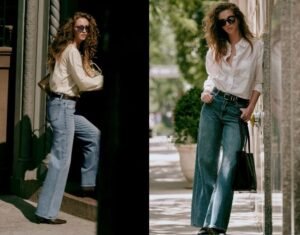
The launch of its first denim collection on August 5 marks the brand’s largest category expansion to date, taking Z Supply beyond its knitwear roots and into a much broader head-to-toe wardrobe proposition.
And the response has been strikingly fast. Within days of the launch, the brand’s digital campaign was already positioning Z Supply as “The Denim Shop”—a sign of how aggressively the company intends to establish credibility in a category dominated by specialist denim and major fashion brands.
Denim as the missing piece
For Z Supply, denim was not simply another product category to add to the assortment. It was, according to the company, the logical next chapter.
Founded in 2013 by John Zhao and Greg Garrett, Z Supply built its reputation around comfort, uncomplicated design and soft fabrics. Over time, that proposition expanded into a broader lifestyle offer, but denim remained conspicuously absent.
That absence became increasingly difficult to ignore.
Mandy Fry, Z Supply’s president and co-owner, says the company spent years studying the denim market and preparing for the move. The objective was not to produce jeans merely because denim is a large and commercially attractive category, but to create denim that could behave like the rest of the Z Supply wardrobe: comfortable, versatile and easy to wear.
That distinction is important.
The company’s challenge is not simply entering denim. It is convincing existing Z Supply customers that the brand they trust for soft everyday essentials can also deliver the right fit, wash, fabrication and fashion credibility in jeans.
A customer-led expansion
There was apparently little shortage of encouragement from the market.
Z Supply works with about 3,000 retail partners across North America, and company officials say those partners repeatedly expressed confidence that denim would sell.
Its direct-to-consumer business provided another strong signal. E-commerce customers account for approximately 35% of the company’s business, and customer surveys and feedback from online shoppers reportedly showed significant demand for denim.
That makes the launch less of a speculative category experiment and more of an attempt to respond to an established customer request.
It also reveals something broader about the economics of today’s apparel brands.
For an established label, category expansion can deepen the relationship with an existing customer without requiring the company to acquire an entirely new audience. If a shopper already buys Z Supply tops, knits, loungewear and everyday essentials, adding jeans creates an opportunity to capture a larger share of that shopper’s wardrobe—and potentially increase both purchase frequency and basket size.
In that sense, denim is not simply a product launch. It is a customer-retention and wardrobe-expansion strategy.
The Z Supply interpretation of denim
The collection enters the market with a broad selection of familiar contemporary silhouettes, including wide-leg, barrel, bootcut, flare, straight-leg, cropped, relaxed and mom jeans, alongside high-waisted and stretch options.
The assortment reflects the direction of the wider denim market: consumers continue to move beyond a single dominant silhouette, with room for both relaxed proportions and more body-conscious shapes.
Among the collection’s standout styles is the Studio Denim Modern Bootcut, described as a slim-fitting jean with a subtle bootcut, a touch of stretch and a hem designed to sit just above the shoe for a standard inseam.
The details are revealing.
Rather than chasing the most extreme interpretation of current denim trends, Z Supply appears to be taking a commercial approach: recognizable silhouettes, wearable proportions, versatile washes and enough stretch to preserve the comfort credentials on which the brand was built.
That could prove particularly important for an established customer base accustomed to soft fabrics and uncomplicated dressing.
From knitwear to “every moment, every day”
The larger strategic ambition extends beyond jeans.
Fry says the company has been working to align Z Supply around a broader vision—one capable of outfitting women “for every moment, every day.”
That phrase effectively describes the company’s transformation.
Z Supply began with a relatively focused proposition around knitwear and everyday essentials. It has since expanded into fashion pieces, loungewear through Z Lounge and coordinated styles for girls aged 7–14.
Denim now gives the brand an important foundation category.
A pair of jeans can connect almost every other part of the wardrobe: a basic T-shirt, a lightweight knit, a jacket, a sweatshirt, sandals, sneakers or boots. That makes denim particularly valuable to a lifestyle brand because it does not operate in isolation.
It creates commercial links between categories.
The opportunity is therefore considerably larger than the revenue generated by the jeans themselves.
A carefully staged launch
Z Supply is also treating the debut as a brand moment rather than a quiet assortment addition.
The campaign was photographed on the streets of New York, while wheat-pasted installations were planned across the United States. A two-day retail pop-up on the West Coast adds a physical component to what could otherwise have been primarily a digital launch.
Editors were also invited to experience the collection at New York’s Roxy Hotel, where the denim was displayed alongside Z Supply’s existing basics and late-summer products.
That presentation helps communicate the central idea behind the expansion: these are not jeans sitting beside the Z Supply collection; they are intended to complete it.
Why the timing matters
The denim market is undergoing a particularly interesting stylistic transition.
Skinny jeans have regained relevance alongside a much broader selection of silhouettes, while wide-leg, barrel, bootcut and flare shapes continue to attract attention. Consumers are increasingly shopping across several fits rather than committing themselves to a single dominant shape.
For Z Supply, that fragmentation can actually be an advantage.
The brand does not need to define the next great denim silhouette. Instead, it can offer several commercially proven shapes through its own lens of comfort and accessibility.
The company’s emphasis on stretch, premium fabrics, vintage-inspired washes and everyday versatility fits neatly into that strategy.
It is less about reinventing denim than making denim feel unmistakably Z Supply.
The sourcing question
The launch also creates a new sourcing challenge.
Denim is structurally different from the soft knits and lightweight essentials with which Z Supply established its reputation. It requires expertise across fabric development, washing, finishing, fit engineering and supply-chain management.
As the collection scales, maintaining consistent fit and wash quality across multiple silhouettes will become critical.
The brand’s emphasis on “premium fabrics” and careful development suggests that it understands this challenge. But denim consumers can be demanding: small differences in rise, leg shape, stretch recovery, wash and finishing can determine whether a pair becomes a repeat purchase or a one-season experiment.
For Z Supply’s retail partners, this will also be a test of category productivity. The company’s reported network of roughly 3,000 North American retailers gives the launch significant distribution potential, but denim occupies valuable floor space and competes directly with established denim specialists.
The bigger business opportunity
Z Supply’s estimated annual revenue of around $100 million provides context for the importance of this move.
For a business of that scale, entering a major wardrobe category can create meaningful incremental growth without requiring a complete reinvention of the customer proposition.
The opportunity can be viewed on three levels.
First, there is category revenue. Denim is a large and highly established apparel market.
Second, there is wardrobe capture. Existing Z Supply customers can now potentially buy another core part of their everyday wardrobe from the same brand.
Third, there is brand elevation. Successful denim can help move Z Supply’s perception from an essentials and knitwear label toward a complete lifestyle apparel company.
That third opportunity may ultimately be the most valuable.
A new identity in the making
Z Supply’s denim launch arrives with an unusually clear message: the company does not want denim to sit at the edge of its business.
It wants jeans to help redefine what the business is.
The brand’s female-led positioning and community initiatives—including support for organizations such as The Exodus Road, Breast Cancer Angels, the Keep A Breast Foundation and Court Appointed Special Advocates—also remain part of its broader identity.
But the commercial story is now increasingly about breadth.
From knitwear to essentials, from loungewear to children’s matching styles, and now from tops to jeans, Z Supply is gradually assembling the components of a full lifestyle wardrobe.
The first denim collection may therefore be judged less by how many jeans it sells in its opening weeks than by whether customers begin to think differently about the brand.
If Z Supply can make that transition—from “the brand with the soft basics” to a brand women can build an entire everyday wardrobe around—its Denim Mission will have accomplished something much bigger than launching another product category.
It will have changed the shape of the company itself.