

TCF POST Analysis
Recent market research by Fortune Business Insights valued the global apparel logistics market at USD 105.49 billion in 2026, UP from USD 98.80 billion in 2025.
It is forecast to reach USD 180.73 billion by 2034, expanding at a Compound Annual Growth Rate (CAGR) of 7.0% over the forecast period.
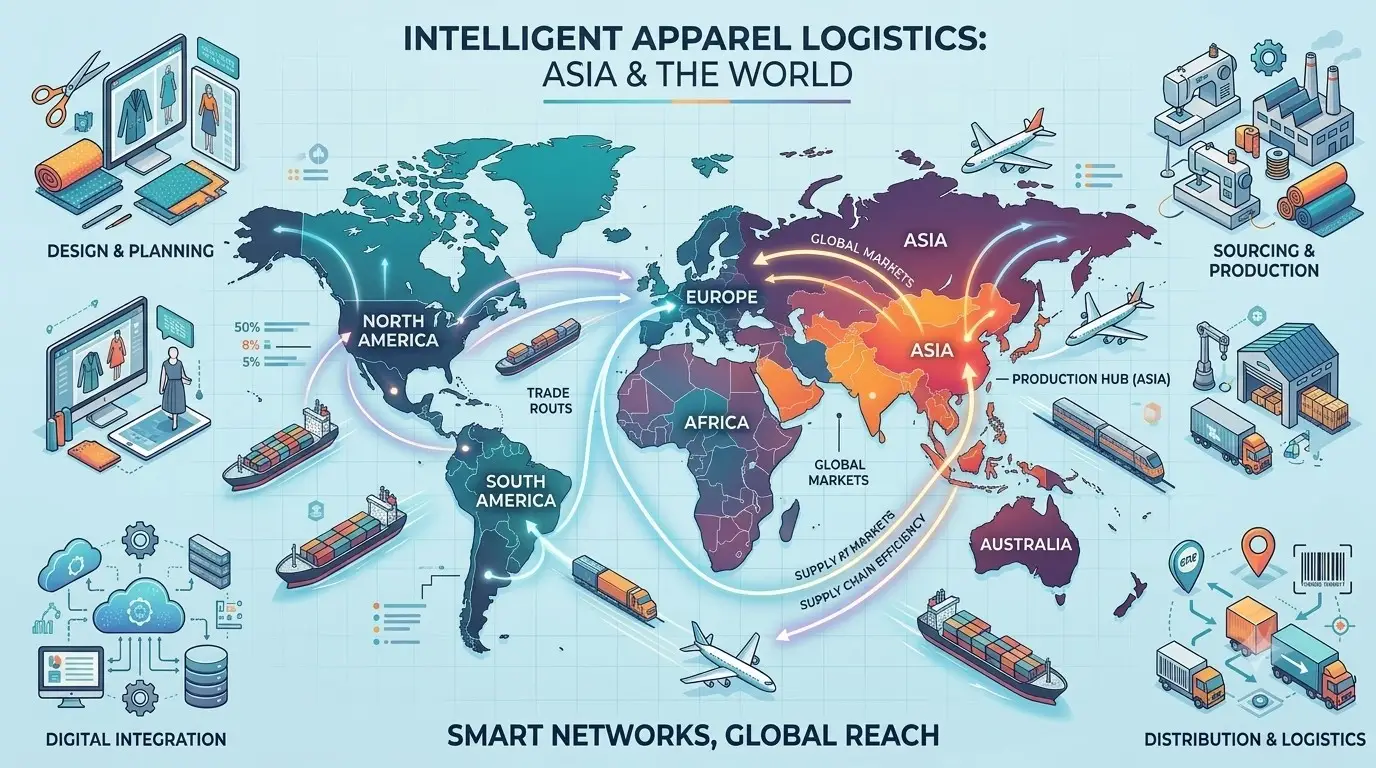
The Asia-Pacific (APAC) region remains the undisputed heavyweight of the global apparel logistics market. It acts as the world’s primary production engine while simultaneously evolving into a massive domestic consumer market. Below, we analyze Asia’s position and contribution to the global apparel logistics landscape.
Asia’s Market Size and Key Drivers
Asia’s market size reached USD 35.98 billion in 2025, up from USD 34.02 billion in 2024. Breakdown of key contributors in 2025:
- China: Accounted for USD 10.33 billion (approximately 10.5% of the total global market).
- India: Accounted for USD 5.11 billion (approximately 5.2% of the total global market).
However, the primary drivers of Asia’s apparel logistics growth include sourcing activities, heavily export-led manufacturing hubs (including Bangladesh, Vietnam, and Indonesia), and infrastructure expansion, alongside a rapidly scaling domestic e-commerce footprint.
Sourcing & Logistics Dynamics for Global Brands
Global fashion brands and retailers rely heavily on APAC’s massive infrastructure to feed their global supply chains. However, managing logistics out of Asia presents a unique set of structural pressures:
Lead-Time Vulnerability & Transit Disruptions
Because fashion is highly seasonal and trend-sensitive, delays out of Asian sourcing hubs drastically increase markdown risks for Western retailers.
- The Shipping Bottleneck: The report highlights that the 2024 Red Sea disruptions forced European fashion retailers to face shipping delays of around 3 weeks for ocean freight originating from Asia.
- The Air Freight Pivot: To circumvent these massive ocean bottlenecks and avoid missing seasonal windows, brands are increasingly turning to expensive alternative modes. Globally, the airways segment is projected to grow at a rapid CAGR of 8.4%, as brands frequently utilize air freight to rush premium inventory or bypass port and maritime congestion in Asian lanes.
The Multi-Channel Sourcing Evolution
Major fashion conglomerates and retailers manage intricate regional networks that must handle both traditional manufacturing exports and direct-to-consumer (DTC) fulfillment.
- Offline Mass Freight: Traditional brick-and-mortar stores still dominate global market share, demanding massive, continuous container-load shipments (via seaways and multimodal networks) out of primary Asian factories for seasonal store replenishment.
- E-Commerce: The e-commerce sector is expanding rapidly, with e-commerce fashion platforms projected to lead growth at a 10.7% CAGR globally. This has given rise to mega-logistics setups within Asia designed entirely around cross-border, ultra-fast fashion fulfillment.
- Decarbonization Pressures on Asian Supply Chains
Western retailers face intense pressure to reduce Scope 3 emissions, shifting the burden of sustainability onto their Asian logistics setups. This is transforming how regional logistics parks and freight options are structured:
- Decarbonizing Manufacturing Ecosystems: To maintain their appeal to global apparel brands, major Asian supply chain operators are investing heavily in green infrastructure.
- Case Study: SHEIN’s Zhaoqing logistics park in China serves as a model case. It achieved verified carbon neutrality for FY2024 by cutting more than 32,000 tons of $CO_2$ emissions through optimized facility management and energy efficiencies.
Conclusion
For global brands sourcing from Asia, apparel logistics is no longer just about securing cheap freight; it is a delicate balancing act between speed, agility, and risk mitigation. While countries like China and India remain core to global volume, the vulnerabilities of long-haul ocean lanes mean brands must increasingly blend automated, green regional hubs in Asia with flexible multimodal transport networks to protect their retail margins.