
TCF POST ANALYSIS
The 2026 “World’s Most Sustainable Companies” report by TIME and Statista signals a structural shift in the Textile, Clothing, and Footwear (TCF) sector: sustainability is evolving from a marketing narrative into a critical tool for supply chain resilience and regulatory compliance.
Sector Leaders: High-End and Global Retailers Dominate
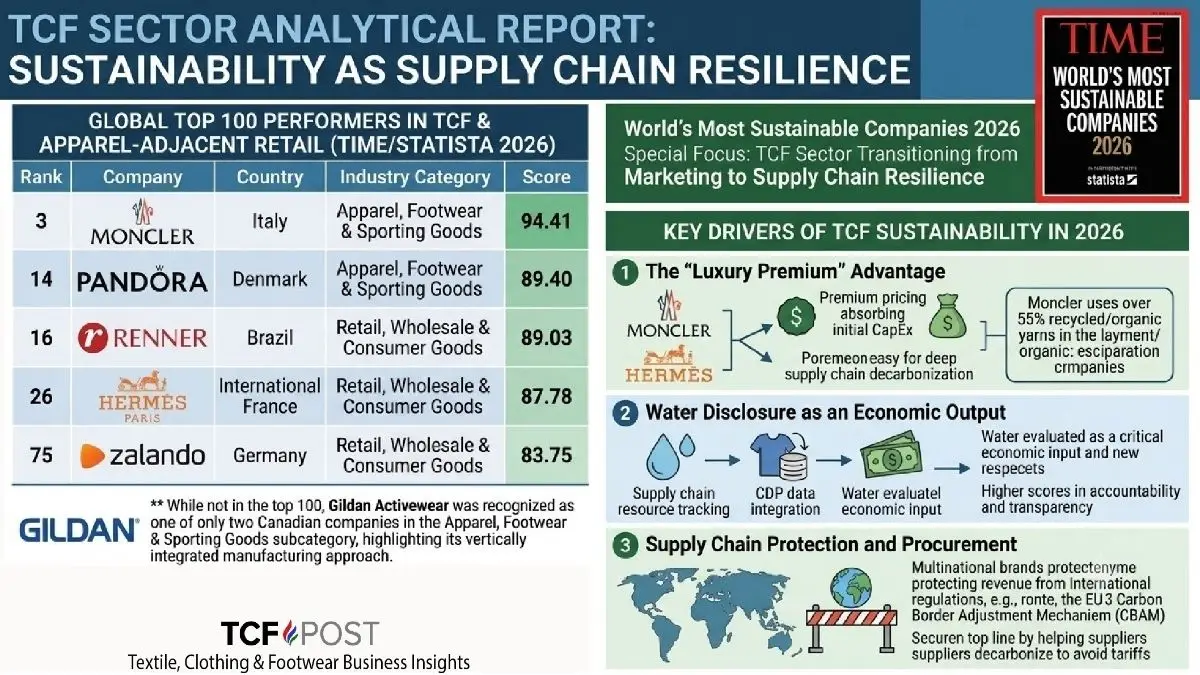
The 2026 rankings underscore a strong showing for firms integrating circular economy principles. Leading the industry is Italy’s Moncler, which achieved the 3rd spot globally with a score of 94.41. Other notable performers include:
- Pandora (Denmark): 14th place (89.40)
- Lojas Renner (Brazil): 16th place (89.03)
- Hermès International (France): 26th place (87.78)
- Zalando (Germany): 75th place (83.75)
While outside the top 100, Canada’s Gildan Activewear was noted for its distinct vertically integrated manufacturing model, marking it as a key player in the Apparel and Footwear subcategory.
Three Drivers Shaping 2026 Sustainability
The report identifies three core trends defining how major brands manage sustainability:
- The “Luxury Premium” Model: Luxury brands maintain a competitive advantage by leveraging pricing power to fund decarbonization. Moncler, for instance, sourced over 55% of its fabrics from sustainable alternatives in 2025, demonstrating that high-margin products can effectively absorb the capital costs of deep supply chain transformation.
- Water as an Economic Metric: Water usage has moved beyond environmental advocacy to become a fundamental economic input. Top-tier companies are now evaluated on their ability to enforce rigorous water and emission tracking across global supplier networks, with transparent disclosure becoming a proxy for operational efficiency.
- Regulatory Risk Mitigation: Sustainability is now a defensive mechanism against shifting trade landscapes. With the 2026 implementation of the EU’s Carbon Border Adjustment Mechanism (CBAM), brands that proactively assist suppliers in decarbonization are effectively protecting their revenue streams from carbon-intensity tariffs.
The Bottom Line: For the TCF sector, sustainability is no longer a choice but a requirement for fiscal survival. Companies that treat environmental transparency as a procurement priority are best positioned to navigate the complex regulatory environment of 2026