
TCF POST Report
KONRADSREUTH/HOF, Germany – The recently concluded “RecyTube” research project has marked a significant milestone in sustainable textile manufacturing, successfully demonstrating that production waste—previously destined for energy recovery or landfills—can be transformed into high-quality materials. Over two and a half years, a collaborative effort between Hof University of Applied Sciences, the textile manufacturer Rohleder, and industry partner BWF Protec has established a blueprint for circularity that bridges the gap between laboratory research and industrial application.
Technical Innovation: Mechanical Recycling Without Additives
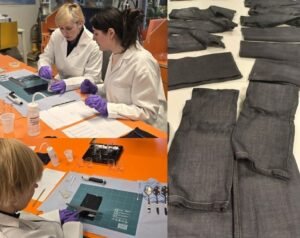
The core technical challenge addressed by RecyTube was the treatment of complex mixed-material waste, such as selvedges and yarn remnants from high-quality upholstery production. While chemical recycling is often discussed in industry, the team opted for mechanical processes, which proved more suitable for their specific waste streams.
Researchers at the Institute for Materials Science (ifm) at Hof University developed specialized processes to prepare this waste for reuse. A critical technical success was the ability to maintain material integrity while significantly increasing the recycled content. The project team achieved a material composition of approximately two-thirds recycled content, effectively reducing the need for virgin fibers to roughly 33 percent.
Furthermore, the team prioritized purity in their material cycles. “Our goal is to avoid adding any additives or other substances to the material mixtures,” stated Leni Rohleder, Sustainability Manager at Rohleder. By avoiding synthetic binders or chemical additives, the project aims to ensure a clean, transparent, and fully traceable material lifecycle.
Material testing showed promising results for industrial scalability. “The material looked remarkably uniform during the first sampling tests. We processed it through the carding machine twice,” noted Felix Hacker, a research associate at ifm.
Business Implications and Scalability
From a business perspective, RecyTube represents a strategic shift in how manufacturing waste is valued. By converting internal waste into a raw material, the partners have developed a model that lowers dependency on virgin materials.
“It makes perfect sense to reduce the use of virgin fibres and increase the proportion of recycled fibres,” explained project manager Melanie Peter. “This approach has now become a fundamental part of Rohleder’s sustainability strategy.”
However, the project also highlighted the persistent challenge of industrializing sustainable innovations. “Scalability is a fundamental issue. Projects are often either very small or very large, while opportunities for intermediate-scale testing are frequently lacking,” Peter added.
The transition from lab to factory floor required overcoming significant logistical hurdles, including the sudden loss of a key local subcontractor. Despite these challenges, the project fostered a cultural shift within the partner organizations. Katja Rödel of BWF Protec noted that internal skepticism faded as tangible results emerged: “This project has been thoroughly well-conceived from beginning to end. We are operating almost at the limits of what is technically feasible.”
Design Integration and Future Outlook
To prove the commercial viability of the recycled material, the project integrated design as a core component. Graduate designer Paula Holzhauser developed seating concepts—including a stool—to test the structural and aesthetic potential of the new composite.
While the prototype currently requires further cost optimization for mass production, the path to commercialization is clear. “At present, the production costs of the stool still need to be reduced,” admitted Alexandra Luft, Scientific Coordinator at ifm. “Nevertheless, during the final phase of the project we established the technical foundations needed to industrialize the product competitively over the coming months.”
With the RecyTube project officially concluded, the partners are already looking toward the future. The prototype has already gained visibility at the Coburg Design Days and is scheduled for display at the international office furniture trade fair, Orgatec, in Cologne.
Looking forward, the success of the collaboration has paved the way for ongoing partnerships. “Our cooperation was highly successful. That’s why we’d like to discuss new project ideas with Rohleder right away,” said Luft. Echoing the sentiment, Melanie Peter added, “We truly enjoyed working on this project. We’d be delighted to do it again.”