

An analysis of Brand Finance’s Apparel 50 2026 report
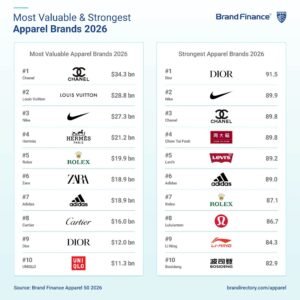
The headline number
Brand Finance’s Apparel 50 2026 report shows that the world’s 50 most valuable apparel brands are worth a combined $350.9 billion in 2026 — down 4% from last year. It’s a modest-sounding figure that hides a much sharper story underneath: the sector isn’t declining uniformly.
It’s splitting in two. On one side sit the old-guard European luxury houses — Chanel, Louis Vuitton, Dior — still enormous, still dominant, but bleeding value as macroeconomic pressure, softer Chinese demand, and cooling tourist spending bite into their numbers. On the other side sit performance- and value-oriented brands — Bosideng, Li Ning, Zara, Hermès, Rolex — quietly gaining ground by selling comfort, function, and accessible premium positioning rather than pure heritage.
The top 10 brands alone lost nearly $10 billion in combined value this year (from $218.6bn to $208.7bn), and most of that came from just two names: Louis Vuitton (down $4.1bn) and Dior (down $5.3bn).
The top of the table: still French, still shrinking
Chanel keeps the number-one spot for a second straight year, valued at $34.3 billion — but that’s a 9% drop from 2025’s $37.9 billion. It still leads the field by nearly $6 billion over second-placed Louis Vuitton, and it also tops the sustainability leaderboard with the highest Sustainability Perceptions Value in the sector ($2.8bn). Its resilience is being credited partly to creative momentum under Matthieu Blazy and continued strength in China, France, and the UK — though Japan remains comparatively weak.
Louis Vuitton slipped 12% to $28.8 billion, still second overall. Parent company LVMH’s Fashion & Leather Goods division reported lower revenue and profit as Chinese demand and tourist spending softened — even as the brand leaned into athlete-ambassador marketing, notably signing Olympic figure skater Alysa Liu.
Nike held third at $27.3 billion, down 7%, but remains the strongest global sportswear brand by Brand Strength Index (89.9/100). Its Milano Cortina Winter Olympics push and new ACG Therma-FIT Air technology for Team USA kept it visible even as value slipped from its Paris 2024 peak.
The steepest fall in the entire top 10 belongs to Dior, down 31% to $12.0 billion — even as it remains, paradoxically, the strongest apparel brand in the world with a Brand Strength Index of 91.5/100 and an AAA+ rating. The gap between Dior’s collapsing valuation and its rock-solid brand equity is one of the report’s most striking findings: 2025 brought a full creative changeover, with Maria Grazia Chiuri departing and Jonathan Anderson taking over menswear, womenswear, and haute couture. His early collections drew strong industry buzz, but the leadership transition clearly hit commercial performance harder than perception.
Top 10 most valuable apparel brands, 2026
| Rank | Brand | Country | Value 2026 | Value 2025 | Change | Rating |
|---|---|---|---|---|---|---|
| 1 | Chanel | France | $34.3bn | $37.9bn | -9% | AAA+ |
| 2 | Louis Vuitton | France | $28.8bn | $32.9bn | -12% | AAA- |
| 3 | Nike | United States | $27.3bn | $29.4bn | -7% | AAA+ |
| 4 | Hermès | France | $21.2bn | $19.9bn | +6% | AAA- |
| 5 | Rolex | Switzerland | $19.9bn | $18.8bn | +6% | AAA |
| 6 | Zara | Spain | $18.9bn | $18.1bn | +5% | AA |
| 7 | Adidas | Germany | $18.9bn | $18.5bn | +2% | AAA |
| 8 | Cartier | France | $16.0bn | $15.7bn | +2% | AA+ |
| 9 | Dior | France | $12.0bn | $17.3bn | -31% | AAA+ |
| 10 | UNIQLO | Japan | $11.3bn | $10.1bn | +12% | AA |
Notably, four of the top 10 actually grew this year — Hermès, Rolex, Zara, and UNIQLO — each up between 5% and 12%. Hermès expanded its retail footprint (new stores in Scottsdale and Nashville) and leaned on craftsmanship storytelling; Rolex deepened its sports-sponsorship portfolio via LIV Golf and Wimbledon; Zara used culture-forward collaborations (Bad Bunny, John Galliano) and a new Shanghai flagship; and UNIQLO pushed aggressive US expansion alongside collaborations like a Pokémon 30th-anniversary collection.
The fastest-mover story: Bosideng and Li Ning
Outside the top 10, the report’s most eye-catching numbers belong to two Chinese brands.
Bosideng, the Chinese down-apparel specialist, is the fastest-growing apparel brand in the world — up 21% to $2.5 billion this year, and nearly 170% since 2019. Brand Finance attributes this to sustained investment in AI-driven manufacturing and supply chain operations, direct-to-consumer retail, and dominance of China’s down-jacket market. In the wider rank table, Bosideng also climbed seven places, from 45th to 38th.
Li Ning enters the ranking for the first time at $1.7 billion — and immediately ranks as the ninth-strongest apparel brand globally on Brand Strength Index (84.3/100, AAA- rating), ahead of many far larger names. Its return as official kit partner for the Chinese Olympic Committee through the 2025–2028 cycle, paired with a push into international sporting events, marks it out as the brand Brand Finance flags as one to watch.
They’re part of a broader pattern in the wider rankings: several performance and “accessible premium” brands moved up sharply even without published valuations — New Balance and Fila each jumped eight places, Dolce & Gabbana climbed five, and Chow Tai Fook and Lululemon each gained three.
Who’s losing ground
The clearest fallers outside the top 10 tell a different story — legacy fashion and formalwear brands losing rank share. Puma dropped nine places (20th to 29th), the sharpest slide in the table. Armani and Burberry each fell five spots, and Under Armour fell five as well. Several long-standing French houses — Van Cleef & Arpels, Givenchy, Yves Saint Laurent — also slipped four places apiece, reinforcing the sense that even France’s storied maisons are not immune to the broader pressure facing heritage-first positioning.
Five brands are entirely new to the 2026 list: Laopu Gold, Reebok, Boss, Asics, and Li Ning — with three of the five (Laopu Gold, Asics, Li Ning) coming from Asia, another marker of where growth energy is concentrating.
The national picture
France remains the dominant force in apparel branding by a wide margin, its eight ranked brands worth a combined $120.7 billion — more than a third of the entire top 50’s value, and well over half of it concentrated in the top-10 French names alone ($112.3bn). Yet France’s total slipped 11% year-on-year, partly because it lost a ninth brand from the ranking that it held in 2025, and partly from the Dior/Louis Vuitton declines.
The United States has the most brands on the list at 12, worth a combined $68.8 billion — a wider, shallower spread compared with France’s concentrated luxury heavyweights. Italy matches France’s brand count (8) but with far lower individual valuations, reflecting a roster mostly outside the disclosed top 10. China has five ranked brands — Bosideng, Chow Tai Fook, Anta, Laopu Gold, and Li Ning — and is the country most associated with this year’s momentum: three of its five entrants moved up, including two brand-new arrivals.
Sustainability as a value driver
The report’s Sustainability Perceptions Index finds that 8% of consumers now cite sustainability as a key factor in apparel purchases. Chanel leads the sector on Sustainability Perceptions Value ($2.8bn) and shows the largest positive “sustainability gap” of any apparel brand ($727m) — meaning its sustainability reputation is actively adding more to brand value than its rivals’. Leadership splits by category: Van Cleef & Arpels leads on environmental perception, Coach on social perception, and Rolex on governance perception — suggesting ESG reputation is becoming a genuinely differentiated competitive lever rather than a single blanket score.
The bigger picture
Scott Chen, Brand Finance’s Global Sector Head of Apparel, frames 2026 as a moment of divergence — heritage-driven brands still command the largest numbers, but the sector’s growth energy has clearly shifted toward brands built around performance, comfort, and everyday functionality, reinforced by strategic athlete and celebrity partnerships.
Three threads run through the data:
- Value is concentrating differently than rank. The very top of the table is still overwhelmingly French luxury, but the fastest growth — in percentage terms and in rank movement — is coming from sportswear, athleisure, and Chinese challenger brands.
- Brand strength and brand value are decoupling. Dior is simultaneously the world’s strongest brand by consumer perception and its biggest faller by dollar value — a reminder that reputation and financial performance can move in opposite directions during periods of creative or strategic transition.
- China is apparel’s clearest growth story. Between Bosideng’s AI-driven retail expansion, Li Ning’s Olympic partnerships, and new entrants Laopu Gold and Asics, Chinese and China-linked brands are consistently the ones climbing — a trend likely to continue shaping next year’s ranking.