

TCF POST report
DHAKA, Bangladesh — A groundbreaking study published in the American Chemical Society’s prestigious journal ACS Omega has unveiled a new method for functionalizing cotton fabric with zinc oxide (ZnO) nanoparticles, successfully solving a long-standing industry dilemma: how to achieve high-level antimicrobial protection without sacrificing wearer comfort.
The research, titled “ZnO-Functionalized Cotton Textiles with Enhanced Antibacterial Activity, Moisture Management, and Wear Comfort,” was conducted by a collaborative team of Bangladeshi researchers: Md Mehedi Hassan, Jakir Hossain Ridoy, Ahasan Habib, and Md Tanvir Hossain.
The Innovation: Bridging Hygiene and Wearability
Historically, treating cotton with metal oxide nanoparticles to combat bacteria has often come at the expense of tactile quality, frequently resulting in increased stiffness, surface roughness, and poor moisture management.
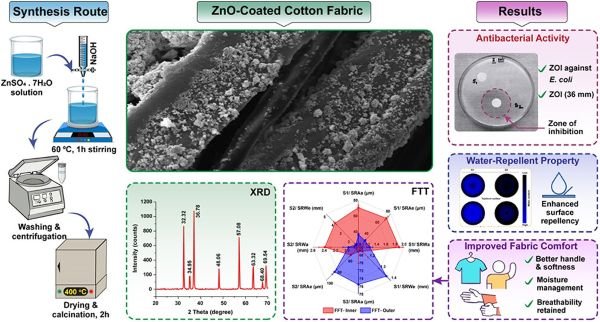
By employing a controlled exhaustion process followed by thermal fixation, the research team achieved a stable, uniform distribution of ZnO nanoparticles (averaging ~46.4 nm) on the fiber surface. Unlike previous methods that often relied on coatings that might degrade or flake, this new technique utilizes strong interfacial hydrogen bonding, ensuring the nanoparticles remain securely anchored to the cellulose matrix.
Key Performance Breakthroughs
The findings, published by the American Chemical Society (ACS), provide a roadmap for manufacturers to elevate their product lines:
- Superior Antimicrobial Efficacy: The ZnO-functionalized cotton demonstrated powerful, broad-spectrum antibacterial activity. It achieved impressive inhibition zones of 35–36 mm against both Staphylococcus aureus and Escherichia coli, with a ~99% reduction in bacterial counts compared to untreated fabric.
- Enhanced Tactile Comfort: Using the advanced Fabric Touch Tester (FTT)—a holistic method for measuring human skin sensation—researchers confirmed that the nanocoating did not diminish fabric quality. On the contrary, key comfort parameters—including bending rigidity, softness, and thermal warmth—increased by 10–25% compared to the original substrate.
- Optimized Moisture Management: The modification successfully shifted the fabric’s moisture behavior. By altering the hydrophilic/hydrophobic balance, the treated fabric provides controlled liquid transport, preventing the localized moisture buildup that typically encourages bacterial growth.
A New Standard for the Biomedical Industry
For the textile and medical supply industries, this research offers a significant competitive advantage. As global demand for high-performance protective wear grows, this “comfort-first” functionalization method allows textile brands to market products that are not just antibacterial, but objectively “comfort-enhanced.”
By integrating FTT analysis into the production cycle, manufacturers can now provide empirical data to demonstrate to institutional buyers and healthcare providers that their high-hygiene products also meet rigorous standards for patient comfort and thermal regulation.