

TCF POST Special Report
The latest industry research has identified mechanisms that can help apparel manufacturers in South Asia and across the developing world succeed in balancing two dual goals: profitability and sustainability. The researchers at Southern Cross University’s Faculty of Business, Law and Arts suggest that by utilizing advanced traceability technologies, companies can move beyond superficial “green” branding to create verifiable, data-driven sustainable supply chains.
The research, titled “Identifying Strategies for Balancing Profitability and Sustainability: An Exploratory Case from the Apparel Supply Chain,” was conducted by Anuradha Colombage and supervised by Professor Darshana Sedera. The final paper is published in the MDPI journal Sustainability.
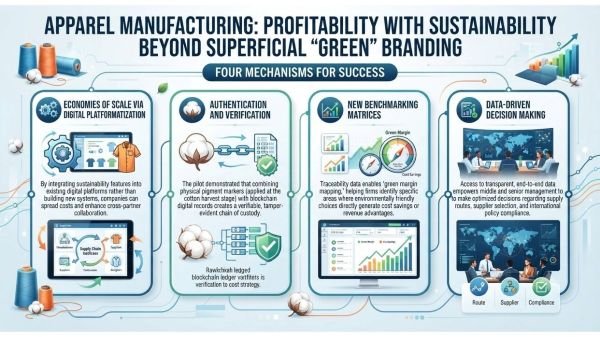
Four Mechanisms for Success
- Economies of Scale via Digital Platformatization: By integrating sustainability features into existing digital platforms rather than building new systems, companies can spread costs and enhance cross-partner collaboration.
- Authentication and Verification: The pilot demonstrated that combining physical pigment markers (applied at the cotton harvest stage) with blockchain digital records creates a verifiable, tamper-evident chain of custody.
- New Benchmarking Matrices: Traceability data enables “green margin mapping,” helping firms identify specific areas where environmentally friendly choices directly generate cost savings or revenue advantages.
- Data-Driven Decision Making: Access to transparent, end-to-end data empowers middle and senior management to make optimized decisions regarding supply routes, supplier selection, and international policy compliance.
The Challenge: Beyond Trade-offs
The apparel industry has historically struggled to balance profit and sustainability, often leading to “greenwashing”—the practice of misleading stakeholders about environmental performance—or failing to address systemic issues within complex, multi-tier supply chains. This study specifically addressed the intensified tension between these goals within the apparel supply chains of developing economies in South Asia, focusing on how manufacturers can navigate the conflicting demands of economic profitability and environmental responsibility.
The researchers utilized “strategic duality theory” to analyze a pilot project involving a South Asia-based apparel manufacturer. They identified that multi-tier traceability serves as a “third way” to manage these competing interests rather than forcing a choice between the two. However, regarding the challenges of implementing full traceability, the researchers emphasize the necessity of collective action, noting: “It is simply not possible to do these [traceability] on our own. Too costly.”.
Strategic Implications for the Region
The research highlights that for manufacturers in regions like South Asia, the infrastructure required to track sustainability is increasingly becoming identical to the infrastructure needed for regulatory compliance, such as the European Union’s upcoming Digital Product Passport (DPP).
The researchers suggest that companies should view traceability as a strategic investment rather than a defensive cost. By running de-risked, time-bound pilot projects on high-volume product lines, manufacturers can build the capabilities required to embed sustainability into their core business model, thereby securing long-term value and remaining competitive in the global market.